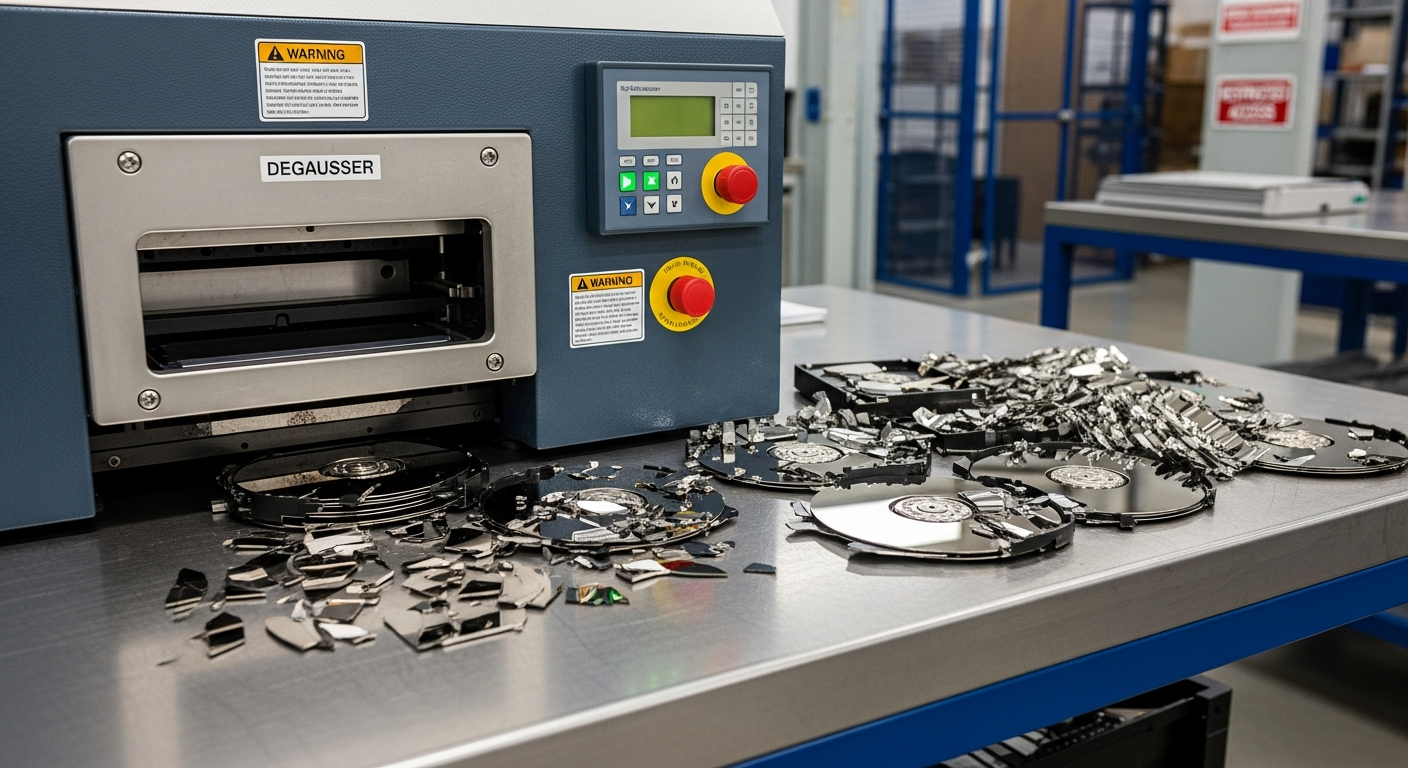
On-Site Data Destruction in Omaha, NE
When your policy says intact drives cannot leave an Omaha building, the destruction is scheduled at your site and your own witness checks every serial number. Only destroyed remnants travel to Lincoln for recycling, and qualifying business volumes also get free pickup of any remaining equipment.
What Is On-Site Data Destruction, and Why Do Omaha Teams Choose It?
On-site data destruction in Omaha is the physical destruction of hard drives and other storage media at your own building while your staff watch, so no readable drive leaves your control. Precision E-Cycle plans these witnessed events for Omaha-area organizations, using methods informed by NIST SP 800-88 Rev. 2, and scopes each one around your building.
Omaha information security officers, privacy leads in healthcare and insurance, and facility security officers at federal contractors share one problem: a policy, or its auditor, treats an intact drive in transit as the exposure to remove. The Greater Omaha Chamber lists Offutt Air Force Base and the University of Nebraska Medical Center among the metro's employers of 5,000 or more.
Why Omaha Security Teams Choose to Watch It Happen
Intact media never leaves your control
The readable drive never rides in a vehicle, sits on a dock, or waits in someone else's warehouse. What leaves your building is remnant, not data, which removes the transit question from your risk review.
A witness who can sign for what they saw
Your own staff check serial numbers and look at the remnants in person. Their signature on the record carries more weight with an auditor than a report produced somewhere else, days later.
Management systems for work inside your building
Precision holds ISO/IEC 27001:2022 for information security, ISO 45001 for occupational health and safety, ISO 14001 for environmental management, and ISO 9001 for quality. Your security and facilities teams can review each one before the event.
Request Service
Ready to Recycle?
Pickup is free for qualifying business volumes. Schedule yours or contact us with questions.
Related Services
How an On-Site Destruction Event Runs in Omaha
Project review and media count
You describe what needs destroying, which buildings it sits in, and why it cannot travel intact. Scoping fits the on-site service to your building, picks the method for each media type, and sets the event date.
Serialized list and a named witness
Before the event, your team pulls the drives and lists them by serial number. You name who will witness, such as your security officer or facility security officer, and agree which fields the record will carry.
Destruction at your location
On the scheduled day, media is destroyed at your site. Your witness checks each serial number against the list as it goes and inspects the remnants before signing.
Remnants to Lincoln, records to you
Destroyed remnants and any remaining equipment go to our Lincoln facility for recycling through R2-certified downstream processors. You receive the records that close out each serial number on your list.
Destruction at Your Building: What the Event Involves and What You Keep
Witnessed drive destruction moves the step most policies worry about, the moment a drive becomes unreadable, into a room you control, such as a hospital records area in Omaha or a contractor office in Bellevue. Your team decides which drives are in scope, who watches, and what the record must show. Recycling starts only after the data is gone.
Why choose on-site over a plant run? Usually because a written policy, a contract clause, or an audit finding says intact media may not leave. When evaluating on-site destruction providers, security officers typically rank a complete device record above the speed of the event. Whatever the reason, the event depends on your inventory discipline rather than replacing it.
The record you should ask for
Per NIST SP 800-88 Rev. 2, section 4.6, a certificate of sanitization should be completed after the work, and Appendix C gives a sample form. Use its fields when you agree the record format in the project review. We tailor the record to those fields before anything is destroyed, and a free Certificate of Destruction comes with your project.
- Manufacturer, model, and serial number of each device
- Media type, such as hard drive or solid state drive
- Sanitization category and the method used
- The tool or equipment used, and how the result was verified
- Name, title, and signature of the person who performed it
- Date and location of the destruction, plus your witness
A drilled drive is not a destroyed drive
NIST SP 800-88 Rev. 2 warns that drilling or bending may only partly damage a drive, leaving portions of it readable with laboratory techniques. An on-site event is only worth running if the media is fully destroyed, so ask your witness to reject any remnant that still looks like a working part.
Key takeaway
Put the serial list, the method, and the witness signature on one record, and agree those fields before you choose a date. That single record is what an auditor reads first.
What Rules Push Omaha Organizations Toward Witnessed Destruction?
None of the rules below names on-site destruction as a requirement. Each asks for disposal an organization can defend, and many policies meet that by destroying drives where their own witness can see it. In Omaha that pressure runs through health systems, finance and insurance headquarters, and the federal contractor base.
What NIST SP 800-88 Rev. 2 says about destroying media
According to NIST SP 800-88 Rev. 2, published in September 2025, verification and validation are separate steps. Verification for destruction means inspecting the remnants and identifying the equipment used, while validation decides whether the outcome is acceptable, such as rejecting shred output larger than your organization allows. A witness beside the process can do much of that verification in person.
Shredding is not one size fits all
NIST SP 800-88 Rev. 2, section 3.1.3, says pulverize and shred techniques "should be avoided for anything but the lowest security categories of data" and points to IEEE 2883 or NSA/CSS Policy Manual 9-12 for more sensitive media. Precision E-Cycle therefore matches the method at each Omaha event to media type and data sensitivity.
Healthcare, finance, and federal contract rules
Nebraska Medicine, with two hospitals, more than 800 licensed beds, and over 9,000 employees, anchors Omaha's healthcare sector alongside CHI Health and Methodist Health System. Systems of that size must set ePHI disposal policies under HIPAA. Mutual of Omaha, one of the metro's four Fortune 500 headquarters, represents a finance and insurance base with its own disposal rules.
- HIPAA Security Rule, 45 CFR 164.310(d)(2)(i) and (ii): covered entities need policies for the final disposition of ePHI and the media holding it. Precision's records support that obligation.
- 45 CFR 164.310(d)(2)(iii): a record of hardware and media movements, and the person responsible, is an addressable specification that a serialized, witnessed event supports.
- FTC Disposal Rule, 16 CFR Part 682: anyone holding consumer report information must take reasonable measures at disposal, including destroying electronic media so it cannot practicably be read.
- FAR 52.204-21(b)(1)(vii): federal contractors must sanitize or destroy media holding Federal Contract Information before disposal or release for reuse.
Offutt Air Force Base, next to Bellevue in Sarpy County, hosts the 55th Wing and U.S. Strategic Command headquarters and anchors a federal contractor base whose firms may carry that FAR clause. For those firms the facility security officer may want to see destruction firsthand, with the serial list in hand.
Nebraska statute 87-808, and where it stops
Nebraska statute 87-808 requires any business holding computerized personal information on Nebraska residents to keep reasonable security procedures, including safeguards at disposal. Subsection 2 requires a contract binding any outside service provider that receives the data to maintain reasonable security. The statute does not govern a Council Bluffs building, so confirm the Iowa requirements for those sites with your counsel.
Key takeaway
Map each rule to a line in your event record: the witness signature for HIPAA accountability, the serial list for FAR, and the signed vendor agreement for 87-808.
Disposition planning for government agencies and contractors
How Should an Omaha Site Prepare for Destruction Day?
An in-building destruction event is booked around your calendar after scoping, so preparation runs at your pace. Start with one list line per building, whether it sits in Omaha, Bellevue, or Council Bluffs. The record then shows where each drive came from and which state's rules applied to it.
Which drives belong on the on-site list?
- Drives from systems that stored ePHI, where your HIPAA disposal policy calls for destruction you can witness
- Media holding consumer report information covered by the FTC Disposal Rule
- Drives from systems that processed Federal Contract Information under FAR 52.204-21
- Any media an internal audit finding or client contract says may not leave intact
- Pull drives from laptops, servers, and arrays, and keep them locked and labeled
- Build the serialized media list, with SSDs and HDDs listed separately
- Name a primary witness and a backup from security, compliance, or IT
- Reserve a room or dock area with access your building rules allow
- Sign the vendor agreement your 87-808 or HIPAA program calls for
- Decide which remaining equipment will also go to Lincoln for recycling
During the event
Your witness reads each serial number against the list before the drive is destroyed, then looks at what is left. Any drive without a matching line is set aside and resolved before the record is signed. Hospital and contractor buildings often want the event held away from patient floors or restricted spaces, a detail the project review settles.
Plan the event with us
The destruction method for each media type, the space the event needs, and pickup of remaining equipment are all planned during scoping, and the event date follows. Request a free quote to start.
After the event
Wondering where the remnants go? They travel to our secure Lincoln, Nebraska facility with any other retired hardware. From there, material is recycled through R2-certified downstream processors, and the records that close out each serial number come back to you.
Key takeaway
Precision E-Cycle on-site engagements begin with the same two items, a finished serial list and a named witness. Those two items keep an Omaha destruction day short and let its record hold up later.
Omaha hard drive shredding for volumes that can travel under custody
On-Site Destruction Questions from Omaha Organizations
Request Service
Ready to Get Started in Omaha?
Get a free quote or send us a message about your project, and we scope pickup and documentation around your site.