Certificate of Destruction in Omaha, NE
Facing an audit that asks you to prove specific Omaha drives were destroyed? Precision pairs the certificate with your own serial list and a signed chain of custody record. Free pickup is available for qualifying business volumes.
What Does a Certificate of Destruction Prove for an Omaha Organization?
Precision E-Cycle provides certificates of destruction for Omaha and Council Bluffs organizations that answer to an auditor, regulator, or insurer for retired media. The certificate is the signed record that listed devices were sanitized or destroyed. Equipment is collected by scheduled Omaha pickup and processed at our secure Lincoln, Nebraska facility, with methods informed by NIST SP 800-88 Rev. 2.
For compliance officers and vendor risk managers, the hard audit question is rarely whether drives were destroyed; it is proving one logged drive was covered. Omaha hosts four Fortune 500 headquarters, Mutual of Omaha among them, per the Greater Omaha Chamber. Council Bluffs sites follow Iowa DNR guidance instead of Nebraska law, so one project can need two record sets.
What a Reconciled Certificate Adds to Your Omaha Audit File
A certificate your auditor can test
Your serial list exists before pickup, so the certificate is tested against a record you control rather than one written afterward. Gaps surface while they can still be fixed.
Nebraska and Iowa records kept apart
Loads from Omaha and Sarpy County sites and from Council Bluffs are identified separately in the project review, so each state's file gets its own records.
Security management certified to ISO/IEC 27001:2022
Precision holds ISO/IEC 27001:2022 for information security, along with ISO 14001, ISO 9001, and ISO 45001. Vendor risk reviewers can ask to see those certificates during the project review.
Request Service
Ready to Recycle?
Pickup is free for qualifying business volumes. Schedule yours or contact us with questions.
Related Services
How Does an Omaha Certificate of Destruction Come Together?
Agree the certificate before anything moves
You share a device count by media type, the sites involved, and what your auditor expects the record to show. The review plans pickup, the method for each media group, and the certificate fields.
Build the serial list at each site
Your team lists serial numbers, or scans drive label bar codes, at every Omaha, Sarpy County, or Council Bluffs location in scope. That list is the intake record the certificate is checked against.
Sign custody, then destroy in Lincoln
Your site contact signs the chain of custody record at pickup, and the load travels to our secure Lincoln, Nebraska facility, where Precision processes equipment. Media is destroyed there by the agreed method.
Receive, reconcile, and file
You receive the certificate in the agreed format and check it against your serial list, by serial where it lists them or by count where it covers a lot. Remnants and other material that cannot be reused then move to R2-certified downstream processors.
What Does an Omaha Auditor Check on a Certificate of Destruction?
A vendor risk reviewer at an Omaha bank such as FNBO rarely reads a destruction certificate alone. They test whether serials match logged devices, the method fits the data, and nothing left without a line. The certificate holds up only when all records agree. Metro employers named on this page are market context, not presented as Precision clients.
The certificate is one record in a set of four
NIST SP 800-88 Revision 2 section 4.6 warns that without tracking, sanitization records show only that the listed media were sanitized, not that every device was covered. NIST wants records when media enters use, when it leaves its last location, and at its final destination, so a file holding the certificate alone is half a file.
What fields should a certificate of destruction record?
- Manufacturer, model, and serial number, plus any property number your organization assigns
- Media type and media source, such as the user or computer the media came from
- Sanitization method, meaning clear, purge, or destroy, and the technique used
- The tool used, including its version, and the verification method
- Name, title, date, location, contact details, and signature of whoever verified the result
- Media destination, such as reuse, a recycling facility, or the manufacturer, as the Appendix C sample shows
Paper or electronic both count
Section 4.6 calls this record a certificate of sanitization and allows it on paper or electronically, for example by scanning drive label bar codes. Appendix C gives a sample of the information to collect. Compare Precision's certificate fields and format with this list during the project review.
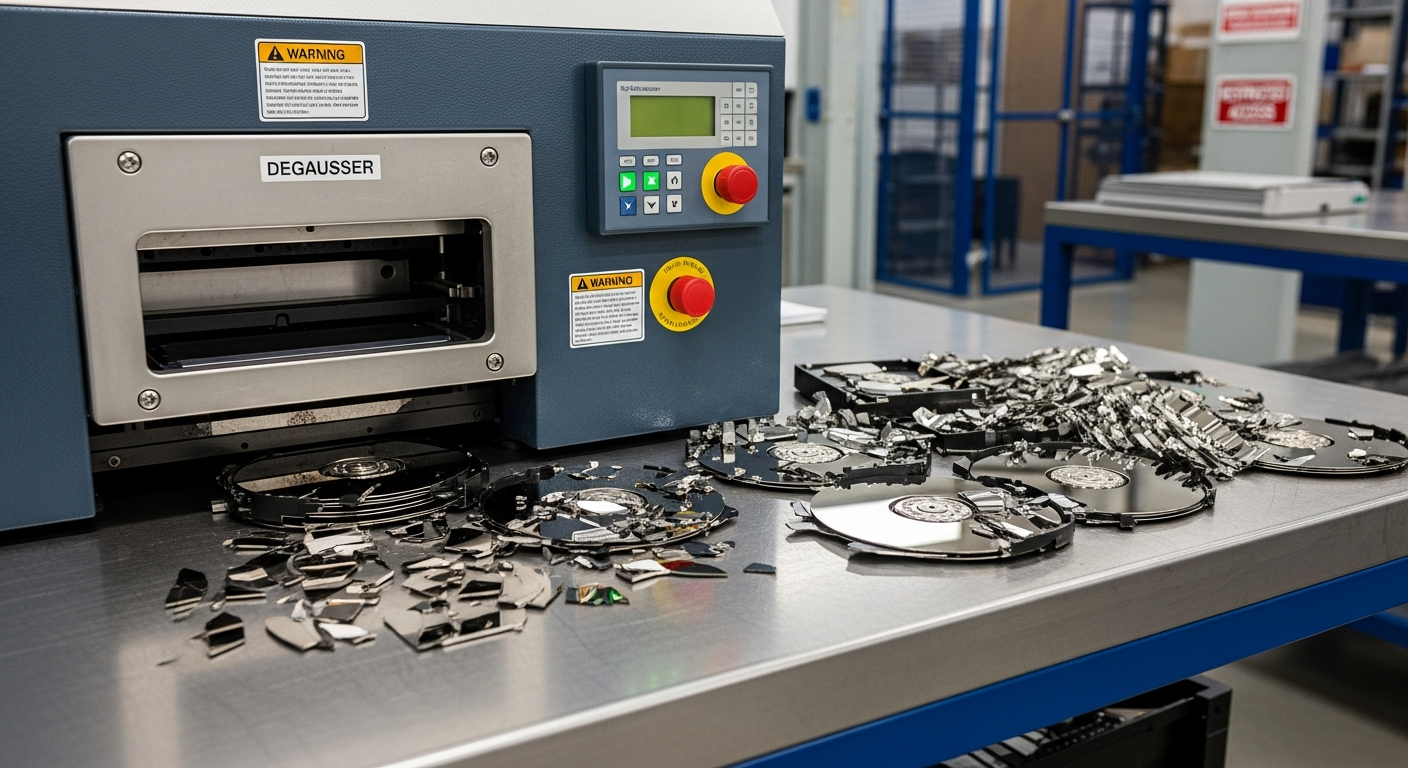
Two checks catch most weak certificates in an audit file. First, a method that does not fit the data: NIST SP 800-88 Rev. 2 section 3.1 limits shredding and pulverizing to the lowest security categories, and degaussing is not a destroy technique and fails on SSDs. Second, a count that does not match, usually from a list made after pickup.
Key takeaway
Read the certificate against your intake list, never by itself. Vendor risk reviewers generally expect the certificate, the custody record, and the intake list to agree before they close a disposal finding.
Two States, One Metro: Nebraska and Iowa Paperwork for Omaha Projects
The Omaha metro spans Douglas and Sarpy counties in Nebraska and Council Bluffs in Iowa, and many organizations run sites on both sides. A destruction certificate reads the same in either state, but the records filed beside it do not. Your counsel decides which law applies to each site.
Omaha and Sarpy County sites: the Nebraska file
- Nebraska statute 87-808: a business holding computerized personal information on Nebraska residents must keep reasonable security, including at disposal, and bind any outside provider receiving the data to it by contract.
- Shipment records: the Nebraska Department of Water, Energy, and Environment (DWEE) requires large quantity universal waste handlers to keep a log, manifest, bill of lading, or similar document for at least three years.
- Business e-waste status: DWEE guidance places electronics from businesses, schools, and hospitals under Title 128, Chapter 25, where they may be accumulated as universal waste for recycling.
Council Bluffs sites: what Iowa DNR tells businesses to expect
Nebraska rules do not describe what a Council Bluffs site owes. Per the Iowa DNR business guide, revised in 2015, companies should vet recyclers, follow RCRA for electronics that test hazardous, and expect a certificate of recycling saying where each piece is sent. Collectors of CRT-containing e-waste must also register with Iowa DNR.
Keep two folders, not one
A certificate of recycling answers where material went; a certificate of destruction answers whether data was destroyed. Council Bluffs files usually need both, while Nebraska files need the certificate plus the vendor contract and any shipment records.
Federal rules that apply on both sides
- FTC Disposal Rule, 16 CFR Part 682: holders of consumer report information must take reasonable measures at disposal, which includes selling or donating computer equipment.
- FTC Safeguards Rule, 16 CFR 314.4(c)(6)(i): FTC-regulated financial institutions need secure disposal procedures for customer information, and destruction records show those procedures ran.
- HIPAA Security Rule, 45 CFR 164.310(d)(2)(i) and (ii): covered entities need policies for the final disposition of ePHI and its media, which Precision's documentation supports.
Health insurers, a sector represented in Omaha by Blue Cross and Blue Shield of Nebraska, typically hold both consumer and health data, so one certificate may be tested against HIPAA and FTC expectations at once. Does the certificate move the insurer's legal duty to the vendor? No. It supports the review, but it does not by itself satisfy a rule.
Key takeaway
Sort the file by state first, then by rule. Before choosing a destruction vendor, organizations with Council Bluffs sites can ask whether each Iowa load comes with a certificate of recycling.
Getting an Omaha Certificate That Reconciles the First Time
Every Omaha certificate starts at the site where the devices sit. Precision collects equipment across the metro by scheduled pickup, and data-bearing media is destroyed at our secure Lincoln, Nebraska facility. Multi-site organizations usually find it easier to build the serial list site by site than to rebuild it after pickup.
- List every device by serial number, or scan drive label bar codes where labels are readable
- Note the site and state for each device: Omaha, Papillion, Bellevue, or Council Bluffs
- Mark the data each device held: health, consumer report, or financial
- Flag failed drives and loose SSDs, which need their method agreed separately
- Ask your auditor which certificate fields and format they expect
- Sign the vendor agreement your 87-808, HIPAA, or Safeguards program calls for
Pickup day at each site
Devices are counted against the list at each location before the container is sealed. Your site contact then signs the chain of custody record, the intake point the certificate traces back to. Equipment collected across the metro is then processed at our secure Lincoln, Nebraska facility.
Our staffed Omaha sales office at 1299 Farnam St, Omaha, NE 68102 handles local sales inquiries and pickup coordination, while all media processing takes place at our Lincoln, Nebraska facility.
On-site data destruction options
When the certificate arrives
Tailored to your audit
Omaha projects set Precision's certificate fields, whether each device gets its own line at your service level, the format, and timing in the project review, before anything is collected. Request a free quote to start.
For hospital systems such as CHI Health and Nebraska Medicine, which lists more than 9,000 employees, a missing serial on a drive that held ePHI is a question for the privacy officer, not a clerical note. Settling it before filing is easier than explaining it in a HIPAA review.
Healthcare IT disposal and ePHI media
Key takeaway
Make the list before pickup, keep it by site and state, and check the certificate against it on arrival, the same order an auditor follows.
Certificate of Destruction Questions from Omaha Teams
Request Service
Ready to Get Started in Omaha?
Get a free quote or send us a message about your project, and we scope pickup and documentation around your site.