01
Define the media scope
We review the equipment list, locations, storage types, sensitivity, access rules, and whether any assets are intended for reuse. This prevents a generic method from being applied to the wrong media.
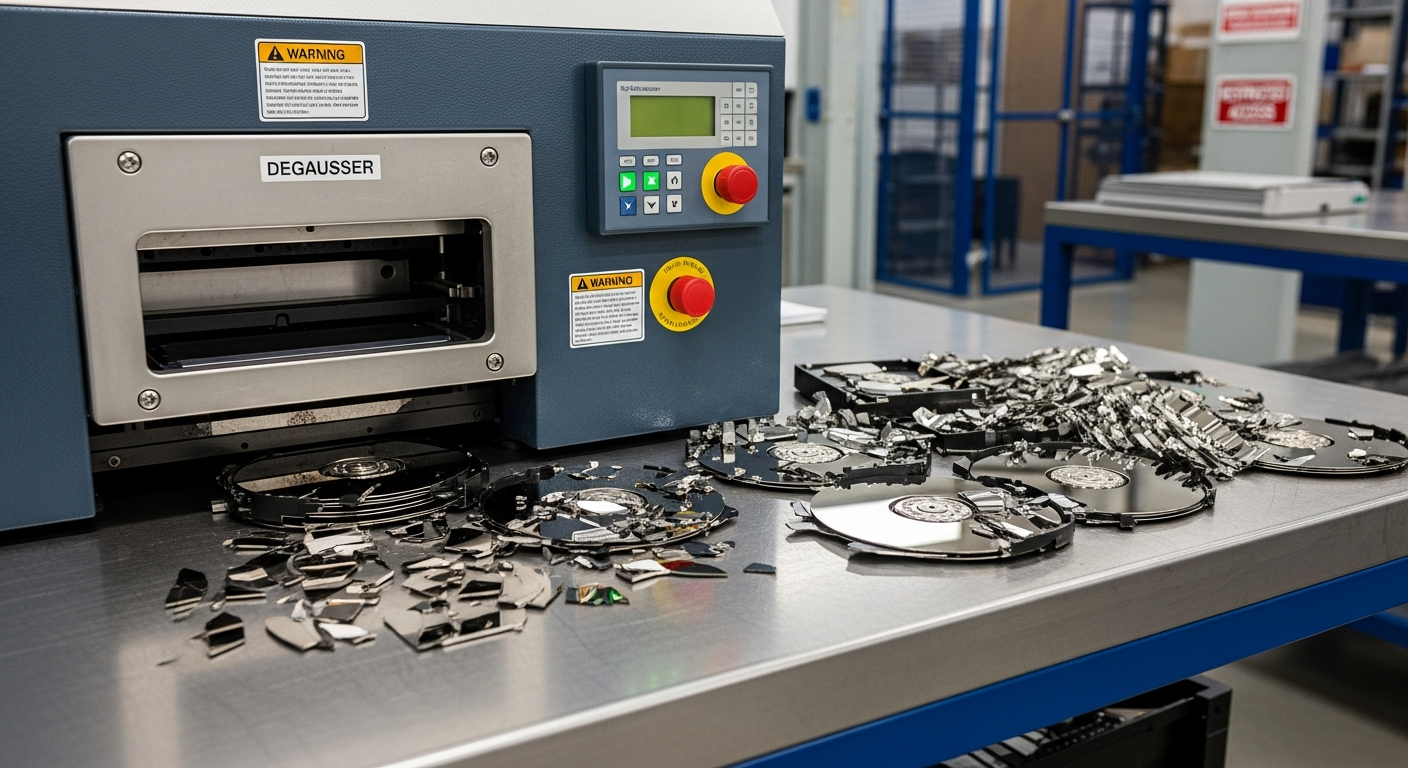
For sensitive retirements where your team needs the destruction event to happen at your location, with a documented handoff and a clear record of what was processed.
On-site destruction is a practical option when an internal policy, customer requirement, security review, or facility constraint means data-bearing media should be destroyed before it leaves your control. Precision E-Cycle coordinates the scope, media count, witnessed event, and documentation so your staff is not left guessing which devices were handled.
A successful on-site service gives your team confidence before, during, and after the event. We keep the workflow specific enough to reconcile the media and flexible enough to work in offices, clinics, server rooms, schools, and controlled facilities.
We review the equipment list, locations, storage types, sensitivity, access rules, and whether any assets are intended for reuse. This prevents a generic method from being applied to the wrong media.
Your team stages the drives, devices, or media for the event. We reconcile the physical count to the available manifest and identify missing labels, mixed media, or items that need a separate decision.
The agreed NIST 800-88 aligned method is applied to each scoped device or media group. Physical destruction is available when the media is not intended for reuse or policy requires destruction.
Authorized staff can observe the event. We record the applicable device details, method, date, and processing information so the final documentation connects the event to the original scope.
After media destruction, the remaining equipment can continue to recycling, value recovery, or another agreed disposition path. The destruction record is delivered with the closeout package.
On-site destruction is especially useful when moving media creates an unacceptable gap in control or when an internal stakeholder needs to witness the event. We scope the service around your actual policy instead of treating a compliance label as a substitute for a workflow.
Retire workstations, laptops, mobile devices, and loose media from clinical or administrative areas with a clear destruction record.
Handle media carrying account, customer, or transaction data when internal controls require destruction before transport.
Coordinate a controlled event for teams with facility access rules, approval steps, or witnessed destruction requirements.
Plan repeated witnessed events across offices or facilities and consolidate the resulting records for the project owner.
Organizations commonly remember laptop drives and forget printers, copiers, network appliances, backup media, and specialized equipment. Include the whole retirement list during scoping so the security plan reflects the real data surface.
Loose drives, desktop drives, laptop drives, server drives, and removable disk assemblies.
SSDs, flash storage, eMMC, NVMe modules, and embedded storage that require media-aware handling.
LTO tapes, removable cartridges, USB devices, memory cards, and other portable storage.
Firewalls, routers, switches, wireless controllers, and appliances with internal storage.
MFPs and office equipment that may retain jobs, address books, or configuration data.
Workstations and equipment with embedded storage that need to be reviewed before retirement.
The reason to bring destruction on-site is control. The reason to document it is accountability. We use the project manifest and available serial information to connect the scoped media to the destruction method and event date. That gives your security or compliance team something more useful than a statement that a truck visited the building.
NIST SP 800-88 Rev. 2 provides the vocabulary for Clear, Purge, and Destroy. It does not replace your organization’s risk assessment or policy. We use it as a method reference while confirming the intended disposition and media type with the project owner. HIPAA, FACTA, GLBA, and other frameworks can create disposal obligations, but the exact policy and retention requirements remain with the organization.
A witnessed event also benefits from a little preparation. The organization should identify an authorized contact, choose a staging area, decide how the count will be reconciled, and separate media that belongs to another owner or remains under a retention hold. If a device cannot be safely opened or identified at the site, that exception should be visible in the scope rather than forced into an uncertain on-site result. Those decisions make the event shorter, easier to observe, and easier to defend later.
The service is best planned as a controlled event, not an informal walk-up request. Confirm the media types, expected count, facility access, witness roles, and the record that must be returned. That preparation helps the team distinguish a drive intended for physical destruction from a device that can be sanitized and evaluated for reuse, while keeping the customer’s policy in charge of the final decision.
Combine data security, reuse, recycling, logistics, and closeout records.
ExploreCompare physical shredding, degaussing, and overwrite methods.
ExploreRetire server hardware with inventory and chain-of-custody.
ExploreCoordinate a larger server room or facility retirement.
ExploreTell us what media is in scope, where it is located, and what your policy requires. We will help plan the witnessed event and the records that follow it.
Free pickup for qualifying business volumes, with availability confirmed during scheduling. Call 402-540-6965 with project details.