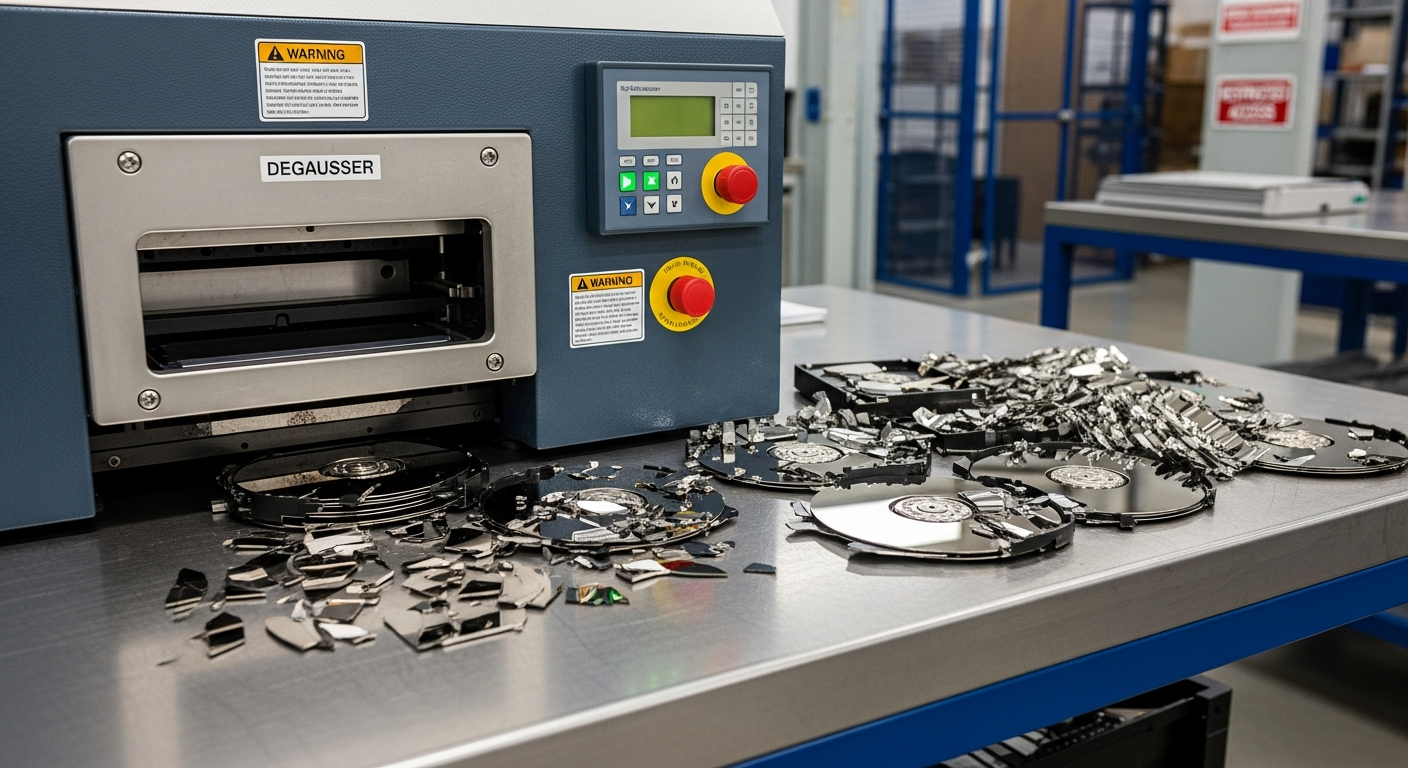
Hard Drive Shredding for Business Pickups in Omaha, NE
Holding a locked box of pulled or failed drives from Omaha offices? Precision shreds the drives that suit shredding, records each serial number, and matches the method to each drive's media type and data sensitivity. Free pickup applies to qualifying business volumes.
When Is Hard Drive Shredding the Right Call for an Omaha Drive?
Hard drive shredding in Omaha is the physical destruction of storage media so its data cannot practicably be read or reconstructed, a measure the FTC Disposal Rule names as reasonable. Precision E-Cycle provides it for Omaha and Council Bluffs businesses, choosing each method by media type and data sensitivity, informed by NIST SP 800-88 Revision 2.
Omaha IT and security managers often inherit a locked box of pulled and failed drives, with no note of what each one held. The Chamber's employer list includes insurers and lenders such as Mutual of Omaha and FNBO, plus three hospital systems employing 5,000 or more each. Drives travel by scheduled pickup to our secure Lincoln, Nebraska facility, or ask about on-site destruction.
What Omaha Security and IT Teams Gain
Failed drives finally leave the closet
A drive that will not spin up cannot be wiped, so it tends to sit in a drawer for years with its data intact. Shredding closes out those drives with a serialized record your security team can file and show.
A method you can defend in an audit
When comparing hard drive destruction vendors, compliance officers check whether the method changes with the data category or stays fixed. Precision picks a method for each group of drives, informed by NIST SP 800-88, and the project review records why it fits the data.
Certified security management behind custody
Drive handling runs under Precision's ISO/IEC 27001:2022 information security certification, alongside ISO 14001, ISO 9001, and ISO 45001. Chain of custody and serialized reporting are agreed before pickup, not after.
Request Service
Ready to Recycle?
Pickup is free for qualifying business volumes. Schedule yours or contact us with questions.
Related Services
How Does an Omaha Hard Drive Shredding Job Run, Step by Step?
Drive count and data review
You share a rough count by media type, which drives work and which have failed, and what data they held. The review plans pickup or on-site destruction at your address, the method for each group, and the certificate format.
Serials captured before anything moves
Serial numbers are recorded against your drive list while the drives are still at your Omaha, Sarpy County, or Council Bluffs site. Your site contact signs the chain of custody record, and that signature is where Precision's handling begins.
Destroyed by the agreed method
Drives in the lowest security categories are shredded, and higher-sensitivity media gets the purge or destroy method agreed in the review. Remnants are inspected afterward, which is how NIST describes verifying a destroy method.
Records, then recycling
The record's fields, including whether it ties each serial number to the method used, the date, and who performed it, are agreed at the review. Shred remnants and other non-reusable material then move to R2-certified downstream processors.
Shred, Wipe, or Degauss: Which Method Fits Each Omaha Drive?
Many Omaha drive disposal requests start with a box: drives pulled from laptops during a refresh, spares from a server room, and a few that failed in service. Those drives are not one population. A working drive headed for reuse, a dead drive, and an SSD each need a different answer, set by the data they held.
Which method fits each kind of drive?
What NIST changed about shredding
According to NIST SP 800-88 Rev. 2 (September 2025), pulverize and shred techniques "should be avoided for anything but the lowest security categories of data" as data density and component hardness increase. For medium- and high-security categories, Rev. 2 treats shredding alone as insufficient and points to IEEE 2883 and NSA/CSS Policy Manual 9-12 for stricter methods.
That is why Precision E-Cycle treats shredding as one destroy method matched to media type and data sensitivity, not the default for every drive. Degaussing stays out of the destroy column: NIST SP 800-88 Rev. 2 treats it as a purge technique for magnetic media rather than a destroy method, and it can leave a drive broken yet readable.
Why SSDs from an Omaha refresh need their own plan
An SSD keeps its data in flash memory, not on magnetic platters. NIST says degaussing does not work on non-magnetic media, and shredding loses ground as data density rises. An SSD pulled during a laptop refresh therefore gets its own method in the project review, based on the data it held, instead of going into the bin with spinning disks.
What counts as a finished shred
NIST describes verification of a destroy method as inspecting the remnants and identifying the equipment used. It also treats shred output larger than your organization's acceptable size as a failed result, even when the shredder ran normally. Set that acceptable size in your own policy, and ask in the project review how remnants will be checked against it.
Records to ask for after shredding
Section 4.6 of NIST SP 800-88 Revision 2, and the sample certificate in its Appendix C, are the practical reference for what a destruction record should hold. We tailor the certificate format and fields during scoping, so compare them with that reference before the first drive is collected. The checklist below follows the same reference.
- Your drive list reconciled by serial number, with any unreadable labels noted
- The media type and the method used for each serial number
- How remnants were inspected and which equipment was used
- Who performed the destruction, where, and on what date
- Where the remnants went next, such as R2-certified downstream processors
Key takeaway
Sort before you shred. A mixed drive stockpile can hold several media groups, and each one needs its own method and its own line on the record.
Which Rules Apply When Omaha Insurers and Hospitals Shred Drives?
Three sets of rules shape drive disposal for Omaha's insurers and hospitals: the FTC Disposal Rule, Nebraska statute 87-808, and the HIPAA Security Rule. Insurers such as Physicians Mutual retire laptops and servers holding consumer and health data, so physical drive destruction is a common policy choice among them. Precision's records support those obligations rather than replacing your own program.
FTC Disposal Rule, 16 CFR Part 682
Anyone holding consumer report information for a business purpose must take reasonable measures to protect it at disposal. Disposal includes selling, donating, or transferring computer equipment that stores the data, not only throwing it away. Example measures include destroying or erasing media so the information cannot practicably be read or reconstructed, and hiring a disposal company after due diligence.
Nebraska statute 87-808
A business holding computerized personal information about Nebraska residents must keep reasonable security procedures, including safeguards when it disposes of that information. Subsection 2 requires a contract binding any outside provider that receives the data to reasonable security. A shredding vendor taking custody of your drives is such a provider, so sign the agreement before the first box leaves.
Council Bluffs sits on the Iowa side
Nebraska's statute reaches businesses holding Nebraska residents' information; it is not a description of Iowa's rules, which govern Council Bluffs sites. Your counsel decides which state's law applies to each location, and the project review records the state for every site a drive comes from.
HIPAA for the metro's hospital systems
Hospital systems such as Nebraska Medicine, with two hospitals and more than 9,000 employees, fall under the HIPAA Security Rule at 45 CFR 164.310(d). It requires policies for the final disposition of ePHI and the media holding it, and removal of ePHI before media is reused. Precision's documentation supports that policy, which stays the covered entity's own.
- Sensitivity sort before destruction: reflects the NIST Revision 2 caution on shredding anything above the lowest data categories
- Signed vendor agreement: the contract duty in subsection 2 of Nebraska statute 87-808
- Due diligence file on the destruction vendor: one of the FTC Disposal Rule's example measures
- A disposition record for each serial number: evidence behind a HIPAA final disposition policy
- Remnant inspection noted on the record: the NIST verification step for destroy methods
Where the rules meet the shredder
None of these rules names a particle size or requires shredding. They ask for reasonable measures, a written contract with the provider, and a disposal policy the organization can show. Shredding a low-sensitivity drive fits those expectations, while shredding a drive whose data category calls for another method leaves the gap that NIST's current guidance describes.
Key takeaway
Match the destroy method to each drive's data category, not one method for the whole box. Settle the category first, and these rules tell you which paperwork to keep.
How Should an Omaha Drive Stockpile Be Prepared for Shredding?
Prepare by counting, listing, and locking up every drive at each address before anything is scheduled. A company may keep pulled drives at a Douglas County headquarters downtown, a Sarpy County branch in Papillion or Bellevue, and a Council Bluffs site across the river. The serial list from every location is what the final record is checked against.
- Count drives by type: spinning hard drives, SSDs, tape cartridges, and flash media
- Mark which drives failed and which still work, since working drives may suit purge instead
- Record serial numbers where labels are readable, and note any that are not
- Tag drives that held health, financial, or consumer report data for the sensitivity review
- Keep pulled drives in a locked, labeled container with a named custodian at each site
Drives already sitting in a drawer
Can a failed drive just stay in the supply closet? It still holds everything ever written to it, yet it often appears on no inventory. Nebraska statute 87-808 expects reasonable security procedures for the personal information you maintain, so start a custody log now, giving every drive already pulled a recorded holder and date.
On-site shredding or destruction in Lincoln
The day the drives leave your site
Drives collected anywhere in the metro travel to our secure Lincoln, Nebraska facility under a signed custody record, unless you chose on-site destruction at your address. Before the container is sealed, the count and serial list are checked against it, and your site contact's signature marks where Precision's handling begins.
Our staffed Omaha sales office at 1299 Farnam St, Omaha, NE 68102 handles local sales inquiries and pickup coordination, while off-site media destruction takes place at our Lincoln, Nebraska facility.
Plan it in one review
Pickup for your volume, on-site destruction at your address, the method for each media group, and the certificate fields are all planned in the project review, and scheduling follows. A free Certificate of Destruction comes with your project. Request a free quote to start.
Related Omaha pages for the rest of the job
On-site data destruction in Omaha
What an Omaha certificate of destruction should list
Omaha data destruction for working drives and purge methods
Key takeaway
A counted, labeled, locked container is most of the preparation. Everything on the final record is checked against it.
Omaha Hard Drive Shredding Questions
Request Service
Ready to Get Started in Omaha?
Get a free quote or send us a message about your project, and we scope pickup and documentation around your site.