On-Site Data Destruction in Kansas City, MO
Does your policy say intact drives cannot leave a Missouri-side building? Precision E-Cycle scopes on-site destruction in a project review, where availability, method, and media types for your site are confirmed before any date is set. Where media can travel, pickup is free for qualifying business volumes. Request a free quote, and a free Certificate of Destruction comes with your project.
What Does On-Site Data Destruction Mean in Kansas City, MO?
On-site data destruction in Kansas City, MO means data-bearing media is destroyed inside your own building, so intact drives never leave your control, a location factor NIST SP 800-88 Revision 2 asks organizations to weigh. Precision E-Cycle scopes each event in a project review that confirms availability, method, and media types for your site.
Information security officers, HIPAA privacy officers, and compliance leads here share one pain point: showing an auditor that a readable drive never left their control. Kansas City is headquarters to the Federal Reserve Bank of Kansas City and H&R Block, and its hospitals and defense suppliers hold ePHI and Controlled Unclassified Information under rules about media control.
What Do Kansas City Security and Compliance Teams Gain From the Review?
A location decision you can defend
The review weighs on-site destruction against secure pickup using factors NIST lists, such as where media is processed and by whom, so your file shows why this media stayed in your building.
A method matched to the data
Methods are matched to media type and data sensitivity and informed by NIST SP 800-88, rather than defaulting to shredding, which Revision 2 limits to the lowest security categories of data.
ISO 27001 for work in your building
Precision holds ISO/IEC 27001:2022 for information security management, along with ISO 45001 occupational health and safety, ISO 14001 environmental, and ISO 9001 quality management certifications your teams can review.
Request Service
Ready to Recycle?
Pickup is free for qualifying business volumes. Schedule yours or contact us with questions.
Related Services
How Is an On-Site Destruction Event Planned in Kansas City?
Project review: on site or secure pickup
You describe the media, the buildings it sits in, and the policy or contract clause that keeps it from traveling intact. The review decides whether an on-site event fits and confirms availability, the method for each media class, and which media types it can cover. Secure pickup is free.
Serialized list and site plan
Your team pulls the drives, lists them by serial number, and reconciles that list against the asset register. If your policy calls for a witness, you name one for the review to confirm, and you arrange the room, dock access, and building escorts the event needs.
Destruction at your building
On the agreed date, media is destroyed at your site by the confirmed method. Items are checked against your list as the work proceeds, at the serial detail agreed in the review, and the remnants are inspected before anyone signs off.
Remnants recycled, records returned
Remnants and remaining equipment are routed from our Lincoln facility to R2-certified downstream processors for recycling. The certificate of destruction and your reconciled list close out the event.
What Does an On-Site Destruction Event in Kansas City Involve?
An on-site event moves the point where a drive becomes unreadable into a space your organization controls. NIST SP 800-88 Revision 2 section 2.4 lists on-site or off-site processing, by the organization or a third party, among the factors in a sanitization decision, and section 4.3.4 treats supervised work on your site as work under your control.
When is secure pickup the better fit?
On-site destruction is not automatically the stronger choice. A large mixed load where only some drives hold sensitive data is often better split: the restricted subset destroyed on site, and the rest collected by pickup and processed in Lincoln. That keeps the event small and the record focused on the media your policy restricts.
Hard drive shredding for media that can travel
Questions to settle before an event is booked
- Is on-site destruction available for this Kansas City, MO site and this volume?
- Which media in your inventory can be destroyed on site, and which should travel instead?
- Which method applies to each media class, given the sensitivity rating your team assigned?
- Can a member of your staff witness the destruction and sign the record?
- Which fields will the certificate of destruction carry, and at what serial detail?
- How are remnants and remaining equipment collected and routed afterward?
Scoped site by site
Looking for on-site data destruction near me in Kansas City, MO? Ask about on-site destruction for your Kansas City site: each event is scoped for one building at a time, with availability, method, and media coverage settled for your site before a date is set. Media outside that scope can travel to our secure Lincoln, Nebraska facility under chain of custody instead.
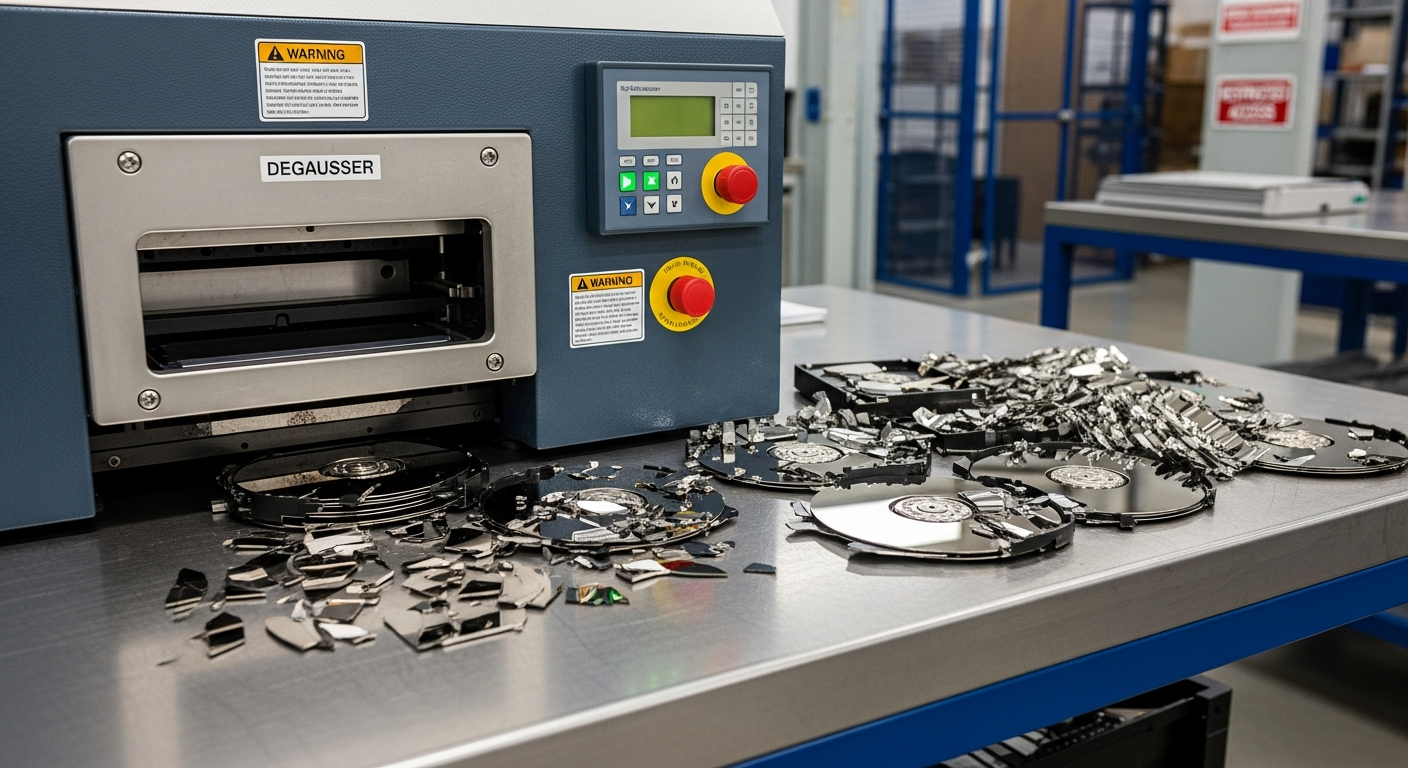
The method matters as much as the location. Revision 2 warns that bending, cutting, or drilling a hole through a device may only partly damage the media, leaving portions readable with state of the art laboratory techniques. It also says degaussing is not an approved destroy technique, so neither step should appear on your record as the act of destruction.
What should the event record show?
Section 4.6 of Revision 2 says a certificate of sanitization should be completed for each item of media, with at least the fields below, and that records are most useful when they follow media from entry into your environment to its post-sanitization destination. For an on-site event, we tailor Precision's certificate fields and serial detail to your auditor.
- Manufacturer, model, and serial number for each drive or tape
- Your property or asset tag number, where your team assigns one
- Media type, and the host device each item came from
- The method and technique, plus the tool that performed it
- How the result was verified before sign-off
- Name, title, date, location, contact, and signature of the verifier
Ask in the review how an item with a damaged or unreadable label will be recorded. A line marked as unreadable, matched to a count your team confirmed, is easier to defend than a silent gap. The goal is that the number of items on your list, the number destroyed, and the number on the certificate all agree.
What a certificate of destruction should record
Key takeaway
Security officers typically expect availability, method, and certificate fields settled for their site before any event date is set.
Why Do Kansas City Organizations Keep Drives On Site?
The rules that reach a Kansas City destruction project focus on who controls media until it is unreadable, not only how it is destroyed. NIST SP 800-88 Revision 2 notes that losing control of storage media holding certain sensitive data "may constitute a data breach." The table shows where an on-site record can serve as evidence.
Hospital systems and ePHI drives
The metro's hospital sector includes Saint Luke's Health System. Health systems like it retire ePHI-bearing drives under a HIPAA standard that requires disposal procedures. Keeping those drives on site until they are destroyed shortens the movement record the accountability specification asks for. Precision's documentation supports a covered entity's disposal and accountability records without replacing its own policy.
Accountability, not only disposal
HIPAA's accountability specification at 164.310(d)(2)(iii) asks for a record of hardware and media movements and the person responsible. When destruction happens on site, that movement log can end inside your own building, with the responsible person named on the record.
Healthcare device disposal in Kansas City
Tax, lending, and consumer report offices
Kansas City is also headquarters to H&R Block, and tax, lending, employment screening, and property management offices across the city hold consumer information. The FTC Disposal Rule reaches anyone who keeps it for a business purpose, and one reasonable measure it describes is hiring a record destruction company after due diligence. An on-site event extends that diligence into the room.
Overseeing the vendor
The Safeguards Rule, at 16 CFR 314.4(f), asks covered financial institutions to select capable service providers, require safeguards by contract, and assess them periodically. Before signing, ask for the vendor's information security certification (Precision holds ISO/IEC 27001:2022), the written method for each media class, and the certificate fields.
For non-bank financial institutions under FTC jurisdiction, 16 CFR 314.4(c)(6)(i) also calls for procedures to dispose of customer information no later than two years after its last use, with stated exceptions. A scheduled on-site event can become the recurring step that retires drives aging past that point. Whether a given office is covered is a question for its own counsel.
Defense and federal contractors holding CUI
NIST SP 800-171 Revision 3 requirement 03.08.03 asks contractors to sanitize media containing Controlled Unclassified Information before disposal, release out of organizational control, or reuse. Its discussion notes that NARA policy may require destruction when other methods cannot be applied. An on-site event keeps CUI media under the contractor's control until it is destroyed.
Missouri's breach statute, RSMo 407.1500, requires notice to affected residents after a breach of computerized personal information and contains no disposal requirement. Encrypted or otherwise unreadable data falls outside its definition of personal information. The practical link: an intact, unencrypted drive that goes missing in transit is the scenario an on-site event removes.
Key takeaway
When evaluating on-site destruction, Kansas City compliance leads map each applicable rule to one line of the event record first.
How Should a Kansas City Site Prepare for Destruction Day, and What Follows?
An on-site event is booked once its scope is set, so preparation runs on your calendar. Inventory takes most of the effort, because the day runs smoothly only when every drive in the room already has a line on the list, whether the media sits in a downtown office, a hospital data room, or a Jackson County branch.
- Pull drives from laptops, servers, and arrays and hold them in a locked, labeled container
- Build a serialized list, with each media class counted separately
- Reconcile that list against your asset register and flag gaps before the event
- Rate the data sensitivity of each media class so the confirmed method can be matched to it
- Name a witness and a backup from security, compliance, or IT if your policy requires one
- Arrange a room or loading dock, building access, and any escort your security rules require
Between pulling drives and the event
Drives pulled weeks ahead of the event are the weak point in many plans. Keep them in a locked container with a sign-out log, so the accountability trail your HIPAA or Safeguards Rule program relies on has no gap between removal and destruction. Count the container again on the morning of the event, before the first item is destroyed.
What happens on the day of the event?
Media is checked against your reconciled list as the work proceeds, at the serial detail agreed in the review. A drive that turns up without a matching line is set aside and resolved before anything is signed. Remnant inspection under section 4.5.1 of Revision 2 is the last step before sign-off.
Reject partial damage
If a remnant still looks like a working component, it has not been destroyed in the sense NIST means. Hold it back, note it against the list, and resolve it before the certificate is issued.
Defense suppliers and seasonal offices
The Kansas City National Security Campus, operated for NNSA by Honeywell Federal Manufacturing & Technologies, makes about 80 percent of the non-nuclear components in the nuclear stockpile. Suppliers in its defense chain should flag CUI media so it is listed and destroyed as its own class; classified media and the campus itself are outside this service.
After the event: remnants, equipment, and Missouri's landfill rule
Destroying the data does not settle what happens to the hardware. Missouri DNR's position is that businesses, schools, non-profits, churches, and public agencies in Missouri cannot legally put certain electronics in Missouri landfills, under the state's hazardous waste management law, RSMo 260.350 to 260.430. Monitors, chassis, and other equipment retired alongside the drives still need a documented recycling path.
- The certificate of destruction, with the fields agreed in the project review
- Your reconciled serial list, marked against what was destroyed on site
- The witness sign-off, where your confirmed scope includes a witness
- A record showing remnants and remaining equipment were routed for recycling through R2-certified downstream processors
Remnants and other retired equipment travel from your Kansas City site to our secure Lincoln, Nebraska facility, and remaining equipment can ride on the same pickup. We plan how remnants are collected when we scope your event. From Lincoln, applicable material is routed to R2-certified downstream processors.
Clear, purge, or destroy: Kansas City data destruction
Key takeaway
A reconciled list, a confirmed method, and a named witness where policy requires one are what make a destruction day hold up in an audit; Missouri's landfill rule then governs the hardware that is left.
On-Site Destruction Questions From Kansas City Organizations
Request Service
Ready to Get Started in Kansas City?
Get a free quote or send us a message about your project, and we scope pickup and documentation around your site.