Data Destruction in Kansas City, MO
Deciding whether retired drives, laptops, and tapes should be wiped for reuse or destroyed outright? Precision E-Cycle helps Missouri-side organizations make that call by media type, picks up qualifying business volumes for free, and processes everything in Lincoln. A free Certificate of Destruction comes with your project.
How Is Kansas City Data Made Unrecoverable?
Precision E-Cycle provides data destruction for Kansas City, MO organizations retiring hard drives, SSDs, laptops, phones, and backup tapes, making the data unrecoverable before any hardware is reused or recycled. Methods are informed by NIST SP 800-88 Revision 2, media is collected by pickup, and processing happens at our Lincoln, Nebraska facility.
For a security or privacy officer, the hard part is showing how every retired device was handled. GSA described the IRS Kansas City Service Center in 2019 as able to process 18 million returns, and the city's hospitals, banks, and tax preparers retire devices holding similar records. Two questions settle each device: reuse or destroy, and which record you keep.
What Kansas City Security and Compliance Leads Can Count On
A method you can explain
Methods follow media type and data sensitivity, so your file shows why a phone, an SSD, and a tape were each treated differently. Security leads comparing destruction vendors can ask whether the method changes by media or everything is shredded.
A record built for review
The certificate of destruction and any reporting are scoped against the NIST SP 800-88 Revision 2 section 4.6 field list before pickup, so an auditor or records officer sees what was agreed and what was delivered.
ISO 27001 information security
Precision holds ISO/IEC 27001:2022 for information security management, together with ISO 14001 environmental, ISO 9001 quality, and ISO 45001 occupational health and safety management certifications.
Request Service
Ready to Recycle?
Pickup is free for qualifying business volumes. Schedule yours or contact us with questions.
Related Services
How Does a Kansas City Data Destruction Project Run?
Media inventory and sensitivity rating
Your team lists the devices and loose media being retired, with media types, serial numbers where available, and the kind of data each held. Your security lead rates sensitivity, and we confirm the scope and schedule your pickup.
Reuse or destroy, class by class
Each media class is assigned a goal: sanitize so the device can be reused, or destroy it at end of life. The method is matched to media type and data sensitivity, informed by NIST SP 800-88, and written down with the certificate fields before pickup is booked.
Counted pickup at your Missouri site
Media is counted against your inventory at your Kansas City, MO location, and chain of custody documentation begins there. Pickup is free, and every load travels to Lincoln for processing.
Destruction, recycling, and records
At our Lincoln facility each item is sanitized or destroyed by the agreed method. Emptied hardware goes to reuse where the project allows or to R2-certified downstream processors, and the certificate of destruction and agreed reporting close out the job.
Clear, Purge, or Destroy: Which Fits Each Kansas City Device?
Under NIST SP 800-88 Revision 2, published in September 2025, a retired device is sanitized by one of three methods: clear, purge, or destroy. Only destroy ends a device's useful life, so choosing among them is the first real decision in a Kansas City project. Revision 2 replaced the earlier edition, which NIST has withdrawn.
Matching the path to the device
Will the device be used again? A laptop headed back into service or out for resale needs clear or purge, since destroying it removes any reuse value. A failed drive, or one holding data your policy says must never be reused, belongs on the destroy list. We match a technique to each media type in your project.
Why shredding is not the default
Section 3.1 of Revision 2 states that "pulverize and shred techniques for ISM should be avoided for anything but the lowest security categories of data." That is why the method is matched to the media type and your data sensitivity instead of sending every device to a shredder.
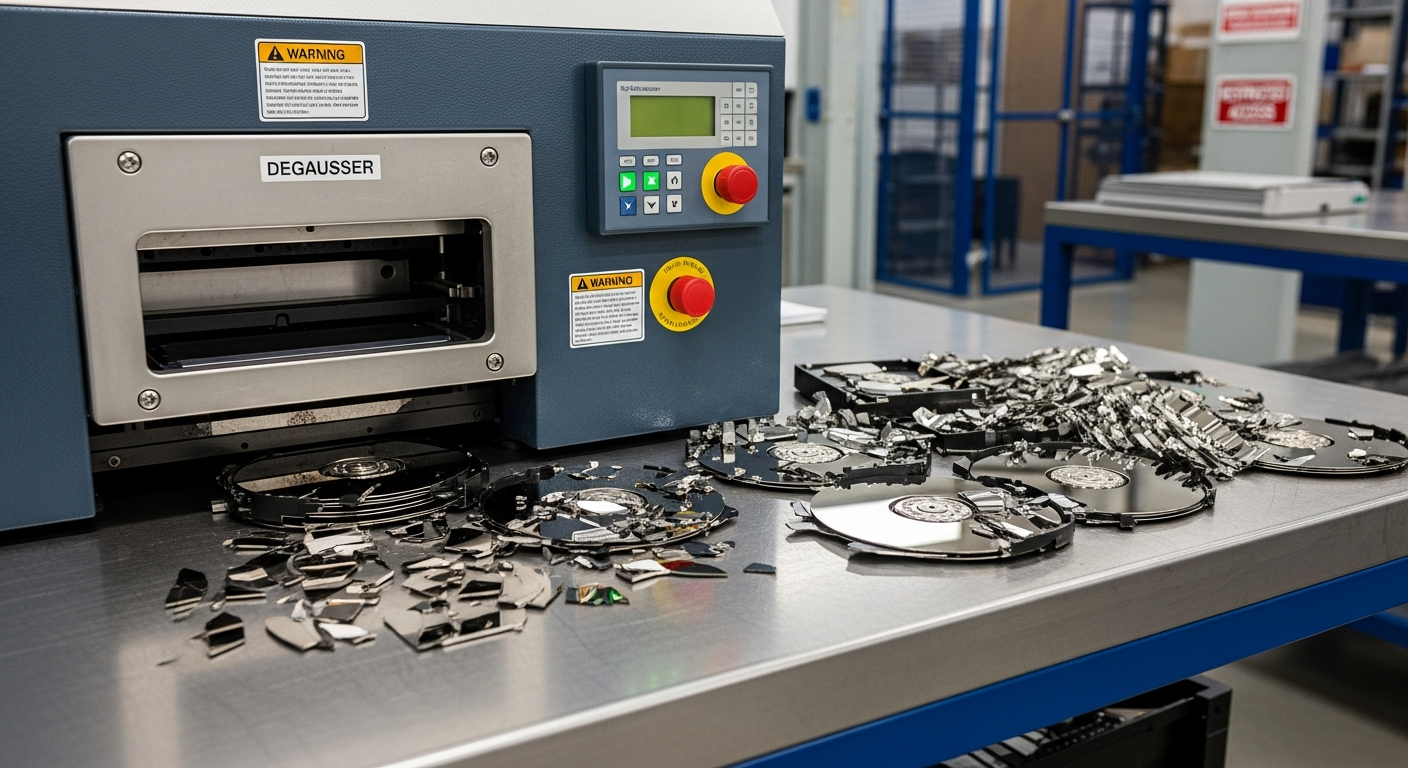
- Degaussing is not an approved destroy technique under Revision 2
- Degaussing should not be used on SSDs or other non-magnetic media
- Many degaussers lack the force needed for modern high-coercivity hard drives
- Drilling a hole through a drive can leave portions readable in a laboratory
- Most verification language was removed, so sampling is needed only if your organization requires it
Encryption opens another route to reuse. If laptops and phones were encrypted from the day they were issued, cryptographic erase can serve as the purge step, and the way the keys were retired belongs in the sanitization record.
Some media falls outside this page entirely. Classified material, such as work produced for the NNSA at the Kansas City National Security Campus, follows federal agency rules not covered here. Everything here concerns commercial and public-sector data that your own policies govern.
The record your organization keeps
Section 4.6 of Revision 2 says a certificate of sanitization should be completed for each item sanitized, whether on paper or electronic, and Appendix C gives a sample form. It works as a benchmark for what to request. The fields below are the ones the section names.
- Manufacturer, model, and serial number of the media
- Organizational property number, where your team uses one
- Media type, and the media source such as the host device
- Sanitization method (clear, purge, or destroy) and the technique used
- The tool and its version
- The verification method
- Name, title, date, location, contact, and signature of the person performing verification
Records built around your audit
Precision issues a certificate of destruction, and we tailor its fields and format to your auditor, including whether it lists each device by serial number or covers a whole lot. Bring this list so the answer is on paper first.
What a Kansas City certificate of destruction should record
Key takeaway
Decide reuse or destroy for each media class first, then agree the certificate fields; a record is easiest to defend when both choices are written down before pickup.
Which Missouri and Federal Rules Shape a Kansas City Destruction Decision?
Six rules can reach a Kansas City destruction project: HIPAA, the FTC Safeguards and Disposal Rules, and Missouri rules on public records, breach notice, and business electronics in landfills. Some govern data disposal, one covers a lost device, and one the hardware itself, so knowing which apply tells you what the record must show.
Hospitals: disposal and re-use are separate requirements
Hospital systems such as Saint Luke's Health System work under HIPAA device and media controls with two required parts. One covers disposal of ePHI and the hardware holding it; the other covers removing ePHI before media is re-used. That split maps onto the destroy and purge paths, and Precision's documentation supports a covered entity's records for both.
Tax preparers and financial firms
Customer-information disposal rules matter to Kansas City tax and financial firms such as H&R Block, headquartered here with about 4,600 regular full-time associates as of June 30, 2026. The Safeguards Rule asks covered institutions to keep secure disposal procedures and review retention periodically. Coverage is a call for counsel, but a destruction certificate belongs in that file either way.
The FTC Disposal Rule casts a wider net than the Safeguards Rule. It applies to any person who maintains or possesses consumer information for a business purpose, and its examples include destroying or erasing electronic media so the information is rendered unrecoverable. That reach is one reason the erase or destroy choice matters well outside banking.
Vendor due diligence
The same rule offers, as one reasonable measure, hiring a record destruction company after due diligence such as reviewing its audits, references, certifications, and security policies. The questions below give that review a starting point.
- Which information security certification the vendor holds; Precision holds ISO/IEC 27001:2022
- Whether the method for each media type is written down and tied to data sensitivity
- Which NIST SP 800-88 revision informs the methods, which should be Revision 2
- Where the media is processed, which for Precision is Lincoln, Nebraska
- Where emptied hardware goes, which for Precision means R2-certified downstream processors
City and county offices in Jackson County
Public bodies face a step private firms do not. Under RSMo 109.260, a city or county office may not destroy a record until the relevant board or commission finds it has no further administrative, legal, fiscal, research, or historical value. The Secretary of State's April 2025 guidelines leave the method to the office, but confidential records must be made unrecoverable.
The permanent part of the file
Those guidelines treat the list of records destroyed, together with the authorization, as a permanent record. A certificate of destruction from the vendor sits beside that list, so match its identifiers to the ones on your authorization before pickup.
Kansas City government electronics recycling and data security
Missouri's breach statute, RSMo 407.1500, is about notice, not disposal, and it contains no records destruction requirement. It does define encryption as making data unreadable or unusable without a confidential process or key. An unencrypted laptop that is lost or improperly discarded can therefore become a notice event.
Key takeaway
Map each Missouri and federal rule that applies to your organization onto the destroy or reuse decision, and one certificate can serve as evidence for all of them.
Preparing Kansas City Media for Pickup and What Follows
In a Kansas City office cleanout, data rarely lives only in the computers on the asset register. Phones in a desk drawer, a box of USB sticks, and last decade's backup tapes all carry records. A media sanitization project is easier to scope when those are found and listed before the project review.
- Laptops, desktops, and workstations in storage closets or returned by departing staff
- Smartphones and tablets from retired mobile plans
- USB flash drives, memory cards, and external hard drives
- Loose hard drives, SSDs, and NVMe or M.2 drives pulled during repairs
- LTO and other magnetic tape from old backup rotations
- Multifunction printers and copiers, which your IT team should check for internal storage
Splitting the list before anyone arrives
If your own staff sanitize anything in house before release, record the technique, the tool, and its version for each item, since section 4.6 asks for all three. That keeps your internal steps and Precision's certificate readable as one continuous record.
Pickup day at a Missouri-side location
Searching for data destruction near me on the Missouri side of Kansas City? Schedule a pickup at your location, where media is counted against the inventory you sent. Chain of custody documentation begins at that count, with controls agreed in the project review, and all media then travels to our secure Lincoln, Nebraska facility.
- Counts by media class, split into the reuse list and the destroy list
- Serial numbers or asset tags wherever your records already hold them
- Encryption status for laptops, phones, and external drives
- The data sensitivity rating your security lead assigned to each class
- The person at your location who will confirm the count at pickup
- For public offices, the reference for the board authorization that covers the records
When media cannot leave your premises
If your policy requires destruction before drives or devices leave the building, ask about on-site destruction for your Kansas City site when you request a free quote.
Ask about on-site data destruction in Kansas City
After destruction, the hardware still has a Missouri rule
Destroying the data does not end your obligations for the hardware. The Missouri DNR says organizations cannot legally discard certain electronics in Missouri landfills, citing the state's hazardous waste management law. That rule concerns the equipment rather than the data, so it applies whether a device was wiped, purged, or destroyed.
What comes back after processing
- A certificate of destruction, with fields set in the project review
- Reporting at the level of detail agreed before pickup
- Chain of custody documentation from your Missouri location to Lincoln
- Confirmation that emptied hardware went to reuse or to R2-certified downstream processors
Where should the returned records go? File them with the inventory you sent, since together they show where every item went. A covered health entity keeps them with its disposal procedures, and a financial firm keeps them in its Safeguards Rule disposal file. A Jackson County office files them beside its board authorization and list of records destroyed.
Physical destruction for Kansas City hard drives
Key takeaway
Find every piece of data-bearing media, split it into reuse and destroy lists, and plan a recycling path for all of it before the pickup is booked.
Kansas City Data Destruction Questions
Request Service
Ready to Get Started in Kansas City?
Get a free quote or send us a message about your project, and we scope pickup and documentation around your site.