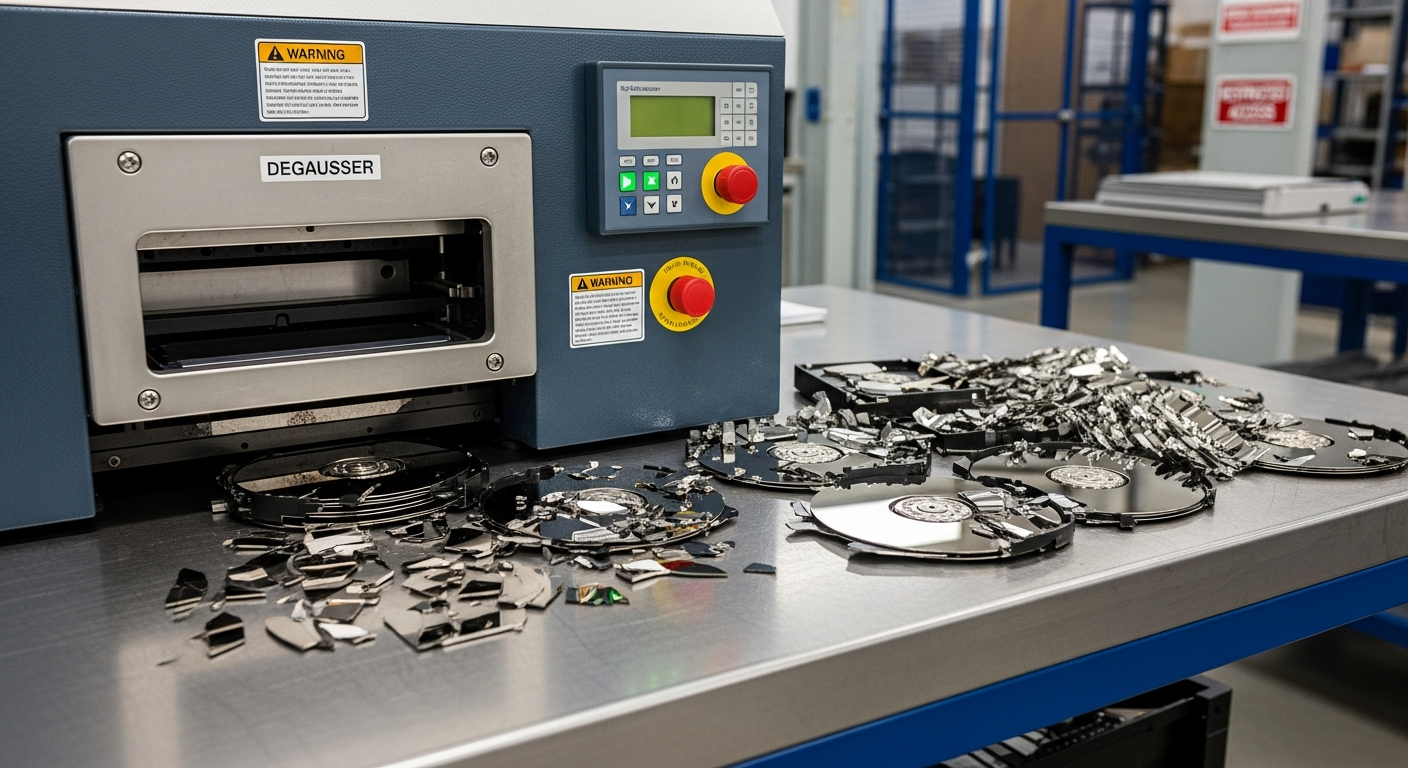
On-Site Hard Drive Destruction in Overland Park, KS
When a hospital policy, a campus media rule, or an agency's federal tax safeguards expect drives destroyed under your own staff's eyes, ask about on-site destruction for your Johnson County site. Precision E-Cycle scopes the event around your building, media types, and observer, and documented pickup to our secure Lincoln, Nebraska facility covers the rest, with free pickup for qualifying business volumes.
What Does On-Site Destruction Mean for a Johnson County Building?
On-site hard drive destruction in Overland Park makes retired drives unreadable inside your Kansas building, under your staff's supervision, so no drive leaves intact. Precision E-Cycle scopes it for hospitals, agencies, and campuses in Johnson County, the most populous county in Kansas, so request a free quote and ask about on-site destruction for your address. A free Certificate of Destruction comes with your project.
The hard part is proving a drive holding patient, taxpayer, or university data never left your control while readable. Kansas law does not demand on-site destruction: K.S.A. 50-6,139b lets a holder destroy records or arrange their destruction. The push comes from hospital media policies, IRS rules for agencies with federal tax information, and campus contractor rules.
What Johnson County Security, Privacy, and Records Teams Gain
Evidence of reasonable care
K.S.A. 50-6,139b(c) offers a defense where a holder took reasonable care in selecting and employing a destruction method. A reviewed method and a record made inside your own building are practical evidence of that care.
A method chosen for the media
NIST SP 800-88 Revision 2 says shred and pulverize techniques should be avoided for anything but the lowest security categories of data, so the review matches each media class to a method rather than defaulting to shredding.
An ISO 27001 vendor in your building
Precision holds ISO/IEC 27001:2022 for information security management, plus ISO 14001, ISO 9001, and ISO 45001, which your security office can review before vendor staff work inside a hospital or county building.
Request Service
Ready to Recycle?
Pickup is free for qualifying business volumes. Schedule yours or contact us with questions.
Related Services
How Does an On-Site Destruction Event Come Together in Overland Park?
Test the reason for staying on site
Precision's on-site projects start with the policy, contract clause, or agency rule that keeps these drives in the building, plus your count by media type. We then scope whether an event at your Johnson County site fits, the method for each media class, and the media it covers.
Stage and list the media
Your team removes drives from computers, copiers, and printers, lists them by serial number, and holds them in a locked container. You name the employee who will observe or verify if your policy or an agency rule calls for one, and reserve the room and dock time.
Destroy and inspect at your site
On the agreed date the media is destroyed in your building by the confirmed method, with items checked against your list at the serial detail agreed in scoping. Remnants are inspected for intact pieces before the event is signed off.
Close the Kansas record
Remnants and remaining equipment travel to our Lincoln facility and on to R2-certified downstream processors, in line with KDHE's preference for recycling over landfill. The certificate of destruction and your reconciled list then go into the file your records policy relies on.
When Is Destruction at Your Overland Park Site Worth It, and What Does the Event Involve?
Choosing on-site destruction at an Overland Park or Olathe site is about control, not a different end result. NIST SP 800-88 Revision 2 lists where media is sanitized, and whether your staff or a third party does it, as factors in a sanitization decision. A footnote warns that losing control of some sensitive media may itself be a breach.
Drives cleared to travel: hard drive shredding for Overland Park
What happens during an on-site event?
- Check-in with your building security and a count of the locked media container
- Staging in the room your team reserved, away from public and patient areas
- Each item matched to your serial-numbered list before it is destroyed
- Destruction by the method agreed for that media class
- Remnant inspection by your observer, where your scope includes one
- Sign-off, then remnants packed for the trip to Lincoln and recycling
Near me, scoped to your Kansas site
Looking for on-site hard drive destruction near me in Overland Park? Ask about on-site destruction for your Overland Park, Olathe, or Kansas City, Kansas building. Each event is scoped one project at a time, and we set what it covers before a date is discussed.
Holding the event in your building does not hand responsibility to the vendor. Revision 2 section 4.3.4 treats provider work on your site, under your supervision, as remaining in your control, and section 4.7.4 places supervision of it on the information owner. Name the employee who supervises, and tell us during scoping how that person takes part.
Questions to settle before any date is set
- Is on-site destruction available for our Overland Park, Olathe, or Kansas City, Kansas building at this volume?
- Which media types can the event cover, listed class by class for our building?
- Which method applies to each media class, given the sensitivity rating we assigned?
- Can our named employee observe the work, inspect remnants, and sign the record?
- Which certificate fields will be recorded, including the location where destruction took place?
- How are remnants and any remaining equipment collected and moved to Lincoln afterward?
What record should an on-site event leave behind?
Section 4.6 of Revision 2 calls for a certificate of sanitization for each item, with minimum fields, and suggests scanning bar-coded serials into a tracking application as items are sanitized, keeping your list and the certificate in step. Precision reports by serial number and agrees its certificate fields and format with you before the event, so bring this list.
- Manufacturer, model, and serial number for every drive, tape, or card
- Your organizational property number, if your team tags media
- Media type, plus the device or system it was removed from
- The sanitization method and technique, and the tool used with its version
- The verification method applied before sign-off
- Name, title, date, location, contact details, and signature of the person verifying
What an Overland Park certificate of destruction should record
Key takeaway
Security officers typically settle why media stays on site, what the scope covers, and what the record carries before an Overland Park event.
Which Kansas and Federal Rules Keep Some Johnson County Drives in the Building?
Kansas does not require on-site destruction. The state's disposal duty asks a holder of personal information to take reasonable steps to destroy, or arrange destruction of, records it no longer intends to keep, and only the attorney general enforces it. Sector and agency rules layered on top are what move some Johnson County drives into an on-site event.
Reasonable care, written down
The subsection (c) defense turns on evidence. A scoping record that shows why a method was chosen, and a certificate that shows where and how each item was destroyed, are the kind of documents that support it, while the legal judgment stays with your counsel.
Hospitals, laboratories, and health plans
Hospitals such as Overland Park Regional Medical Center, a Level II trauma center, retire workstations and storage that held ePHI. HIPAA's device and media standard, 45 CFR 164.310(d)(1), asks for policies on moving that media into and out of a facility. Destroying drives before they leave simplifies the removal policy and ends the movement record inside the building.
Supports, never replaces, your policy
Under 164.310(d)(2), the disposal specification is required and the accountability specification is addressable. Precision's certificate and your reconciled list support both records, while the covered entity's own policy decides when on-site destruction is needed.
Public agencies, federal tax information, and witnessed destruction
IRS Publication 1075 applies to state and local agencies receiving federal tax information, not to private businesses generally. Section 2.F.3.1 says media not being reused is destroyed, an agency employee witnesses or verifies sanitization, and every third piece is tested afterward. Section 2.F.4 lets a contractor certify destruction when no employee witnesses it, given contract safeguarding language.
For the agency's safeguards lead
Your agency determines whether your office holds federal tax information. Tell us early if a contract must carry the Publication 1075 safeguarding terms, so your safeguards lead can review Precision's documentation against them before anything is scheduled.
County offices carry a second Kansas layer. The Kansas Historical Society says State Records Board retention and disposition schedules are mandatory for state agencies and county governments, though not for cities or townships. A Johnson County office should therefore tie each on-site event to the schedule item that authorizes disposal.
Disposition planning for Johnson County public agencies
Regents campuses and outside contractors
Kansas State University's media sanitization policy covers all university units and says that when physical destruction is contracted to a third party outside the university, all university data must be purged first. K-State Olathe, a Johnson County Education Research Triangle campus, brings that policy into the county.
Whether a vendor destroying media on campus counts as an outside contractor is for the unit's security office to decide. The policy also cites an earlier NIST revision, so ask which one your unit now follows.
Key takeaway
When evaluating on-site destruction in Kansas, buyers start with the hospital, agency, or campus rule, because state law allows either path.
Preparing an Overland Park Site for Destruction Day and the Kansas Rules for What Remains
Preparation starts once the event is scoped for your site. Blue Valley School District, with 3,363 full-time employees on the 2025 county list, may prefer an academic break, when IT staff and an observer are free. Inventory takes the most time, because every item in the room needs a line on the list.
- Pull drives from laptops, desktops, and servers, and remove internal drives from copiers and printers
- Gather flash cards, USB drives, optical discs, and backup tape from desks, closets, and field kits
- List every item by serial number, with each media class counted separately
- Hold the media in a locked, labeled container with a sign-out log until the event
- Rate the sensitivity of each media class so the agreed method can be matched to it
- Reserve a room and dock time, arrange escorts, and name an observer plus a backup
A Kansas source for the staging list
KDHE's EW-105 standards for grant-funded Kansas e-waste programs name easily missed data-bearing items: flash cards, printer hard drives, compact discs, VCR tapes, typewriter ribbons, and printer spools. They also call for removing other data-bearing devices first and storing units securely until destruction. They bind grant recipients only, but make a practical checklist for a Johnson County storeroom.
Items to raise during scoping
Tell us about media not on Precision's accepted items list, such as optical discs, and we scope it before the event. Settle it early so nothing sits in the locked container without a plan.
On the day of the event
The locked container is counted again when the event begins, and each item is checked against your list at the agreed serial detail. Anything without a matching line is set aside and resolved before sign-off. Revision 2 section 4.5.1 verifies a destructive method by inspecting remnants and identifying the equipment used, which your observer can do in the room.
Partial damage is not destruction
Revision 2 warns that bending, cutting, or drilling a hole through a device may leave portions readable with state-of-the-art laboratory techniques, and it says degaussing is not an approved destroy technique. If a remnant still looks like a working part, hold it back and note it against the list.
What goes into your file after the event
- A certificate of destruction carrying the fields agreed before the event
- Your serial-numbered list, marked item by item against what was destroyed
- The observer's sign-off, where your scope includes one
- The schedule item or policy clause that authorized the event
After the event: KDHE's order of preference
Destroying the media does not decide where the hardware goes. KDHE Policy 05-02 states that "Kansas laws and regulations do not specifically address E-waste disposal," and permitted municipal solid waste landfills may accept it. The same policy ranks equipment reuse first, materials recycling second, and landfill disposal last.
Remnants from an on-site event, and any equipment retired with the drives, travel to our secure Lincoln, Nebraska facility for processing. Schedule pickup for remaining equipment at the same time, and we build remnant collection into the scope. From Lincoln, applicable material goes to R2-certified downstream processors for recycling.
Overland Park data destruction by media type
Key takeaway
A reconciled list, an agreed method, and an observer where your rule calls for one make an Overland Park destruction day defensible; KDHE's preference for recycling then guides the hardware left over.
On-Site Destruction Questions From Overland Park Organizations
Request Service
Ready to Get Started in Overland Park?
Get a free quote or send us a message about your project, and we scope pickup and documentation around your site.