Data Destruction in Overland Park, KS
Kansas expects retired records holding personal information to be made unreadable or undecipherable through any means. Precision E-Cycle schedules pickup on the Kansas side of the metro, free for qualifying business volumes, matches each device to a method informed by NIST SP 800-88, and does the work at our secure Lincoln, Nebraska facility. A free Certificate of Destruction comes with your project.
What Does Data Destruction Mean for an Overland Park Organization?
Precision E-Cycle provides data destruction for Overland Park and Johnson County organizations: drives, phones, flash media, and tape are sanitized or destroyed by methods informed by NIST SP 800-88 Rev. 2 so the information cannot be recovered, and each item is recorded. Schedule Johnson County pickup, and the work is done at our secure Lincoln, Nebraska facility.
For privacy officers and security leads, the hard part is proving what happened to each retired device. Johnson County's 2025 major employer list puts health plans such as UnitedHealth Group beside hospitals, so a laptop retired in Overland Park may have held member or patient data. Kansas law decides what destroying it must achieve.
What Johnson County Security and Compliance Teams Get
Evidence for a written records policy
K.S.A. 50-6,139b rewards a bona fide written records management policy with an affirmative defense. Destruction records tied to your device list give that policy something concrete to point to, without replacing your legal review.
A method you can explain to an auditor
When comparing data sanitization vendors, security leads can ask whether the method changes with media type or stays fixed at shredding. Precision matches each media class to a method informed by NIST SP 800-88 and your data sensitivity, so the record shows why a phone, an SSD, and a tape each went the way they did.
Certified information security management
Precision holds ISO/IEC 27001:2022 for information security management, along with ISO 14001 environmental, ISO 9001 quality, and ISO 45001 occupational health and safety certifications. Ask for the certificate scope when you request a free quote.
Request Service
Ready to Recycle?
Pickup is free for qualifying business volumes. Schedule yours or contact us with questions.
Related Services
How Does an Overland Park Data Destruction Project Run?
List every data-bearing item
Your team lists laptops, phones, loose drives, flash media, tapes, and copier drives with serial numbers, asset tags, encryption status, and the kind of data each held. That list is the starting point for the destruction record you will file later.
Decide reuse or end of life, then the method
Each media class is marked for reuse or end of life, and a sanitize or destroy method is matched to its media type and your data sensitivity. We confirm those methods, pickup scope for your volume, and the certificate fields with you before pickup.
Release under documented custody
Equipment is released at your Johnson County site under the custody controls agreed during scoping, such as how it is counted and signed for. That pickup is free. It then travels to our secure Lincoln, Nebraska facility for processing.
Destroy or sanitize, record, recycle
In Lincoln each item is sanitized or destroyed by the agreed method and recorded. Processed hardware goes to R2-certified downstream processors, and the records come back to you for the file that supports your Kansas records policy.
Which Destruction Method Fits Each Overland Park Device, and What Record Proves It?
Two questions set the method for each device: will it be reused, and how sensitive was its data? Black & Veatch, the engineering firm headquartered in Overland Park with about 2,200 county employees, sits on the 2025 employer list beside health plans, and office refreshes at employers of that size fill storerooms with retired laptops and loose drives.
Which devices hold data besides the laptop drive?
A media sanitization inventory has to reach past the obvious hard drives. KDHE's EW-105 standards for Kansas e-waste processors name printer hard drives, flash cards, and compact discs among the items to remove and destroy. Those standards govern grant-funded programs rather than every business, but the list is a useful prompt for any Johnson County office.
- Laptop and desktop drives, both spinning disks and SSDs
- Smartphones and tablets issued to staff
- Hard drives inside multifunction printers and office copiers
- Flash drives, memory cards, and external drives from desks and field kits
- LTO and other magnetic backup tape
- Compact discs and other removable media, listed so we can scope their handling
Copier and lease returns
NIST SP 800-88 Revision 2 counts media returned from a lease as leaving organizational control, and a copier drive sits inside equipment that rarely looks like storage. Add leased copiers and multifunction printers to the list before their return date so scoping can settle how those drives are handled.
Shred it or wipe it: the reuse decision comes first
Revision 2 frames the choice as clear, purge, or destroy, tied to reuse and to whether media is leaving your control. Section 4.3.3 notes that destroy can be the simplest, most cost effective path for media not meant for reuse. Under section 4.3.4, resale, donation, recycling, or a lease return all count as leaving control.
Drives with no reuse planned: Overland Park hard drive shredding
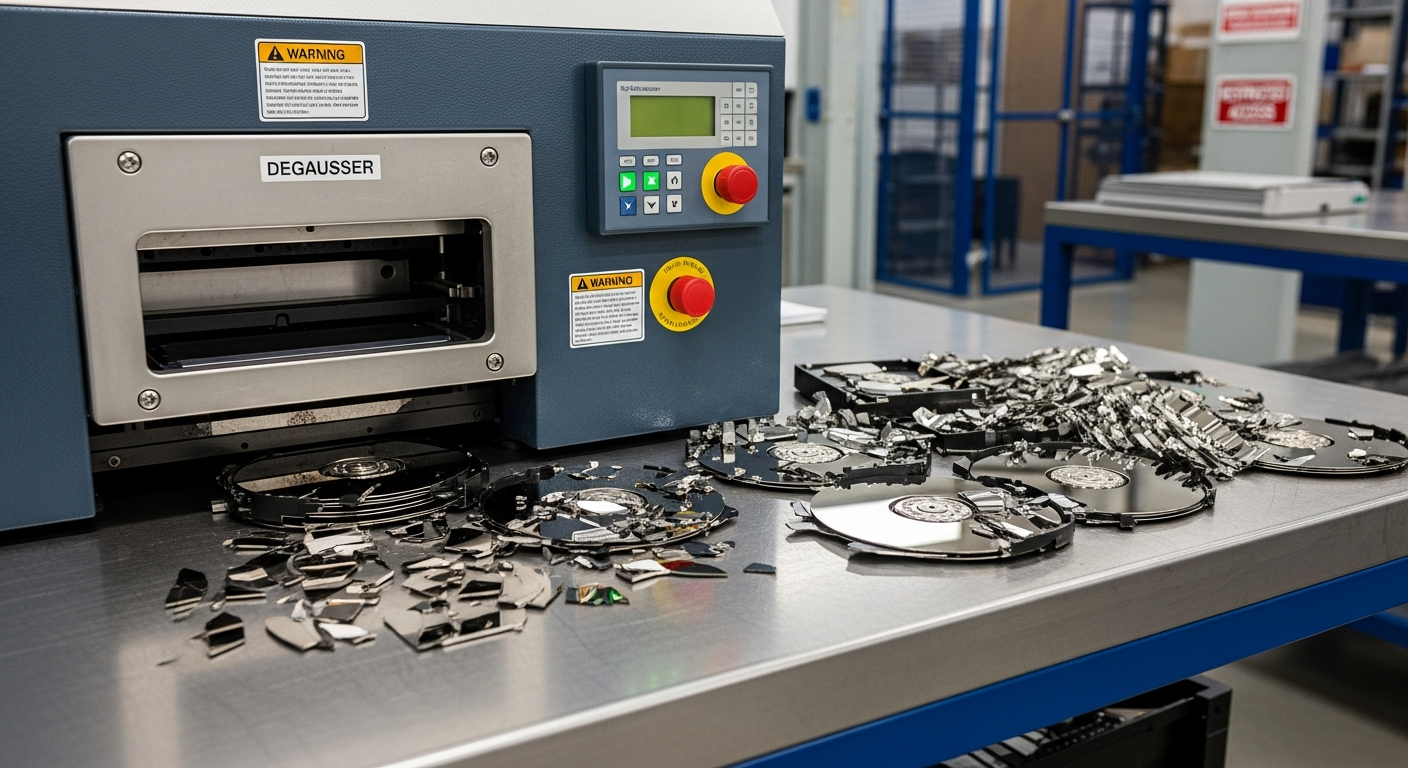
Older Kansas destruction policies can carry two habits that Revision 2 retires. It clarifies that clear does not need multiple overwrite passes, retiring the old DoD 5220.22-M language, and it says degaussing "is not considered an approved destroy sanitization technique." Bending, cutting, or drilling a hole through a drive can also leave parts of the media readable to a laboratory.
What the destruction record should show
Section 4.6 of Revision 2 calls for a certificate of sanitization for each item, and its field list works as a specification when you request one. A buyer can ask any vendor which of these fields its records carry. Precision reports by serial number and agrees the exact certificate fields and format with you before pickup.
- Manufacturer, model, and serial number, plus your property number if you use one
- Media type and media source, such as the laptop or copier the drive came from
- Whether the item was cleared, purged, or destroyed, and by which technique
- The tool used, including its version
- The verification method applied to the result
- Name, title, date, location, contact details, and signature of the person verifying
What an Overland Park certificate of destruction should list
Key takeaway
Decide reuse or end of life for each device first, then the method, then ask for a record naming the method, the tool, and who verified the result.
Which Kansas and Federal Rules Shape an Overland Park Destruction Record?
Three layers shape the record: K.S.A. 50-6,139b, in effect since July 1, 2016; sector rules such as HIPAA and the FTC Safeguards and Disposal Rules; and Kansas records schedules for public offices. Missouri rules a few miles east do not apply. KDHE says Kansas laws and regulations do not specifically address e-waste disposal, but the data destruction duty is separate.
K.S.A. 50-6,139b sets an outcome, not a machine
The statute requires a holder of personal information to take reasonable steps to destroy, or arrange destruction of, records it no longer intends to keep, by shredding, erasing, or otherwise modifying the information "to make it unreadable or undecipherable through any means." It yields where federal law requires otherwise, and the attorney general alone enforces it.
What the statute does not say
K.S.A. 50-6,139b does not require a certificate of destruction and does not name a method standard. The NIST column is a practical reading of the outcome, and Precision's records support your destruction file rather than settling the legal question for you.
A written policy is part of the defense
Subsection (c) gives a holder an affirmative defense, proven by clear and convincing evidence, in two situations. One is a destruction method that failed in a way that could not reasonably have been foreseen despite reasonable care in choosing it. The other is a bona fide written or electronic records management policy reasonably designed to prevent the violation.
- Which record types hold personal information as K.S.A. 50-7a01 defines it
- How long each record type is kept before it is destroyed
- The method assigned to each media type and the reason for it
- Who approves a destruction lot and who signs for its release
- Where destruction records are filed and how long they are kept
- How often the policy and the destruction vendor are reviewed
Violations are unconscionable acts under K.S.A. 50-627, and each record counts as a separate violation. The attorney general has announced a judgment against related companies over customer documents left in unsecured public trash bins in Topeka. That case involved paper, but the same duty covers personal information stored on drives.
Health data on Johnson County devices
Overland Park Regional Medical Center, an acute care hospital and Level II trauma center, is one example of a clinical sector retiring storage that held ePHI. Under 45 CFR 164.310(d), a covered entity needs final disposal policies and must remove ePHI before media is re-used; a movement record is addressable. Section 164.302 extends these controls to business associates.
Health technology firms count too
Health technology employers such as Netsmart, with about 1,075 county employees, also appear on the 2025 list. A software vendor that handles ePHI for a covered entity is a business associate, so its retired developer and support laptops can fall under the same device and media controls.
Healthcare disposition on the Kansas side of the metro
Lenders, tax preparers, and consumer report data
FTC-regulated financial firms, such as lenders, mortgage brokers, and tax preparers, must keep secure disposal procedures for customer information under 16 CFR 314.4(c)(6), generally no later than two years after its last use. Section 314.4(f) adds oversight of service providers through selection, contract terms, and periodic assessment. Insurers are regulated separately and fall outside this rule.
Due diligence the FTC describes
The FTC Disposal Rule, 16 CFR 682.3, reaches anyone holding consumer report information for a business purpose. Its examples include destroying or erasing electronic media so it cannot practicably be read or reconstructed, and hiring a record destruction business after reviewing independent audits, references, third-party certifications, and security policies.
Johnson County offices and public records
Public bodies carry one more layer. K.S.A. 45-403 says state and local government records may not be destroyed except as provided by law or authorized in retention and disposition schedules. The Kansas Historical Society says the State Records Board schedules are mandatory for state agencies and county governments, though not for cities or townships.
- The schedule item that authorizes disposal of the records on each device
- The approval from the records officer who released the lot
- The destruction record for each device, with its agreed fields
Key takeaway
Kansas law sets the outcome and rewards a written policy, and federal rules add sector duties. A policy is easiest to defend when each sanitization record matches a line on the device list, and Precision's documentation supports that match.
Preparing Overland Park Equipment for a Data Destruction Pickup
Searching for data destruction near me in Overland Park? Precision schedules pickup in Overland Park, Olathe, or Kansas City, Kansas, and processes each item at our secure Lincoln, Nebraska facility. Preparation happens before loading, and a clean device list lets us scope your pickup and your records.
- Export a device list with serial numbers, asset tags, and device type
- Mark each item for reuse or end of life
- Note encryption status, since K.S.A. 50-7a01 leaves encrypted data out of its definition of personal information
- Gather loose drives, flash media, and tapes into one counted container
- List copiers and multifunction printers that hold internal drives
- Name the person who will release the equipment and sign for it
Encryption, phones, and keys
For laptop and phone fleets, encryption changes the method but not the need for one. Revision 2 treats cryptographic erase as a purge technique, sometimes the only viable purge for cloud or logical storage. Record which devices were encrypted and how keys were retired, since a lost device with unencrypted data can trigger notice under K.S.A. 50-7a02.
Release day at your Johnson County site
At your site, equipment is released under the custody controls agreed during scoping, such as how it is counted and signed for, then travels to Lincoln. There each item is sanitized or destroyed by the method agreed for its media class. NIST section 4.6 names three points where a record is most useful, mapped below.
What happens to the hardware afterward
Once the data is handled, the remaining hardware falls under KDHE Policy 05-02, which allows e-waste in permitted landfills but ranks equipment reuse first, materials recycling second, and landfill disposal last. Applicable processed hardware goes to R2-certified downstream processors, and you can ask about reuse or resale terms when you request a quote.
If media cannot leave your building
If your policy requires destruction before media leaves the premises, ask about on-site destruction for your Johnson County site; the option is covered on the Overland Park on-site destruction page.
Ask about on-site data destruction in Overland Park
Filing the records when they come back
Where should the returned records go? File them with the device list and the policy they support, so one folder tells the whole story. A Johnson County office adds the schedule item that authorized disposal, and a covered entity keeps them beside its record of hardware movements. An FTC-regulated lender places them in its service provider oversight file.
Key takeaway
A device list with reuse decisions, encryption status, and a named signer is what turns an Overland Park pickup into a destruction record you can file.
Overland Park Data Destruction Questions
Request Service
Ready to Get Started in Overland Park?
Get a free quote or send us a message about your project, and we scope pickup and documentation around your site.