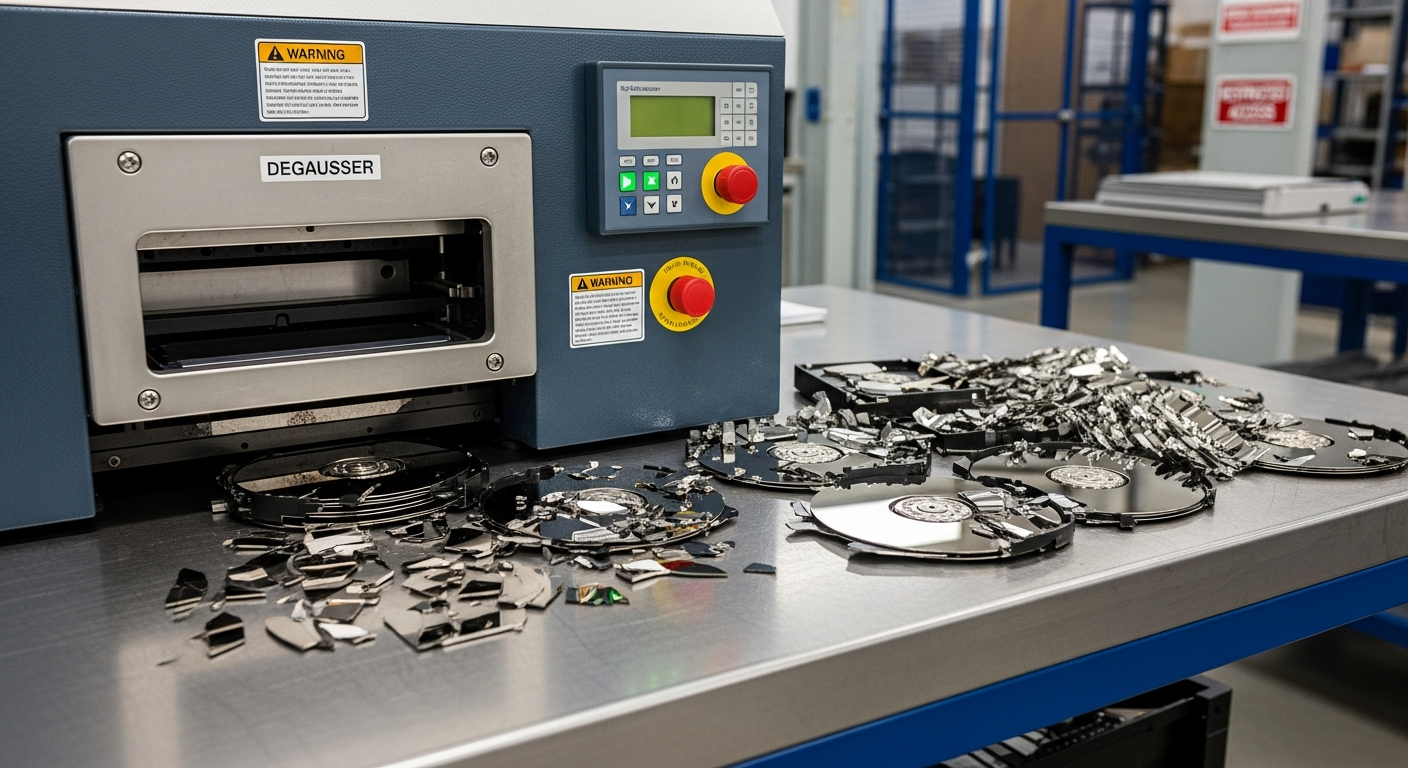
Hard Drive Shredding for Business Pickups in Overland Park, KS
Holding a cabinet of failed or retired drives from a Johnson County office? Precision E-Cycle schedules free pickup for qualifying business volumes, matches each group of drives to a method by media type and data sensitivity, and shreds where shredding fits. Ask about your free Certificate of Destruction.
What Is Hard Drive Shredding on the Kansas Side of the Metro?
Hard drive shredding in Overland Park is the physical destruction of retired drives so their data cannot be read, and Precision E-Cycle provides it to Johnson County organizations through scheduled pickup, with destruction at our secure Lincoln, Nebraska facility. Following NIST SP 800-88 Revision 2, shredding is reserved for the lowest security categories of data.
For an IT security manager, the hard part is proving which drives were shredded, which were not, and why. Drives retired in Overland Park answer to the Kansas statute on destroying personal information, and Johnson County's 2025 employer list runs from health systems to telecommunications and engineering, each retiring drives that held patient, subscriber, or customer data.
What Johnson County IT and Security Teams Gain
A plan for drives no tool can wipe
A drive that will not power on cannot be overwritten, so it tends to sit in a storeroom with its data intact. NIST names destruction as the route when clear and purge cannot be applied, which turns those drives into a documented close-out.
A shredding decision you can explain
NIST's 2025 revision and its July 2026 FAQ limit shredding to the lowest security categories. Auditors reviewing a destruction lot typically expect the record to show why each drive group was or was not shredded.
ISO/IEC 27001:2022 behind the handling
Precision holds ISO/IEC 27001:2022 for information security management, plus ISO 14001, ISO 9001, and ISO 45001. Ask for the certificate scope when you request a free quote and keep it with your vendor due diligence file.
Request Service
Ready to Recycle?
Pickup is free for qualifying business volumes. Schedule yours or contact us with questions.
Related Services
How Does an Overland Park Shredding Job Move From Cabinet to Certificate?
Classify the drives before anyone writes shred
Your team counts drives by media type, flags the ones that failed, and notes the security category of the data each group held. That classification decides whether a group is shredded or matched to another method, and we confirm the choice with you and scope pickup around your volume.
Agree on the record before drives move
Scoping settles the certificate of destruction fields, the serialized reporting detail, and the custody steps for the trip from your Johnson County site. NIST SP 800-88 Revision 2 section 4.6 is a practical checklist for comparing what your policy needs with what the record will show.
Release on site, travel to Lincoln
Drives are released at your Overland Park, Olathe, or Kansas City, Kansas site under the custody steps agreed during scoping, and pickup is free. They travel to our secure Lincoln, Nebraska facility for destruction, or ask about on-site destruction for your Johnson County building.
Destroy by the agreed method, then file
Drive serial numbers are logged at intake, then each group is destroyed or sanitized by the method agreed for its media class and data category. Remnants go to R2-certified downstream processors, and the records return to you for the file behind your Kansas destruction policy.
When Does Shredding Fit an Overland Park Drive Batch, and When Does It Not?
A typical Johnson County request is a locked cabinet of laptop drives pulled over several refreshes, a few failed server disks, and SSDs nobody was sure how to handle. Employers such as T-Mobile, with about 3,825 county employees on the former Sprint campus, run fleets that fill cabinets like that. Every drive needs a decision before anyone writes shred.
What NIST now says about shredding
NIST SP 800-88 Revision 2, published in September 2025, keeps shred as a destroy technique, but section 3.1.3 says pulverize and shred "should be avoided for anything but the lowest security categories of data." NIST's July 2026 FAQ explains why: modern storage writes data in depth on the media, so density defeats shredding at medium and high categories.
IEEE 2883 goes further
The same FAQ notes that IEEE 2883 deprecates shredding and pulverizing as approved destruction methods for all modern HDDs and SSDs. If your data sits above the lowest category, ask in the project review what happens to shredded material downstream and whether a purge method suits the media better.
Two shortcuts that do not count as destruction
Drilling and degaussing look like quick substitutes for shredding. Revision 2 section 3.1.3 warns that drilling, bending, or cutting a drive may leave portions readable in a laboratory. Section 3.1.2 says degaussing is not an approved destroy technique, and the FAQ calls it a purge method for legacy magnetic media that can fail on flash or hybrid parts.
Do encrypted drives need the shredder at all?
Not always. Where a self-encrypting or fully encrypted drive supports it, cryptographic erase is a purge technique that can leave the drive reusable, and the Kansas definition of personal information covers only elements neither encrypted nor redacted. Record which drives were encrypted and how keys were handled, so scoping can set purge or destruction for each group.
Proof that the shredding decision was deliberate
Revision 2 section 4.6 asks for a certificate of sanitization for each item, and two fields matter most on a shredding job: the method and technique, showing the drive was destroyed, and the verification method, showing someone checked. Precision logs serials at intake and reports by serial number; certificate fields are agreed with you before release.
- Did the drive fail, or could it be cleared or purged and put back into service
- Which security category does your policy assign to the data it held
- Is it a magnetic hard drive, or SSD, NVMe, M.2, or hybrid media
- Will the record name the method, technique, and verification for each serial number
- Where do the shred remnants go once destruction is finished
What an Overland Park certificate of destruction should record
Key takeaway
In a Johnson County batch, shred the failed and low-category hard drives, send SSDs and sensitive data to a method agreed during scoping, and keep drilling and degaussing off the destruction list.
What Do Kansas and Federal Disposal Rules Expect From a Shredded Drive?
Kansas expects the data on a shredded drive to end up unreadable, and federal rules expect a paper trail showing how. For a drive retired in Overland Park or Kansas City, Kansas, the state rule is a data rule, not a recycling mandate: KDHE says Kansas laws do not specifically address e-waste disposal.
Why the word shredding in the Kansas statute is not the whole answer
Since July 1, 2016, K.S.A. 50-6,139b has required a holder of personal information to take reasonable steps to destroy, or arrange destruction of, records it no longer intends to keep. It lists shredding, erasing, or otherwise modifying the information, and its test is the result: unreadable or undecipherable through any means. Shredding is permitted; the outcome is what counts.
Which drives the Kansas statute reaches
The statute uses the K.S.A. 50-7a01(g) definition: a first name or initial and last name linked to a Social Security number, driver's license or state ID number, or financial account or card number with any required code, where those elements are neither encrypted nor redacted. HR, payroll, billing, and customer drives usually hold exactly that.
Subsection (c) offers affirmative defenses for reasonable care in choosing a destruction method and for following an established records policy. Under subsection (d), each violation is an unconscionable act under K.S.A. 50-627, each record counts separately, and the attorney general enforces it. A record naming the method chosen for each media class helps show that care.
Health data and the movement record HIPAA describes
Health care leads Johnson County's 2025 employer list, where AdventHealth alone counts about 2,800 full-time employees, and clinical workstations and imaging systems retire drives that held ePHI. Under 45 CFR 164.310(d), disposal is a required specification, while accountability, a record of hardware movements and the person responsible, is addressable.
Lenders, brokers, and consumer report data
The FTC Disposal Rule, 16 CFR 682.3, requires reasonable disposal measures for consumer information, such as destroying or erasing media so it cannot practicably be read or reconstructed. FTC-regulated financial institutions also follow the Safeguards Rule, which at 16 CFR 314.4(c)(6)(i) sets disposal no later than two years after last use, with exceptions.
Due diligence on the shredding vendor
Section 682.3(b)(3) describes contracting with a record destruction business after due diligence, such as reviewing independent audits, references, third-party certifications, and security policies. The Safeguards Rule, at 314.4(f), adds selecting capable providers, requiring safeguards by contract, and assessing them periodically. Security leads typically ask a shredding vendor for these five items.
- The ISO/IEC 27001:2022 certificate and the scope it covers
- The method assigned to each media class, in writing, before pickup
- The custody steps from your Johnson County site to Lincoln, as agreed before pickup
- The certificate of destruction format and the fields it carries
- The downstream route for remnants, which runs to R2-certified downstream processors
Key takeaway
Kansas measures the result, HIPAA and the FTC rules measure the paper trail, and a hard drive destruction job on the Kansas side of the metro should leave evidence for both.
How Do Drives Get From a Johnson County Office to Destruction in Lincoln?
Searching for hard drive shredding near me in Overland Park? Schedule pickup at your Overland Park or Johnson County site and your drives are destroyed at our secure Lincoln, Nebraska facility, or ask about on-site destruction for your building. The preparation that protects your drives starts before the truck arrives.
Pulled drives or whole devices
Many Johnson County IT teams pull drives as laptops and servers retire, which leaves loose drives with no host to identify them. Others send whole devices, which keeps the host serial attached but means every internal drive must be counted. Either approach works when the list records the drive serial, the host it came from, and the data it held.
- Count drives by media type: hard drive, SSD, NVMe or M.2, and tape
- Flag failed drives, since a drive no tool can reach is where shredding most often fits
- Record the data category and encryption status for each group
- Add the internal drives from copiers and multifunction printers to the count
- Place loose drives in one counted container and name the person who will release it
Colleges and public offices
Johnson County Community College, with about 1,389 full-time employees on the county list, is typical of campuses that retire lab and staff drives holding student and employee records. A public body should add to its release record the name of whoever authorized disposal of each batch.
Releasing the drives at your site
Your site contact releases the counted container and any whole devices against your list, under the custody steps agreed during scoping. The load travels to our secure Lincoln, Nebraska facility, where the count is checked before destruction begins. Settle any drive that appears on one document but not the other before the certificate is issued.
If policy says drives cannot leave intact
If your security policy requires that drives holding certain data be destroyed before they leave the building, raise it early. Ask about on-site destruction for your Johnson County site, and tell us how many drives fall under that rule, since the answer shapes the method and the rest of the plan.
Overland Park on-site data destruction options
The same preparation applies in Wyandotte County, where city and county government operate as the consolidated Unified Government of Wyandotte County and Kansas City, Kansas. Kansas law governs both counties, so a drive retired in Kansas City, Kansas carries the same destruction duty as one retired in Overland Park.
Where the shredded material goes
Once destruction is recorded, applicable shred remnants and the rest of any whole devices go to R2-certified downstream processors. Since KDHE says Kansas laws do not specifically address e-waste disposal, that route is set by vendor practice, not a state mandate. If your data sat above the lowest security category, ask us to put the route in writing.
Wider Overland Park data destruction planning for laptops, phones, and flash media
Key takeaway
Count by media type, flag failed drives, name the person releasing them, and settle on-site questions during scoping, and a Johnson County drive destruction pickup closes with a record your team can file.
Overland Park Hard Drive Shredding Questions
Request Service
Ready to Get Started in Overland Park?
Get a free quote or send us a message about your project, and we scope pickup and documentation around your site.