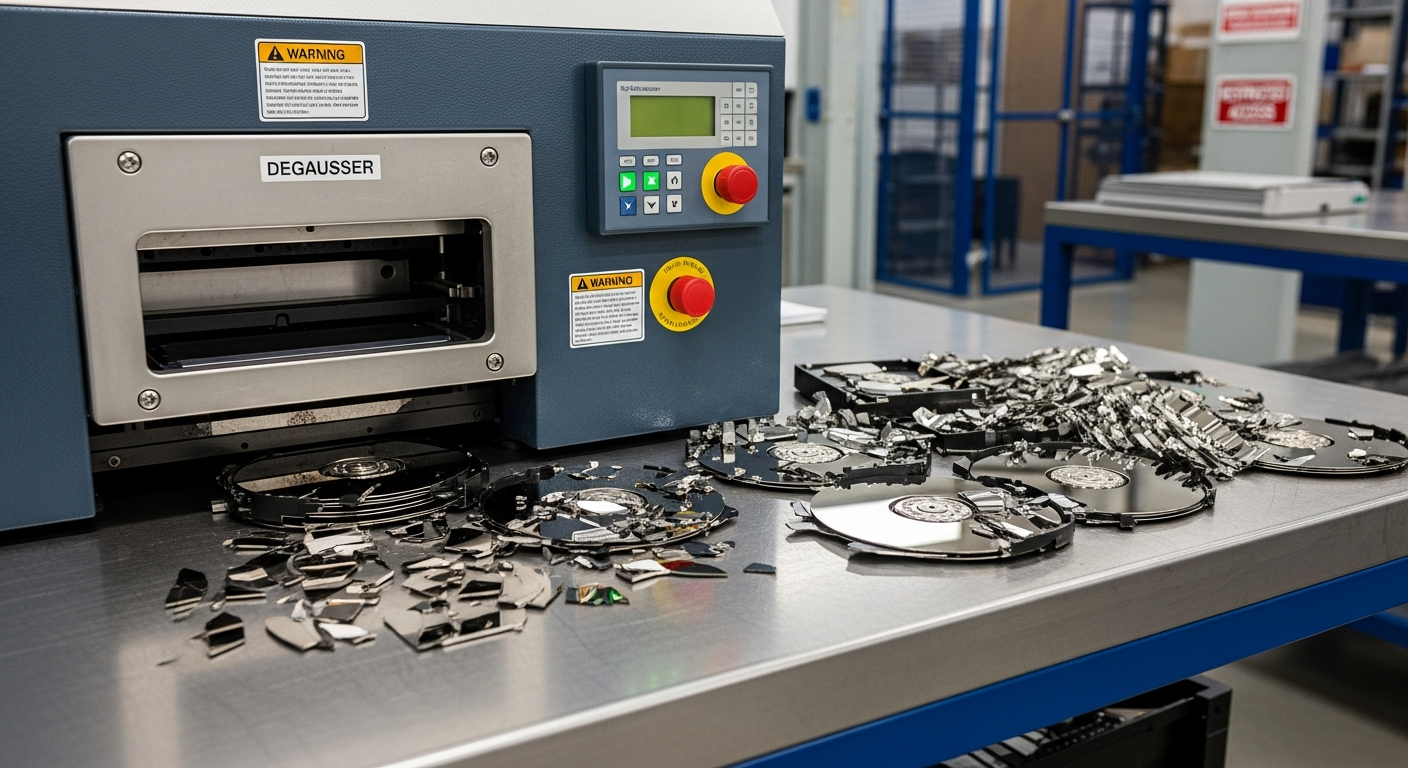
On-Site Data Destruction in Des Moines
Need retired drives destroyed before they leave your Des Moines building? Ask about an on-site event at your address, and Precision E-Cycle scopes the media, the site, and the record in a project review. Remaining equipment gets free pickup for qualifying business volumes.
What Is On-Site Data Destruction in Des Moines, and Who Needs It?
On-site data destruction in Des Moines means retired storage media is destroyed at your location, where your team can be present, before it leaves your control. Precision E-Cycle scopes it for security officers, compliance officers, and IT managers, using methods informed by NIST SP 800-88 Rev. 2, and scopes the event around your address in the project review.
For a Des Moines security or compliance officer, the hard question is rarely which drives to retire. It is who controlled each one between the day it was pulled and the moment it could no longer hold data. An on-site event shortens that gap to a single room inside your own building.
Why Des Moines Teams Choose an On-Site Event
Control stays in the building
The destruction happens where your data owner can see it, not after a transfer between sites.
A method for each data category
Each storage group is matched to its security category rather than one method for everything.
One trail from count to intake
The on-site count, the pickup, and the Lincoln intake log connect through fields agreed in review.
Request Service
Ready to Recycle?
Pickup is free for qualifying business volumes. Schedule yours or contact us with questions.
Related Services
How an On-Site Destruction Project Runs from Review to Record
Scope the media and the address
List each storage group with its owner, quantity, and source equipment. The project review scopes the on-site event for your Des Moines address and the groups it covers.
Match the method to the data
The data categories your organization assigns decide the method, with NIST SP 800-88 Rev. 2 as the reference. Shredding fits only the lowest security categories, so other groups get their own decision.
Hold the event at your site
Your team stages the scoped media and names who may observe. The count is reconciled against the inventory, and the media is destroyed before it leaves your control.
Close the record in Lincoln
Pickup of remaining equipment is free. It is processed at Precision's Lincoln, Nebraska facility, logged by serial at intake, with applicable material routed to R2-certified downstream processors.
When Does On-Site Destruction Make Sense for a Des Moines Organization?
On-site destruction makes sense when media holding sensitive data should not leave your control before it is destroyed. NIST SP 800-88 Rev. 2 lists "Whether sanitization is performed on-site or off-site" among the factors an organization weighs in section 2.4, next to data confidentiality and whether a third party does the work.
- A written policy says certain media must be destroyed before it leaves the building.
- A client contract or an auditor asks for destruction your own staff can observe.
- A security review named transport as the weakest point in the current disposal process.
- The data owner wants the final count signed before any equipment is loaded.
Why control decides the question
Section 4.3.4 of the same guidance says sanitization decisions are influenced by "who has control and access to the media." A footnote in section 2.4 adds that losing control of media holding certain sensitive data may be a data breach. Which notification duties could apply is a question for your counsel.
Precision E-Cycle on-site projects start with a project review that sets the media scope, the observers, and the record fields. Ask about on-site destruction for your Des Moines address, and the same review scopes what the event looks like there.
Observation is part of the scope
Authorized staff can observe the event. Name the observers for each media group in the project review, so the closing record shows who watched which media being destroyed.
What an on-site event leaves with your team
An on-site event settles where destruction happens, not what your data requires. Your organization still assigns each group's security category, clears retention holds, and decides how breach duties apply. NIST SP 800-88 Rev. 2, section 4.7.8, gives the records management officer the job of advising data owners on retention before media is sanitized.
Key takeaway
Before booking, confirm who holds custody at each step and which record ties the destroyed count to your inventory.
Weighing pickup against an on-site event? Start with Des Moines data destruction planning
How Should Des Moines Teams Prepare the Media and the Site?
Prepare two lists before the project review: a media inventory and a site plan. The inventory records each storage group by type, owner, quantity, and source equipment. The site plan names who authorizes access, where media is staged, and who may observe, so Precision E-Cycle can scope the event for your address.
- Give each storage group its own line, with type, owner, and quantity.
- Record the computer, server, or enclosure each traceable drive came from.
- Keep solid state media on separate lines from magnetic drives.
- Flag any item whose type or owner is unknown rather than guessing.
Check storage categories against Precision's accepted list
Storage that inventories miss
NIST SP 800-88 Rev. 2, section 2.2, counts phones, networking devices, and office equipment as information storage media, alongside drives and tape. Walk each floor for copiers, network appliances, and retired phones before the list is final. Give each one its own line and a named owner.
Build the site plan around access rules
Downtown Des Moines holds city, Polk County, state, and federal offices, and buildings like these can set their own entry and escort rules. If media sits at more than one address, such as a downtown office and a West Des Moines campus, list each address with its own contact so each can be confirmed separately.
Let the data category choose the method
Per NIST SP 800-88 Rev. 2, section 3.1.3, pulverize and shred techniques should be avoided for anything but the lowest security categories of data. Section 3.1.2 also says degaussing is not an approved destroy technique. Precision E-Cycle matches the method to each storage group's category in the project review.
Higher security categories
A shred-only plan does not fit a storage group above the lowest security categories. Before the visit, settle these four points for every group so no method is chosen on the day.
- Its security category, assigned by your organization.
- Any retention hold, cleared by records management.
- The method decision, recorded as section 4.3.6 of NIST SP 800-88 Rev. 2 advises.
- Whether the group is destroyed on site or picked up for Lincoln.
Key takeaway
Settle a separate method decision for each storage group before an on-site event is booked, so nothing is chosen on the day.
Drives in the lowest security categories? Compare Des Moines hard drive shredding
How Does a Des Moines On-Site Event Close Out in Lincoln?
Precision E-Cycle closes an on-site project in two parts. For a scoped event at your Des Moines location, media is counted against the inventory and destroyed while authorized staff can observe. Remaining equipment is then picked up and processed at Precision's only facility, in Lincoln, Nebraska, where serial information is logged at intake.
- Reconcile the staged count against the inventory before destruction starts.
- Hold any mismatched item out of the event until its owner decides.
- Note which staff members observed which media groups.
- Have your sign-off role confirm the reconciled total at the end of the event.
Searching for on-site data destruction near me in Des Moines?
Organizations in Des Moines, West Des Moines, and across Polk County can ask about an on-site event or schedule pickup. Des Moines pickup is processed at our secure Lincoln, Nebraska facility, and the project review scopes what happens at your address. Request a free quote today.
The record you file should connect the on-site count, the pickup, and the Lincoln intake log. Serial logging at intake supplies the last link. Certificate fields and format, including whether each line covers one device or a whole lot, are agreed in the project review rather than assumed.
See what a Des Moines certificate of destruction records
When the count does not match
A mismatch between the staged media and the inventory can happen when devices move between desks, floors, or buildings. Hold the unmatched item out of the event, record who found it, and let its owner decide. The exception then carries forward to the pickup and the Lincoln intake log instead of disappearing into a total.
Credentials
Precision E-Cycle holds ISO/IEC 27001:2022 for information security management, along with ISO 14001, ISO 9001, and ISO 45001. Its destruction methods are informed by NIST SP 800-88 Rev. 2, which is guidance, not a certification.
Questions to settle in the project review
- Which Des Moines addresses on the list want an on-site event?
- Which storage groups are destroyed on site, and which are picked up?
- Who from your team observes, and who signs the reconciled count?
- Which certificate fields and format will the closing record use?
- Does the remaining equipment qualify for pickup to Lincoln?
Key takeaway
Sign the on-site count before anything is loaded, so the Lincoln intake log has a fixed number to match.
On-Site Data Destruction Questions from Des Moines Buyers
Request Service
Ready to Get Started in Des Moines?
Get a free quote or send us a message about your project, and we scope pickup and documentation around your site.