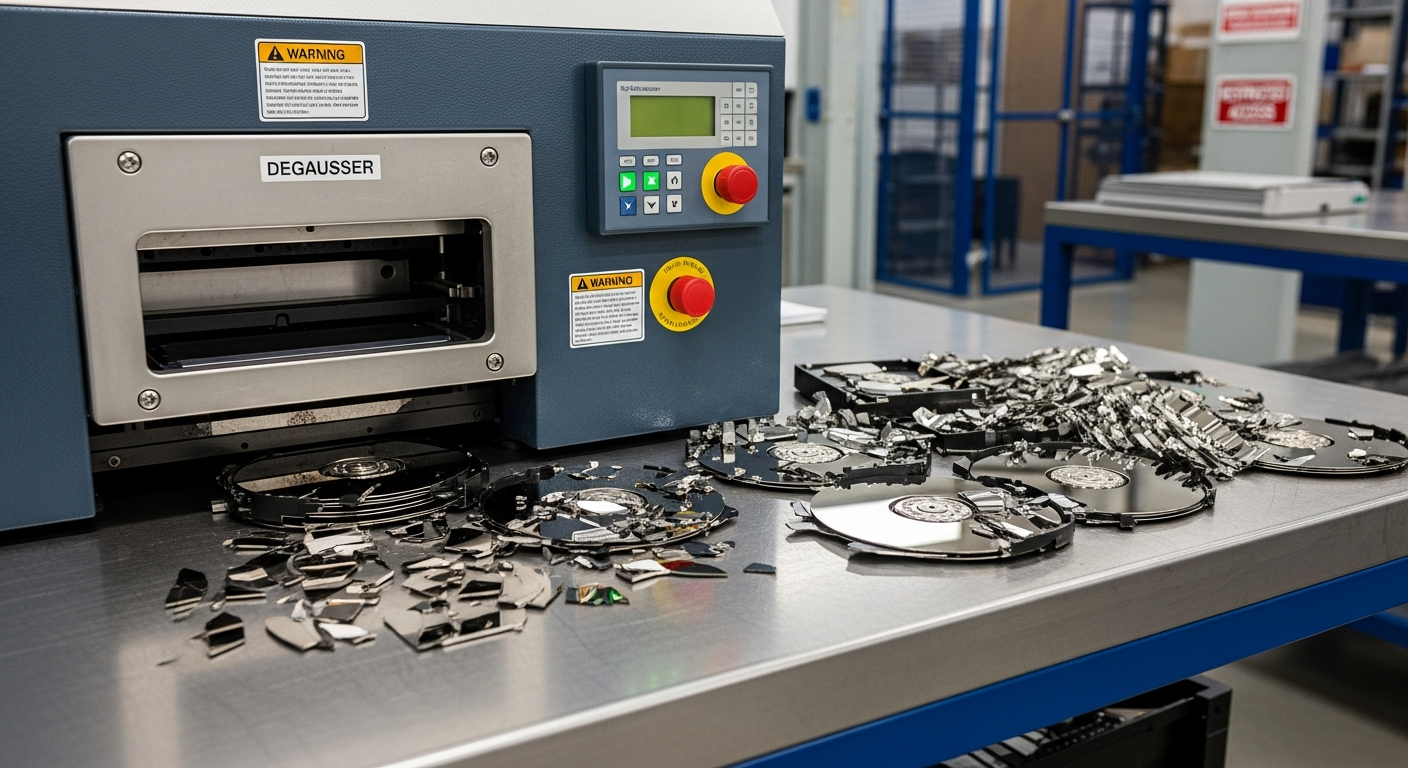
Hard Drive Shredding for Business Pickups in Des Moines, IA
Which of your retired drives can simply be shredded, and which need more? Precision E-Cycle draws that line from your data classification, logs serial numbers at intake, and settles pickup or an on-site shred in the project review. Pickup is free for qualifying business volumes.
When Is Hard Drive Shredding the Right Call in Des Moines?
Precision E-Cycle provides hard drive shredding for Des Moines organizations and reserves it for drive groups your data classification places in the lowest security categories, the limit NIST SP 800-88 Rev. 2 sets for shredding. Drives are collected from your Des Moines site and processed at Precision's only facility, in Lincoln, Nebraska.
Information security managers often inherit a drive list with no data category column, which stalls every shredding decision. Back-office drives can hold account data above the lowest category, so each group needs a recorded data classification before its method is chosen.
What Does Classification-Led Shredding Give a Des Moines Security Team?
A stated reason for every method
Each drive group carries the data category that sent it to the shredder or somewhere else. An auditor reading your file sees the policy decision behind the outcome, not only the outcome.
Traceability down to one drive
Intake logging and serialized reporting let your team follow any single drive from the list it built to the report line that closes it. Gaps surface as named exceptions instead of shrinking counts.
Management systems you can verify
Precision holds ISO/IEC 27001:2022 for information security management, together with ISO 14001, ISO 9001, and ISO 45001. Each appears on the certifications page for your vendor review file.
Request Service
Ready to Recycle?
Pickup is free for qualifying business volumes. Schedule yours or contact us with questions.
Related Services
Four Steps From Classification to a Reconciled Drive Report
Draw the shredding line
Your policy owner marks the highest data category each drive group held. The project review uses that mark to separate groups that suit shredding from groups that need a different destroy method, and it confirms certificate fields along with free pickup.
Log serials at intake
Each drive's serial number is logged at intake and matched to the list your team prepared. Agree in the review that missing or unreadable labels are recorded as exceptions, not dropped from the count.
Destroy by the agreed method
Groups below the line are shredded, in Lincoln after pickup or at your site when an on-site event is scoped. Groups above it follow the method set in the review, and degaussing is never counted as destruction.
Reconcile and report
Destroyed drives are reconciled to the intake log, and any mismatch is listed as an exception. You then receive serialized reporting and a free Certificate of Destruction in the format agreed during the review.
What Does a Des Moines Shredding Order Cover, and What Record Does It Leave?
A shredding order starts with a count, not a calendar date. Precision needs to know how many drives are involved, which media types they are, and which Des Moines addresses hold them today. Drives pulled during a laptop refresh, spares from a storage array, and dead units sitting in a locked cabinet all belong on the same list.
Media and data category decide whether shredding fits
Drives retired from banking operations can carry customer account data. Classification, not age or capacity, decides whether a drive goes to the shredder.
Drives still inside computers and servers
Are some drives still inside laptops, desktops, or servers? Say whether your team removes them first or lists them with the host device, because the serial list has to match what actually arrives. A server with several bays should show a separate line for each drive, tied to the host's own asset tag.
Serial logging at intake
The first checkpoint
Each drive's serial number is logged at intake, and serialized reporting closes the job. Ask in the project review for unreadable labels to be recorded as exceptions rather than skipped, so gaps stay visible on the record.
NIST SP 800-88 Rev. 2, section 4.6, says sanitization records work best when media is tracked as it enters service, when it leaves its last place of use, and when it reaches its final destination. A destruction certificate covers only the last point. Your asset records cover the first two, and the intake log is where they meet.
Fields to write into the order
- Manufacturer, model, and serial number for each drive, or a note where the label was unreadable
- Your property or asset tag number, where your organization assigns one
- Media type and the computer, server, or array the drive came from
- The sanitization method and technique applied to each drive group
- Name and title of the person who verified the work, with the date and location
Section 4.6 of Revision 2 lists these details, and it also names the pre-sanitization confidentiality category as an optional entry. Appendix C shows a sample certificate of sanitization built from the same fields. Precision agrees its certificate of destruction fields and format with you in the project review, so compare them with this list before the first drive moves.
How to specify a certificate of destruction
Key takeaway
Count the drives at each Des Moines address, sort them by media and data category, and fix the record fields before scheduling.
Where Does NIST Draw the Line on Shredding, and Where Does Your Policy?
The current federal reference for media sanitization is NIST SP 800-88 Revision 2, released in September 2025, which supersedes the prior revision. It is guidance, so following it does not make any provider NIST certified. Precision's data destruction methods are informed by it, while the method for each drive group rests on the classification your organization assigns.
What Revision 2 says
Revision 2 states: "Pulverize and shred techniques for ISM should be avoided for anything but the lowest security categories of data." ISM means information storage media. Shredding stays a legitimate choice, but only below that line.
Wondering whether a drive's brand, age, or capacity matters? The rule sets all three aside and turns on data categories, which is why a drive list needs a category column before anyone chooses a method.
Four answers from the July 2026 NIST FAQ
Read together, those answers narrow shredding rather than retire it. A drive whose data sits in the lowest security category can still be shredded, while a higher-category drive needs the destroy method your policy and the project review settle on. Precision records degaussing only as a purge step, not as destruction.
Choosing between purge and destroy for your media
Writing the shredding line into your policy
Write the line into your disposal policy in plain terms: which categories may be shredded, which need another destroy method, and how flash drives are handled apart from hard disks. Name the role that assigns each drive's category, and have that role record it on every drive group before the project review.
Which statutes and regulations govern your records is a question for your counsel and compliance staff, not Precision. Bring their conclusions to the project review so each drive group's classification reflects them, and confirm that no drive sits under a litigation hold before release.
What each reference changes in the order
Drive retirement planning for local law firms
Key takeaway
NIST marks where shredding stops being enough, and your classification decides which drives land on each side.
How Should Drives Across Des Moines Be Staged for Pickup or an On-Site Shred?
Stage drives by gathering them onto one list, and into one locked container per address, before any pickup is discussed. Downtown Des Moines holds municipal, county, state, and federal offices, and many private employers run several buildings across the metro, so retired drives drift into server rooms, branch offices, and storage closets.
- List every downtown and suburban address that holds retired drives
- Record serial number, media type, and whether each drive powers on
- Mark each drive's data category using your own scheme
- Bag flash drives (SSD, NVMe, M.2) separately from spinning hard disks
- Pull any drive under a legal hold or a pending decision before sealing
Searching for hard drive shredding near me from a Des Moines or West Des Moines office? Precision collects drives from each site for shredding in Lincoln. Name one contact who holds the combined list and reconciles counts from every building, so a drive moved between sites is neither counted twice nor missed.
Healthcare and public-sector drive owners
Healthcare is the metro's other large technology user: MercyOne reports 5,641 employees across hospitals and home care on the 2025 list. Drives from clinical settings can hold patient information that many policies rank above the lowest category, which points them away from shredding. Flag those groups before the project review.
Polk County, the city, the state, and several federal agencies all keep offices in downtown Des Moines. A public body may follow its own records retention and disposal procedures, so bring those to the review before any drive is classified for shredding.
Pickup day compared with an on-site event
After the shredder
Shredded material is not the end of the record. Precision routes it to R2-certified downstream processors for recycling, and the serialized report ties each destroyed drive back to its intake line. Keep that report beside your own asset records so each drive's history runs from purchase to final disposition.
Timing and cost both depend on the number of drives, how many addresses are involved, and whether an on-site event is requested, so they are agreed in the review rather than stated here. After destruction, the intake log becomes the reference for reconciliation. Any drive that appears in one record and not the other is reported back as an exception.
When drives cannot leave the building
Key takeaway
One list per address, one locked container, one signed handoff, and a single reconciled report across every site. Request a free quote for your drives today.
Hard Drive Shredding Questions From Des Moines Buyers
Request Service
Ready to Get Started in Des Moines?
Get a free quote or send us a message about your project, and we scope pickup and documentation around your site.