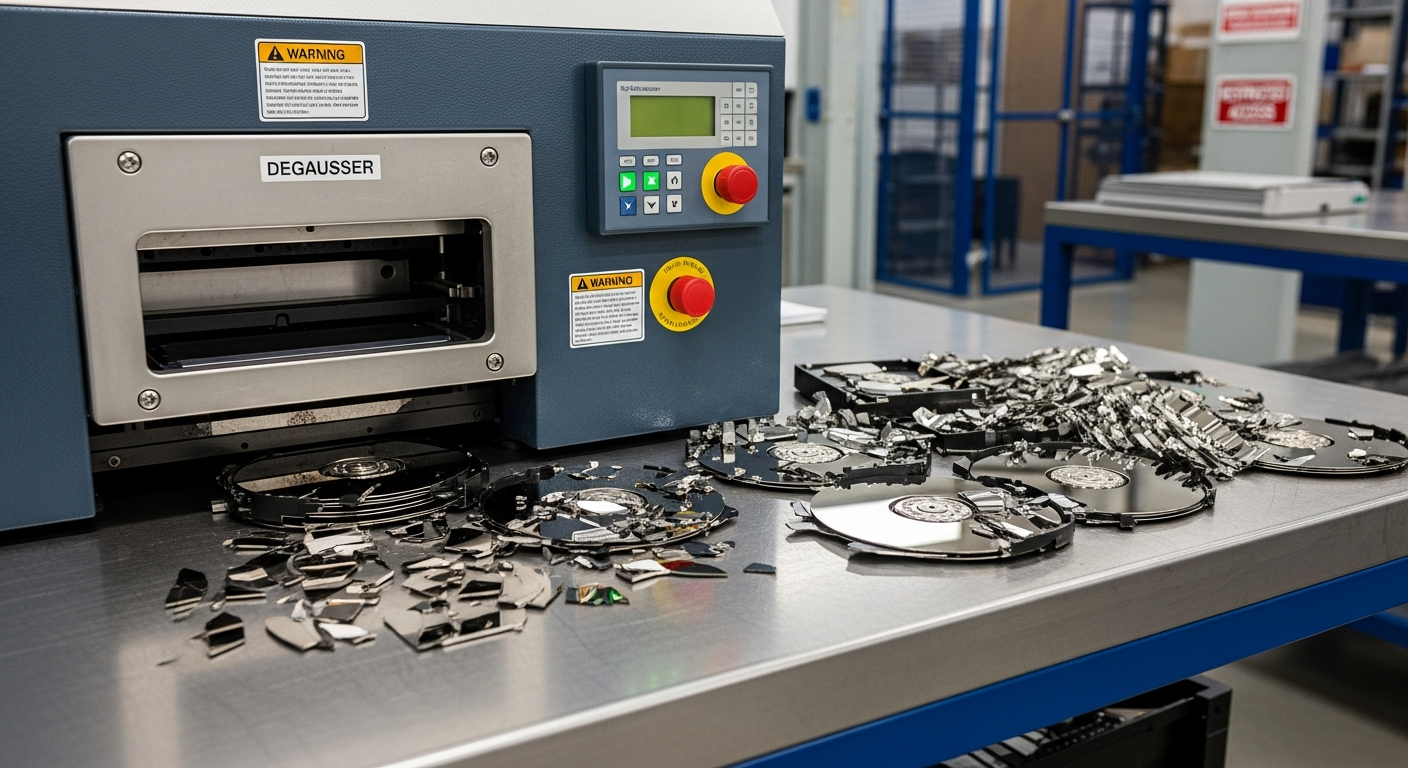
On-Site Data Destruction in Denver, CO
Does your policy bar intact drives from leaving a Denver building? Ask about on-site destruction at your Denver site. Precision E-Cycle scopes on-site options around your own witnesses, a signed event log, and a method matched to each media type, with secure pickup to Lincoln, Nebraska ready for everything else. Qualifying loads get free pickup.
What Is On-Site Data Destruction, and When Do Denver Organizations Need It?
Precision E-Cycle scopes on-site data destruction in Denver for organizations whose policy or client contracts bar storage media from leaving a building intact. Where an event is scoped for your site, media are destroyed at your premises while staff you name observe, with a method informed by NIST SP 800-88. Ask about on-site destruction at your Denver site, and we scope the options around your address.
For Denver security and compliance officers, the hard part is proving that media never left the building intact. Denver media is processed at Precision's secure Lincoln, Nebraska facility, so every retirement starts with a choice: scheduled pickup under a chain of custody record, or an on-site option scoped for your building. For covered entities, that choice belongs in the written disposal policy Colorado's statute calls for.
What Denver Security and Compliance Officers Gain From an On-Site Event
Destruction before media travels
Where an on-site event is scoped for your site, storage media are destroyed before they leave your Denver building. That removes the transit leg that some security policies and client contracts will not accept.
Witnesses drawn from your own staff
The people who observe and sign the event log are named by your organization. A Colorado disposal policy can then point to a record your own staff attested to, not only a document issued afterward.
ISO-certified management systems
Precision holds ISO/IEC 27001:2022 for information security management, plus ISO 14001, ISO 9001, and ISO 45001. Material left after a Denver event is routed to R2-certified downstream processors for recycling.
Request Service
Ready to Recycle?
Pickup is free for qualifying business volumes. Schedule yours or contact us with questions.
Related Services
How a Denver On-Site Destruction Event Is Planned and Recorded
Decide on-site or pickup
Share which Denver sites hold the media, rough counts by type, and the policy or contract that raises the on-site question. The project review scopes the on-site options for your site, which media they cover, and the method, alongside secure pickup to Lincoln.
Plan access and witnesses
Your team confirms the event address, staging area, dock and building access, and security sign-in. You name the witnesses who will observe and the contact who signs the event log, and the certificate fields are agreed at the same time.
Count, destroy, and observe
On the event day, staged media are counted against your inventory before destruction begins. Each group receives the agreed method while your witnesses observe, and the remains are checked before anyone signs the log.
Reconcile and document
The event log is reconciled against the inventory, with every exception written down. Destroyed material leaves under a chain of custody record and is routed to R2-certified downstream processors, and you receive a free Certificate of Destruction, with its form agreed in the review.
What Happens at a Denver On-Site Destruction Event, and What Records Remain?
What changes when destruction moves to your Denver site? Only where the destruction step happens. Instead of traveling intact to Precision's facility in Lincoln, Nebraska, the media are destroyed at your premises while your own staff watch. The inventory, the count, and the certificate still have to be planned and checked.
On-site event or pickup to Lincoln
Ask about your Denver site
On-site destruction in Denver is scoped one project at a time. Tell us your address, the media types, and your policy, and the project review scopes the event, the destruction method, and its coverage before anything is scheduled.
What happens during the event
An on-site event follows the same logic as a pickup project, compressed into one visit. Media are counted against your inventory and destroyed by the method agreed for each group. According to NIST SP 800-88 Revision 2, verification after a destructive method "involves inspecting the remnants of a destruction technique," and your witnesses see that check before signing.
- Staged media are counted against the inventory you prepared, group by group
- Any item missing from the list, or present but unlisted, is set aside and noted
- Each media group receives the destruction method agreed in the project review
- Your named witnesses observe the destruction and sign the event log
- Destroyed material leaves the site under a chain of custody record for recycling
What proof should you request when the event ends?
The event log shows what your witnesses saw, and the certificate of destruction is the lasting record. NIST SP 800-88 Revision 2 covers sanitization records in section 4.6, with a sample certificate in Appendix C. Precision issues a certificate of destruction, and its fields are set against that reference and your policy before the event.
- The event date, the Denver address, and who performed the destruction
- The media types and counts destroyed, matched to your staged inventory
- The method applied to each media group and how the result was checked
- The names of your witnesses and their signatures on the event log
- Serial numbers for each item, where the project review scopes that detail
Reading a Denver certificate of destruction field by field
Key takeaway
Decide which records your Denver auditors will ask for before the event date. Auditors reviewing a witnessed event typically expect a signed log, a reconciled count, and a certificate whose fields were agreed beforehand.
Does Colorado Law or NIST SP 800-88 Require Denver Media to Be Destroyed On Site?
Neither Colorado's disposal statute nor NIST SP 800-88 tells a Denver organization to destroy media on its own premises. Choosing an on-site event is a policy decision, usually driven by internal security rules, client contracts, or a data owner who wants to see the destruction. The law and the guideline shape the policy and the event record.
What C.R.S. 6-1-713 asks of covered entities
Colorado's statute applies to covered entities keeping paper or electronic documents with personal identifying information. They need a written disposal policy and must destroy those documents, or arrange their destruction, once no longer needed, subject to other law. It is not a universal device destruction rule, so it does not settle whether media is destroyed on site or after pickup.
Where the on-site choice is written down
If your Denver organization decides that certain media may not leave a building intact, that decision belongs in the written disposal policy itself. The on-site event then becomes the documented way the policy is carried out for those media groups.
What NIST SP 800-88 Revision 2 adds to the decision
NIST SP 800-88 Revision 2, published in September 2025, is guidance, not a certification, and Precision's methods are informed by it. Section 3.1 cautions that pulverize and shred techniques should be avoided for anything but the lowest security categories of data. So an on-site event does not mean every device is shredded; the method fits media type and data sensitivity.
- Written disposal policy: names the media groups that must be destroyed before leaving a Denver site
- Destroy or arrange destruction when no longer needed: an on-site event, or scheduled pickup to Lincoln
- NIST SP 800-88 outcome: a method matched to each media type and its data sensitivity
- Verification: the remains are checked at the event, and the check is recorded on the log
- Sanitization record: a certificate of destruction whose fields are set in the review with section 4.6 as the reference
When pickup to Lincoln is enough
Does every Denver retirement need an on-site event? No. If your policy lets intact media travel under chain of custody, scheduled pickup and destruction in Lincoln usually disrupts your site less. An event earns its place where policy, a client contract, or the data owner requires destruction to be seen before the media leave.
Denver public bodies and institutions with their own rules
The City and County of Denver is a consolidated city and county government, and a department inside it may follow records and purchasing rules of its own. Bring those rules to the project review, along with anyone who must sign as a witness, so the event log can name the roles they require.
Public sector media disposal planning
Universities and research data
Higher education is part of the Denver market, including the University of Colorado Denver. If a campus unit keeps research, student, or personnel records under its own disposal practice, share that policy before the review so the witness list and certificate fields reflect it.
Records disposal planning for Denver law firms
Key takeaway
When weighing an on-site event against pickup, Denver security officers usually start from the written policy, then client contracts, then disruption at the site. NIST SP 800-88 then shapes the method, and the event log shows the match.
Preparing a Denver Site for the Event Day
Ask about on-site destruction at your Denver address, and the project review scopes the event options first, alongside secure pickup to Lincoln. Preparation then means gathering media from every floor and metro address into one staged count, a sizable task for an organization with several sites.
Site access details to confirm in advance
- Which Denver address hosts the event and where the media will be staged
- Loading dock, freight elevator, and parking arrangements for the event team
- Building security sign-in, badges, and any escort requirements
- The space, power, and time the agreed destruction method needs at your site
- The named contact who signs the event log for your organization
Media types to identify before the event
List every kind of storage media in the Denver batch, even items you expect to handle another way. The project review scopes which of them an on-site event would cover, and by what method, so an early list keeps surprises off the event day.
- Media that still powers on, kept apart from units that failed
- Removable and external storage gathered from desks, drawers, and storage rooms
- Backup media from retention cycles that have reached their end date
- Devices returned by departing Denver staff that still hold company data
- Storage pulled from retired computers, tagged by the business unit that used it
Check the storage items Precision accepts
Roles on the day of the event
UCHealth's FY2024 Metro Denver fact sheet lists 830 available beds at University of Colorado Hospital. In clinical settings like these, retired devices can hold patient information, and patient care areas may limit when an event can run. Plan around those limits in the project review, where timing is scheduled around your site.
Everything else goes by pickup
Media outside the on-site scope leaves your Denver site by scheduled pickup. It travels intact under chain of custody to Precision's secure facility in Lincoln, Nebraska, where serial numbers are logged at intake and the agreed method is applied.
After the event: closing the record
Once the log is signed, the remaining work is reconciliation. Compare the event log with your asset register and retire each destroyed item there, so no Denver device stays listed as in service. File the certificate of destruction with the written disposal policy it supports, and note any media that left by pickup instead.
Why the signed log carries weight
Section 4.6 of NIST SP 800-88 Revision 2 says an organization can best judge its sanitization program when records exist as media enters use, reaches its final destination, and "when it leaves the place where it was last used." At an on-site event, your signed log captures that moment and the destruction together.
When hard drive shredding fits a Denver project
Choosing a data destruction method in Denver
Key takeaway
A reconciled inventory, a confirmed access plan, and named witnesses are most of a successful Denver event. The destruction step depends on all three, so ask about on-site destruction at your Denver site today. Request a free quote to scope your event.
Denver On-Site Data Destruction Questions
Request Service
Ready to Get Started in Denver?
Get a free quote or send us a message about your project, and we scope pickup and documentation around your site.