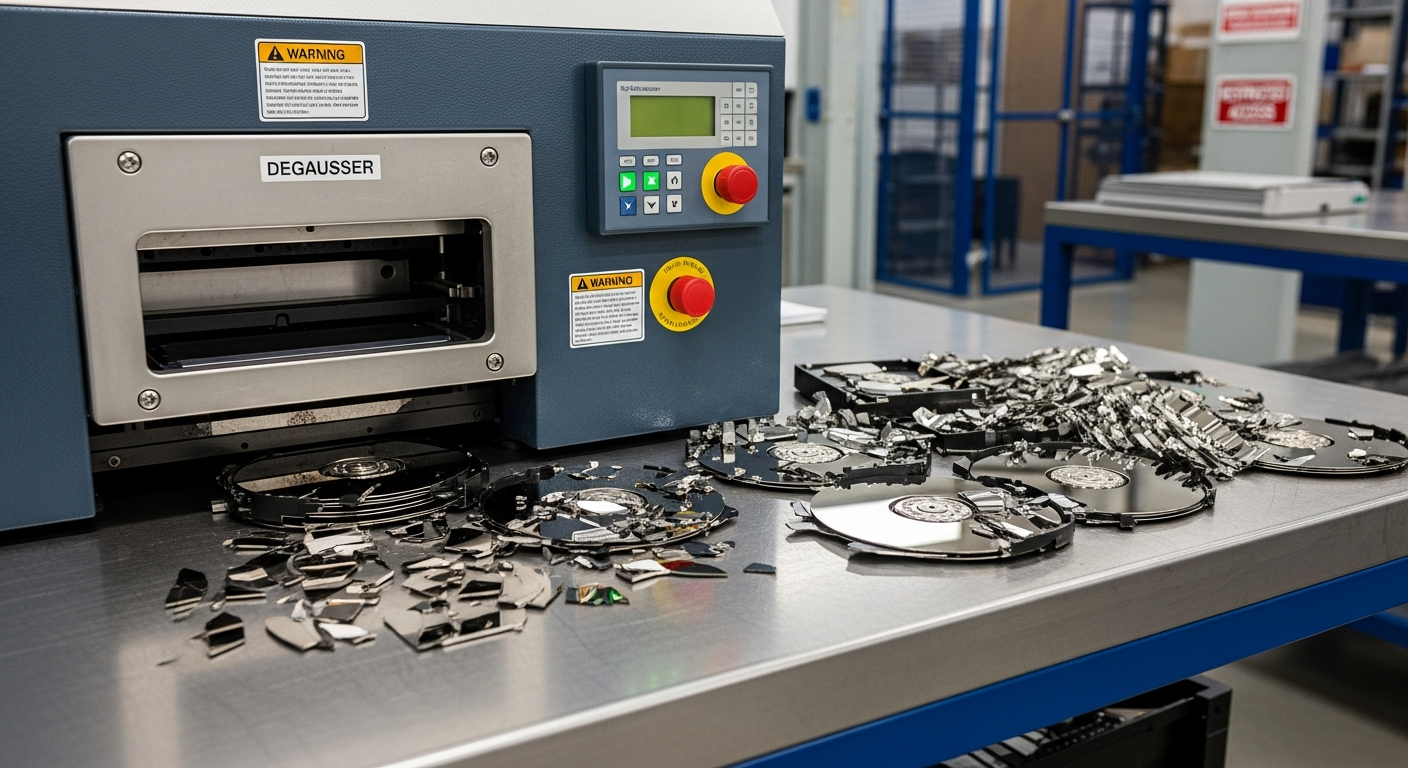
Data Destruction in Denver, CO
Retiring drives, phones, and tape from Denver offices without a clear rule for which to wipe and which to destroy? Precision matches the method to each media type and data sensitivity, informed by NIST SP 800-88, and records custody from pickup to processing in Lincoln. Qualifying business volumes get free pickup.
What Is Data Destruction, and How Do Denver Organizations Choose a Method?
Data destruction in Denver means sanitizing retired storage media so that recovering the data is infeasible for a given level of effort, which is how NIST SP 800-88 defines sanitization. Precision E-Cycle provides it for Denver security and privacy teams: Denver and Front Range businesses schedule pickup, and Precision processes the media at its secure Lincoln, Nebraska facility.
For information security leaders and privacy officers, the hard part is rarely destroying a drive; it is showing an auditor why each drive received its method. Any Denver employer that retires devices holding customer or employee data faces that question. Colorado's C.R.S. 6-1-713 adds a written disposal policy duty for covered entities.
What Denver Security and Compliance Teams Gain
A method choice you can explain
Your auditor sees why each media group received its method, not only that drives were destroyed. The reasoning traces back to NIST SP 800-88 and to the sensitivity of the data your Denver teams held.
Evidence for a Colorado disposal policy
A covered entity under C.R.S. 6-1-713 needs a written disposal policy. Chain of custody records and a certificate of destruction give that policy something concrete to point to when media leave Denver sites.
ISO management systems on record
Precision holds ISO/IEC 27001:2022 for information security management, plus ISO 14001, ISO 9001, and ISO 45001. Ask in the project review which activities each certificate scope covers. Material recycled after sanitization is routed to R2-certified downstream processors.
Request Service
Ready to Recycle?
Pickup is free for qualifying business volumes. Schedule yours or contact us with questions.
Related Services
How a Denver Data Destruction Project Moves From Review to Record
Scope and sensitivity review
You describe the media types, rough counts, which Denver addresses hold them, and the most sensitive data each group carried. The review sets the pickup plan, the outcome for each group, and which fields the certificate of destruction will carry.
Count and custody at pickup
Media are counted against your list before they leave your building, and the handoff is recorded on a chain of custody document. The shipment then travels from Denver to Precision's facility in Lincoln, Nebraska.
Sanitize or destroy by media group
Each group receives the method agreed in the review: clear or purge for media that may be reused, a destroy method for failed media or data that must not survive. Methods are informed by NIST SP 800-88 and the result is verified.
Reconcile and document
Results are reconciled with the pickup count, and any mismatch is flagged rather than closed quietly. You receive a certificate of destruction whose fields, including any serial-level detail, were set in the project review against your policy.
What Does Denver Data Destruction Cover, and What Records Do You Receive?
Which media does a Denver data destruction request involve? Usually several kinds at once: laptop drives from a refresh, SSDs pulled from servers, phones from departing staff, and a few cartons of backup tape. Treating that mix as one pile is how reusable drives get shredded while sensitive ones get only a quick wipe.
The three outcomes NIST SP 800-88 describes
Shredding is not the default
According to NIST SP 800-88 Rev. 2, section 3.1, pulverize and shred techniques "should be avoided for anything but the lowest security categories of data." Precision matches the method to each media type and to your data sensitivity rather than shredding everything by habit.
How each outcome is verified
NIST SP 800-88 treats verification as part of media sanitization, not an optional extra. For clear and purge, verification confirms the media no longer returns the original data; for a destroy method, it means inspecting what remains. Ask in the review how each media group leaving your sites will be verified, because the answer belongs on the record.
Media groups that usually need their own plan
- Hard drives from desktop and laptop refreshes, split into working and failed units
- SSDs and NVMe drives from laptops and servers, which hold data on flash chips
- USB flash drives, memory cards, and external drives collected from desks
- LTO and other magnetic tape from backup rotations
- Smartphones and tablets returned by departing staff
Each group in that list is on Precision's accepted items list. What changes from group to group is the outcome, the method that reaches it, and how the result is verified. Teams that sort the media before the review usually get a plan with fewer exceptions to explain later.
Storage media Precision accepts
What should a sanitization record identify?
Section 4.6 of NIST SP 800-88 Revision 2, with the sample certificate in its Appendix C, is the practical reference for what a sanitization record should identify. Precision issues a certificate of destruction, and the fields it carries, including any serial-level detail, are agreed with you before pickup. Compare that list against your written policy before pickup, not after.
- The media type and, where scoped, the serial number of each item
- The outcome reached for each item: clear, purge, or destroy
- The method and tool used, and how the result was verified
- The date of sanitization and who performed it
- A reference that ties the record back to your pickup and custody documents
What a Denver certificate of destruction should list
Key takeaway
Security auditors typically expect a recorded method decision for each media group, not one line saying the drives were destroyed. Decide the outcome first, because a certificate only proves what was done.
How Do Colorado's C.R.S. 6-1-713 and NIST SP 800-88 Apply to Retired Media?
Colorado's disposal statute and the NIST guideline answer different questions. The statute tells covered entities they need a written disposal policy. NIST SP 800-88 gives that policy a technical vocabulary for how media are actually sanitized in practice.
What Colorado's disposal statute requires
C.R.S. 6-1-713 applies to covered entities that keep paper or electronic documents containing personal identifying information. It calls for a written policy for disposing of those documents and for destroying them, or arranging their destruction, once they are no longer needed, unless other law provides otherwise. It is not a blanket rule that every data-bearing device be physically destroyed.
What the statute leaves to your policy
C.R.S. 6-1-713 names shredding, erasing, or otherwise modifying the information, but it sets no device list or particle size. Your written policy fills that gap, and a method choice informed by NIST SP 800-88 is one well-documented way to fill it.
Where devices enter the Colorado picture
Electronic documents with personal identifying information often sit on laptop drives, file server arrays, and phones. When a Denver covered entity retires those devices, its written policy should say how the data on them is handled, even though the statute does not require destroying the hardware. That distinction lets a drive be purged and reused where the policy allows it.
What NIST SP 800-88 Revision 2 adds
NIST published Revision 2 in September 2025 as the current guideline. Because it is guidance rather than a certification scheme, no provider holds a certificate under it; Precision uses methods informed by NIST SP 800-88. Revision 2 centers on an organization's sanitization program: who decides the method, how results are verified, and what gets recorded.
- Written disposal policy under C.R.S. 6-1-713: the scope review records which media groups the policy covers
- Destroy or arrange destruction when no longer needed: scheduled pickup, with a recorded handoff
- NIST outcome by media and sensitivity: a clear, purge, or destroy decision for each group
- NIST caution on shredding: shredding kept to the lowest data categories where it fits
- NIST records guidance in section 4.6: a certificate whose fields are agreed in the review
Denver organizations that bring their own rules
Departments of the City and County of Denver operate under a consolidated city and county government with its own records and purchasing practices. A department retiring media should bring those requirements to the project review. The method and the certificate can then be set against them from the start.
Universities and other public institutions
Institutions such as the University of Colorado Denver typically keep records retention and disposal practices of their own. Bring the relevant policy to the review so the outcome for each media group and the certificate fields are matched to it.
When another law sets a different rule
The Colorado statute defers to other state or federal law where that law sets a different requirement. If a sector rule applies to your organization, name it in the project review. The method and the records can then be set to that rule as well as to your written policy.
Key takeaway
The Colorado statute asks for a policy, NIST SP 800-88 shapes the method, and the records show the two match. Keep all three in the same file.
Preparing Denver Media for Pickup and What Happens on Pickup Day
Retiring media from more than one Denver metro address? Pull every address into one count before the review, so a forgotten closet does not become a gap in the record. Metro sites can sit outside the city itself: the Denver Federal Center in Lakewood, for example, is a multi-agency federal campus.
- Count media by type: hard drives, SSDs, flash media, tape, and phones
- Note which devices failed and which still power on
- Mark the most sensitive data each group held
- Match serial numbers you already track in your asset register
- Keep the media in a locked container until the handoff
Before a device leaves the desk
In the metro's healthcare sector, led by systems such as UCHealth, whose FY2024 Metro Denver fact sheet reports 14,815 employees, retired phones and laptops can hold patient information long after clinical use ends. Record whether each device was encrypted, because encryption can make a purge by cryptographic erase available. That note matters most when the device may be reused.
Healthcare media disposal considerations
Who handles what, before and after pickup
Where is the media destroyed? Denver and Front Range businesses schedule pickup, Precision records the handoff on the chain of custody document, and the agreed method is applied at its secure Lincoln, Nebraska facility. Timing is scheduled around your volume in the review.
Because destruction happens in Lincoln rather than in Denver, the custody record for the trip matters as much as the certificate. Precision logs serial numbers at intake in Lincoln, and the project review sets how containers are identified in transit and how the count is rechecked on arrival.
Our Denver sales office at 999 18th St, Denver, CO 80202 coordinates local inquiries and pickup scheduling, while all media sanitization and destruction happen at our Lincoln, Nebraska facility.
What the project review sets for you
- The pickup plan for each Denver address
- The outcome and method for each media group
- Which fields and serial detail the certificate will carry
- How custody is recorded at the handoff and on the way to Lincoln
- How any media beyond Precision's accepted items list is handled
If media must stay on your premises
Some Denver policies do not allow storage media to leave a building intact. If yours is one of them, ask about on-site destruction at your Denver site before scheduling, and see how on-site options are scoped.
On-site data destruction in Denver
Denver hard drive shredding and when it fits
Key takeaway
When comparing data destruction providers, ask each one in writing for the method per media group, the verification step, and the certificate fields. A counted, sorted, locked container then gives every line on the final record something to be checked against. Request a free quote to scope your media.
Denver Data Destruction Questions
Request Service
Ready to Get Started in Denver?
Get a free quote or send us a message about your project, and we scope pickup and documentation around your site.