Hard Drive Shredding for Business Pickups in Denver, CO
Is shredding enough for the drives your Denver teams are retiring? Precision E-Cycle matches each drive group to a destroy method by media type and data classification, logs serials before anything is destroyed, and schedules secure Denver pickup, free for qualifying business volumes. Ask about on-site destruction at your Denver site, too.
What Is Hard Drive Shredding, and Which Denver Drives Still Suit It?
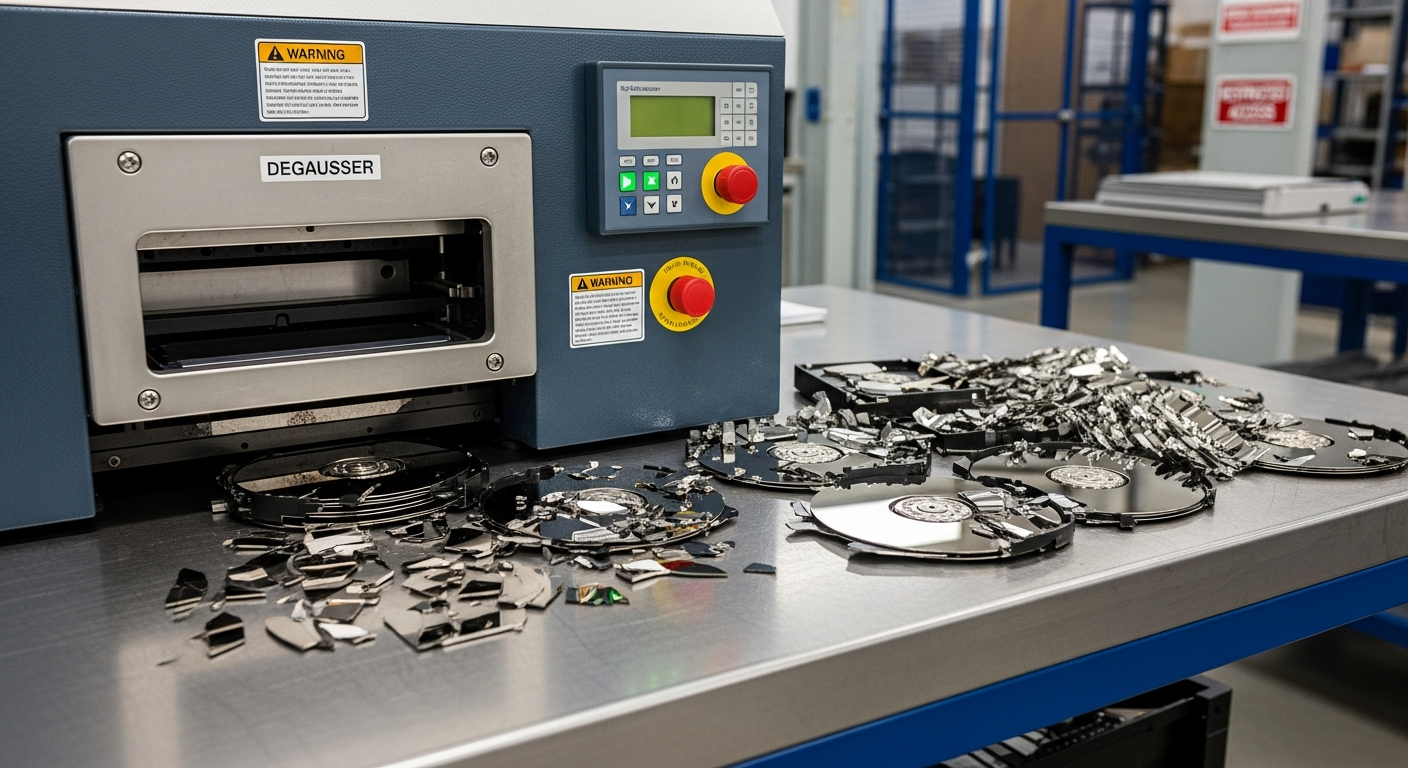
Hard drive shredding in Denver is the physical destruction of retired drives. Precision E-Cycle provides it for Denver security teams using methods informed by NIST SP 800-88 Revision 2. Our Denver sales office at 999 18th St, Denver, CO 80202 coordinates pickup for processing at our secure Lincoln, Nebraska facility, or ask about on-site destruction.
An information security manager retiring Denver drives faces two decisions: which drives can still be shredded, and how to prove what happened to each. NIST's July 2026 FAQ on SP 800-88 Revision 2 notes that pulverizing and shredding fall short for medium- and high-security categories because of data density on modern media. So classification comes before any shredding date is set.
What Denver Security Teams Gain From Classification-Led Shredding
Shredding only where it holds up
Drives in the lowest data categories are shredded, while higher-category drives are not left relying on a technique NIST now calls ineffective for them. Your Denver policy can show why each group received its method.
A serial trail from desk drawer to remnant
Serial numbers logged at intake and carried into serialized reporting let an auditor follow any single drive from the list your Denver team built to the certificate that closes it out.
Information security management you can check
Precision holds ISO/IEC 27001:2022 for information security management, along with ISO 14001, ISO 9001, and ISO 45001, each listed on the certifications page for your vendor review file.
Request Service
Ready to Recycle?
Pickup is free for qualifying business volumes. Schedule yours or contact us with questions.
Related Services
How a Denver Drive Shredding Job Runs, From Classification to Evidence
Classify before choosing shredding
Share drive counts by media type, which drives still power on, and the highest data category each group held. The review sorts groups into those that suit shredding and those that need another method, and sets the pickup plan, any on-site options you ask about, and the certificate fields.
Hand over the list, log serials at intake
Your drive list travels with the drives, and your contact signs the chain of custody record at handoff, or the event log if on-site shredding is scoped for your site. Precision logs serial numbers against that list at intake, before any drive is destroyed, and the review sets whether serials are also read at your Denver site.
Destroy each group by its agreed method
Groups classified for shredding are shredded, and higher-category groups receive the destroy method set in the review. The equipment and method for your media, and how the result is verified, are agreed there in writing.
Report by serial and issue the certificate
You receive serialized reporting and a free Certificate of Destruction with the fields agreed in the review, so your team can match every destroyed drive to its own Denver list and raise any gap before closing the job. Shred remnants move to R2-certified downstream processors.
What Happens Inside a Denver Shredding Job, and What Evidence Remains?
Planning a shredding job for Denver drives? Expect a container of loose drives, not a tidy list. Laptop, array, and server drives each retire on their own cycle. Before anything is shredded, that container has to become drive groups, each with a serial list behind it.
Which drive groups suit shredding?
Drive and flash media types Precision accepts
Shredding is one method, not the answer
Precision matches the destroy method to each drive's media type and to the data classification your policy assigns it. Shredding is used for the groups where it fits, and the review records why every other group received something different.
Where the shredding happens
Denver and Front Range businesses schedule pickup, and drives travel under a signed chain of custody record to Precision's secure facility in Lincoln, Nebraska. Where policy bars drives from leaving intact, ask about on-site destruction at your Denver address, and the project review scopes the method and equipment around your site.
When Denver drives must be destroyed on site
Evidence to specify before the first drive is shredded
According to section 4.6 of NIST SP 800-88 Revision 2, a certificate of sanitization should be completed for each sanitized drive. Its listed details include an optional pre-sanitization confidentiality categorization, the field that ties a shredding decision to a data category. Precision's certificate of destruction fields are agreed during scoping, so write yours into the scope first.
- Each drive's serial number, or a note where the label could not be read
- The media type of each drive: hard disk, SSD, NVMe, or other flash
- The destroy method applied to each drive group, the data category behind it, and how the result was verified
- The date and place of destruction and the person who performed it
- A reconciliation of destroyed drives against the drive list handed over in Denver
Field-by-field guide to a Denver certificate of destruction
Key takeaway
Auditors reviewing a shredding job usually expect the data category, the method, and the serial number on one record. Classify first, because a certificate can only prove the method your review chose.
Where Do NIST SP 800-88 Revision 2 and Colorado's Disposal Statute Draw the Shredding Line?
Two NIST documents and one Colorado statute shape how a Denver organization should think about shredding. NIST SP 800-88 Revision 2, published in September 2025, is the current media sanitization guideline and replaces the earlier version. Following it is not a certification, because it is guidance, and Precision's data destruction methods are informed by NIST SP 800-88 Rev. 2.
What Revision 2 says about shredding
Section 3.1, in NIST's words
Per NIST SP 800-88 Revision 2, section 3.1, pulverize and shred techniques for information storage media "should be avoided for anything but the lowest security categories of data." The section ties this to rising data density and harder component materials in modern drives.
What the July 2026 NIST FAQ adds
- Q10: pulverizing and shredding fall short at medium- and high-security categories, with data density on modern media given as the reason
- Q10: for those higher categories, the FAQ points to incineration, such as melting, for media like SSDs
- Q11: the IEEE 2883 standard deprecates shredding and pulverizing as approved destruction methods for all modern hard drives and SSDs, and lists melting
- Q8: degaussing is a purge technique for legacy magnetic media, not a true destroy method
- Q8: degaussing can fail on flash memory and on hybrid drives that carry flash components
None of this rules out physical media destruction. It narrows shredding to drives whose data sits in the lowest categories, which is why classification comes before any method is chosen. For a Denver drive group above that line, the destroy method is agreed in the project review, and degaussing is treated only as a purge technique for magnetic media, not as a substitute for destruction.
Colorado's disposal statute, section 6-1-713
Section 6-1-713 of the Colorado Revised Statutes covers entities that keep paper or electronic documents containing personal identifying information. Such an entity needs a written disposal policy and destroys those documents, or arranges their destruction, once no longer needed, subject to other law. It is not a blanket rule that every data-bearing drive be physically destroyed.
Record the shredding decision in your policy
If your Denver organization is a covered entity, its written disposal policy is the natural place to name the data categories that may be shredded and the ones that need another method. The certificate then shows the policy was followed.
How each reference shows up in a Denver shredding job
- Written disposal policy under section 6-1-713: the review records which drive groups held covered documents
- Destroy or arrange destruction: scheduled pickup to Lincoln, or an on-site option scoped for your site
- Revision 2, section 3.1: shredding kept to drive groups classified in the lowest security categories
- NIST FAQ Q10 and Q11: higher-category groups routed to another destroy method agreed in the review
- Revision 2, section 4.6: certificate fields fixed before pickup and reconciled against your serial list
Public bodies in Denver often bring disposal rules of their own. Departments of the consolidated City and County of Denver answer to a single government's records practices rather than separate city and county ones. Bring those rules to the project review so the classification of each drive group reflects them.
Drive disposal planning for Denver law firms
Key takeaway
When evaluating shredding providers, Denver security teams tend to ask which data categories each method covers and what the certificate records. Put section 3.1 and your Colorado disposal policy in the scope before a date is set.
Staging Denver Drives for Pickup or an On-Site Shred
Loose drives in a Denver organization collect in more places than anyone expects: a locked cabinet in the IT room, a desk drawer at a branch office, a box of spares beside a storage array. Multi-site employers across the metro may hold them at several addresses at once. Gathering every drive into one counted, locked container is the first job.
- Pull drives from every Denver address onto one list before the review
- Record the serial number, media type, and whether each drive powers on
- Mark the highest data category each drive held, using your own classification scheme
- Keep SSD, NVMe, and M.2 drives apart from hard disk drives
- Lock the container and name one person who holds the key until handoff
Drives from regulated corners of the metro
Healthcare drives deserve a separate look. In the metro's hospital sector, led by systems such as UCHealth, whose FY2024 metro fact sheet lists 830 available beds at University of Colorado Hospital, retired drives can hold patient records that most policies place well above the lowest category. Flag those groups early, since the NIST FAQ points them away from shredding.
Federal tenants in Lakewood
The Denver Federal Center in Lakewood brings many federal agencies onto one campus. Drives from agency tenants may come with disposal procedures of their own, so raise them in the review before any drive is classified for shredding.
Public sector drive disposal planning
Pickup day or on-site day
How long does a Denver shredding job take? Timing depends on drive volume, the number of Denver addresses, and any on-site event, so it is scheduled with you in the review. After destruction, your team matches the drive list handed over in Denver against the serialized reporting and raises any gap before the job closes.
Choosing between purge and destroy for Denver media
Key takeaway
One list, one locked container, and one signed handoff give every line on the final Denver record something to be checked against. Request a free quote for your Denver drives today.
Denver Hard Drive Shredding Questions
Request Service
Ready to Get Started in Denver?
Get a free quote or send us a message about your project, and we scope pickup and documentation around your site.