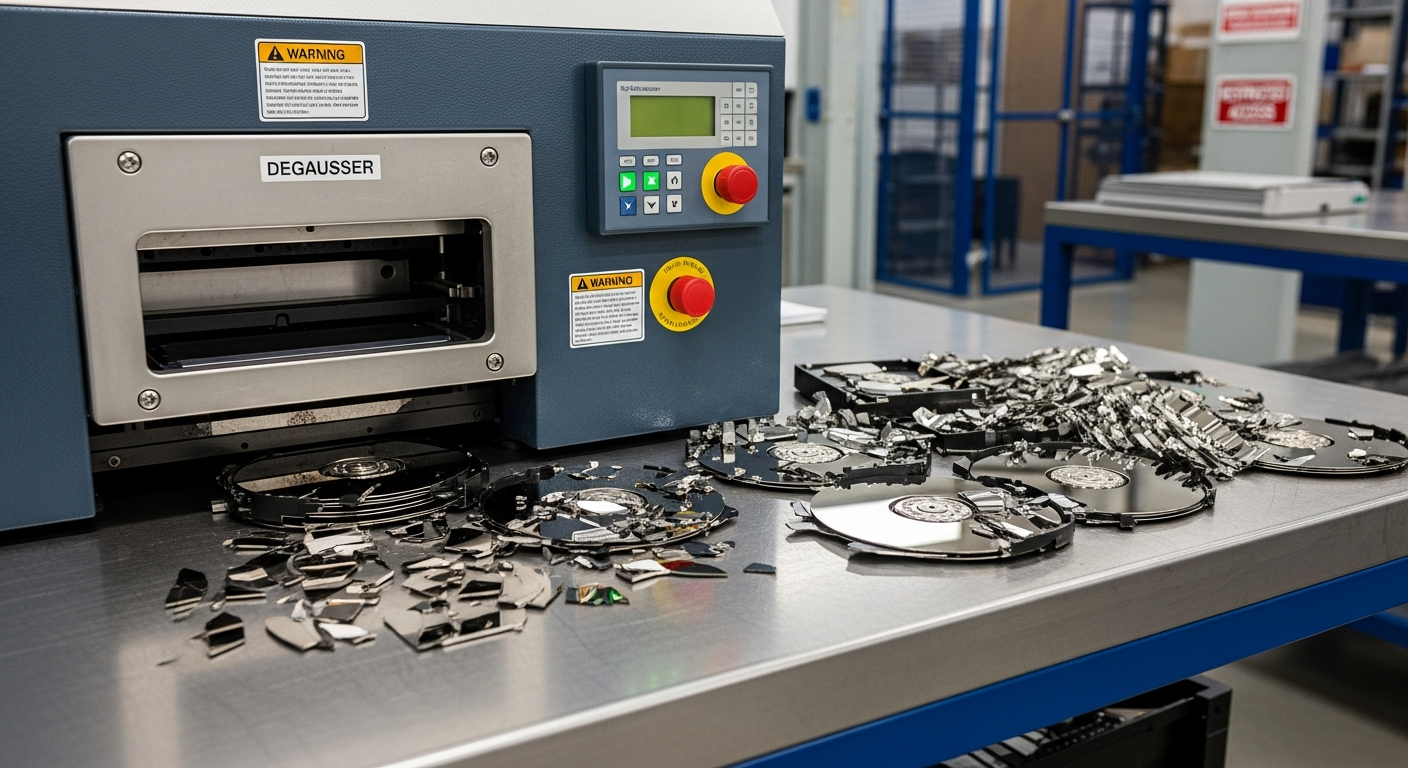
Data Destruction in Arvada, CO for Retired Business Media
Retiring drives that hold Colorado personal identifying information? Precision E-Cycle gives Arvada organizations destruction matched to each media type, with custody records that back up your written disposal policy. Pickup is free for qualifying business volumes.
What Does Data Destruction Involve for an Arvada Organization?
Data destruction is the documented sanitization or physical destruction of the storage inside retired equipment. Precision E-Cycle provides it for Arvada organizations, matching a method informed by NIST SP 800-88 to each hard drive, SSD, flash device, and tape. Arvada and Front Range businesses schedule pickup, and we process the media at our secure Lincoln, Nebraska facility.
Privacy officers and IT leads in Arvada often own the disposal question without a dedicated security team behind them. Colorado ties the written disposal policy to the personal identifying information an organization keeps, so five old drives that held it fall under the same policy as a full refresh.
What Arvada Privacy and IT Teams Gain
Records that answer your own policy
Colorado asks covered entities to keep a written disposal policy. Custody records and the certificate of destruction are scoped so each promise in that policy has a document behind it. When an auditor asks how a clause was met, the answer is a document, not a recollection.
Destruction named in the contract
Colorado's C.R.S. 6-1-713 (summarized by the Colorado Attorney General at coag.gov/resources/data-protection-laws/) requires covered entities to maintain a written policy for destroying or properly disposing of documents containing personal identifying information. A Precision data destruction project puts destruction in the written scope from the first review so your contract and records match your policy.
Information security you can check
Before you sign, ask to review the scope of Precision's ISO/IEC 27001:2022 information security certificate, along with its ISO 14001, ISO 9001, and ISO 45001 certificates. Precision routes applicable material to R2-certified downstream processors.
Request Service
Ready to Recycle?
Pickup is free for qualifying business volumes. Schedule yours or contact us with questions.
Related Services
How Arvada Media Moves From Your Office to a Certificate
Policy and media review
We start with your written disposal policy and a list of the media in scope. The review settles which devices go to destruction, which your team may sanitize for reuse instead, and the pickup plan for your site, free.
Pickup under a custody record
Media leaves your Arvada site under a pickup record that names what was collected and who released it. The record travels with the load to Lincoln, where each device is logged by serial number before any processing begins.
Destruction matched to the media
Each device is destroyed or sanitized by a method chosen for its media type and your data sensitivity. Magnetic drives, flash storage, and tape fail in different ways, so one technique is not applied to everything.
Certificate and project close-out
You receive a free Certificate of Destruction and the custody records for the project. Which fields the certificate carries, and whether it lists devices one by one or by lot, is agreed up front so the record lines up with your policy.
What Does an Arvada Destruction Project Cover, Drive by Drive?
Will this hardware be used again? That is the first question a destruction project asks of each device. NIST SP 800-88 defines three sanitization methods, clear, purge, and destroy, and only destroy leaves the media unusable. When media is not planned for reuse, NIST notes that destroying it can be the simplest method.
The media that needs a decision
- Hard disk drives: magnetic media, where degaussing may purge but is not a NIST destroy technique
- SSDs, NVMe, and M.2 drives: flash storage that degaussing cannot sanitize at all
- USB flash drives and memory cards: small, easy to lose, and easy to leave off asset lists
- LTO and other magnetic tape: backup sets that can outlive the systems that wrote them
- Drives inside servers and RAID arrays: often several per chassis, each with its own serial
- Drives inside multifunction printers and copiers: storage people forget is there
Storage media Precision accepts for processing
NIST SP 800-88 Rev. 2 says destroy techniques "render target data recovery infeasible using state-of-the-art laboratory techniques." That standard is why the record should name the technique used, not just say a drive was destroyed. Destruction also covers drives that have failed and will not be reused.
Where cryptographic erase fits
NIST treats cryptographic erase as a purge technique when its preconditions are met. That makes it a reasonable first step for a sensitive SSD before it leaves your office, but not a substitute for a record of what was done.
NIST also leaves the final judgment with the data owner. After sanitization, your organization decides whether the remaining risk is acceptable. In an office without a dedicated security team, that call falls to whoever owns the disposal policy, so the method and its evidence belong in that policy.
What records does an Arvada destruction project produce?
- A pickup record listing what left your Arvada site, signed by the person who released it
- A serial number log made at intake in Lincoln, before any processing begins
- A certificate of destruction for the project, with its fields agreed in the review
- Reporting by device or by lot, whichever the project review sets
- Custody records that tie the certificate back to the signed pickup record
Tailored to your policy
Certificate fields and whether devices are listed individually are agreed before pickup. Ask for a sample certificate first, then check it against the fields your policy names.
See how a certificate of destruction is laid out
Shredding is one hard drive destruction technique, not the whole answer for every drive in a mixed batch. The regional shredding page covers that method in more depth.
Hard drive shredding in the Denver metro
Questions to ask any destruction provider before you sign
- Which destruction or sanitization method applies to each media type in my inventory?
- Does the contract name destruction, not only recycling?
- Can I review a sample certificate of destruction before the first pickup?
- How is custody recorded between my site and the processing facility?
- Where does leftover material go once the storage is destroyed?
- Which information security certification covers the process, and can I see its scope?
Key takeaway
Privacy officers typically expect two things from a destruction vendor: a recorded method for each media type, and a certificate that traces back to the pickup.
Which Parts of Colorado's Disposal Law and NIST SP 800-88 Shape an Arvada Project?
Under C.R.S. 6-1-713 (summarized by the Colorado Attorney General at coag.gov/resources/data-protection-laws/), a covered entity that maintains paper or electronic documents with personal identifying information must keep a written policy for their destruction or proper disposal once no longer needed, such as shredding, erasing, or otherwise modifying the information so it cannot be read.
Whose duty it is
The duty sits with the organization that owns the information: your legal counsel confirms how C.R.S. 6-1-713 applies to your entity. A destruction vendor supports your written policy and records; it does not replace them.
What the statute counts as personal identifying information
- Social security numbers and personal identification numbers
- Passwords and pass codes
- Driver's license or identification card numbers, and passport numbers
- Biometric data, as the statute defines it
- Employer, student, or military identification numbers
- Financial transaction devices, as the statute defines them
Ordinary HR, payroll, and enrollment systems hold several of those items. Student identification numbers are on the list, which matters in education settings: Red Rocks Community College reports 13,540 total enrollment and lists an Arvada campus. Because the statute covers electronic documents, the drives behind those systems fall inside a policy's scope.
Media disposal planning for schools and colleges
What an Arvada disposal policy should spell out
- Which paper records, devices, and storage media hold personal identifying information
- The point at which a record counts as no longer needed, tied to your retention schedule
- The approved sanitization or destruction method for each media type you use
- Who may release media and who may contract an outside firm for destruction
- That outside contracts name data destruction in the written scope, not only general recycling, so vendor verification matches your policy
- Which documents prove destruction, and where your organization keeps them
- Any federal or state regulator whose disposal rules take priority
From policy wording to the record that backs it
Under C.R.S. 6-1-713, regulated entities that follow their state or federal regulator's disposal procedures can align their written policy with those rules; your counsel confirms how the statute applies. Healthcare is a common example: Intermountain Health Lutheran Hospital in neighboring Wheat Ridge listed 226 licensed beds in its opening announcement, and medical providers answer to federal patient data rules first.
Where NIST SP 800-88 fits
NIST SP 800-88 Revision 2, published in September 2025, is the current federal guidance on media sanitization. It helps you choose a method; it is not a certification any vendor holds. Its section 3.1.3 says pulverize and shred techniques "should be avoided for anything but the lowest security categories of data." Methods are set per media type and sensitivity.
Key takeaway
Your policy, your contract, and your records should all name the same thing: destruction, by a stated method, for each media type you retire.
Preparing Arvada Media Before Pickup Day
Arvada and Front Range businesses schedule pickup, and we process the media at our secure Lincoln, Nebraska facility. Your media therefore leaves your control before it is destroyed, a handoff NIST SP 800-88 tells organizations to account for when media goes to a recycling facility. That makes the transit record as important as the certificate.
Before pickup day
- Count the media and list serial numbers or asset tags wherever you have them
- Mark failed or obsolete drives, since destruction may be their only option
- Separate media headed for destruction from hardware your team plans to reuse
- Keep loose drives, flash media, and tapes in one locked, labeled container
- Decide whether your team will purge high-sensitivity drives before release
- Name one person to sign the pickup record and keep the copy
The statute's trigger is the moment documents are no longer needed, so drives sitting in a storage room are still inside your policy. A regular destruction cycle, tied to each hardware refresh or a set review date, keeps that backlog short. It also means each pickup record covers a known, bounded set of media.
Public offices bring their own records and purchasing rules to a project. Municipal departments, such as those of the City of Arvada, typically buy under procurement terms that shape a project's scope. Those terms belong in the project review, before any media leaves a building.
Property numbers on public equipment
NIST lists an organizationally assigned media or property number as a certificate field where it applies. County departments, such as those of Jefferson County, which lists an office in Arvada, can ask for those numbers to be carried onto the record.
Disposition planning for government offices
On pickup day
- Collected media is checked against your list before it leaves
- Your named contact signs the pickup record and keeps a copy
- The load travels to Lincoln under that record and is checked at intake
- Destruction methods follow the media types agreed in the review
After the load reaches Lincoln
On Precision E-Cycle projects, each device is logged by serial number at intake, and the load is reconciled with the pickup record. Each device then goes through the method agreed for its media type, and Precision routes applicable material to R2-certified downstream processors. The certificate of destruction closes the project and ties back to the signed pickup record.
Many Arvada retirements mix storage media with whole computers and monitors. Drives with data go through digital media destruction, while the rest of the equipment can follow the recycling or disposition path that suits it. Scoping both in one review keeps a single custody record for the whole load.
Arvada IT asset disposition for reusable equipment
Arvada computer recycling for the remaining hardware
Arvada residents: household drop-off at the authorized partner store
Key takeaway
A labeled container, a counted list, and one named signer turn a pickup into a record your policy can point to. Request a free quote for your Arvada project today.
Arvada Data Destruction Questions, Answered
Request Service
Ready to Get Started in Arvada?
Get a free quote or send us a message about your project, and we scope pickup and documentation around your site.