Computer Recycling in Arvada, CO
Retiring laptops, desktops, and workstations from an Arvada office, school, or public building? Build one inventory, separate every device that still holds data, and schedule free pickup for qualifying business volumes, with processing at our secure Lincoln, Nebraska facility.
What Does Business Computer Recycling Cover in Arvada?
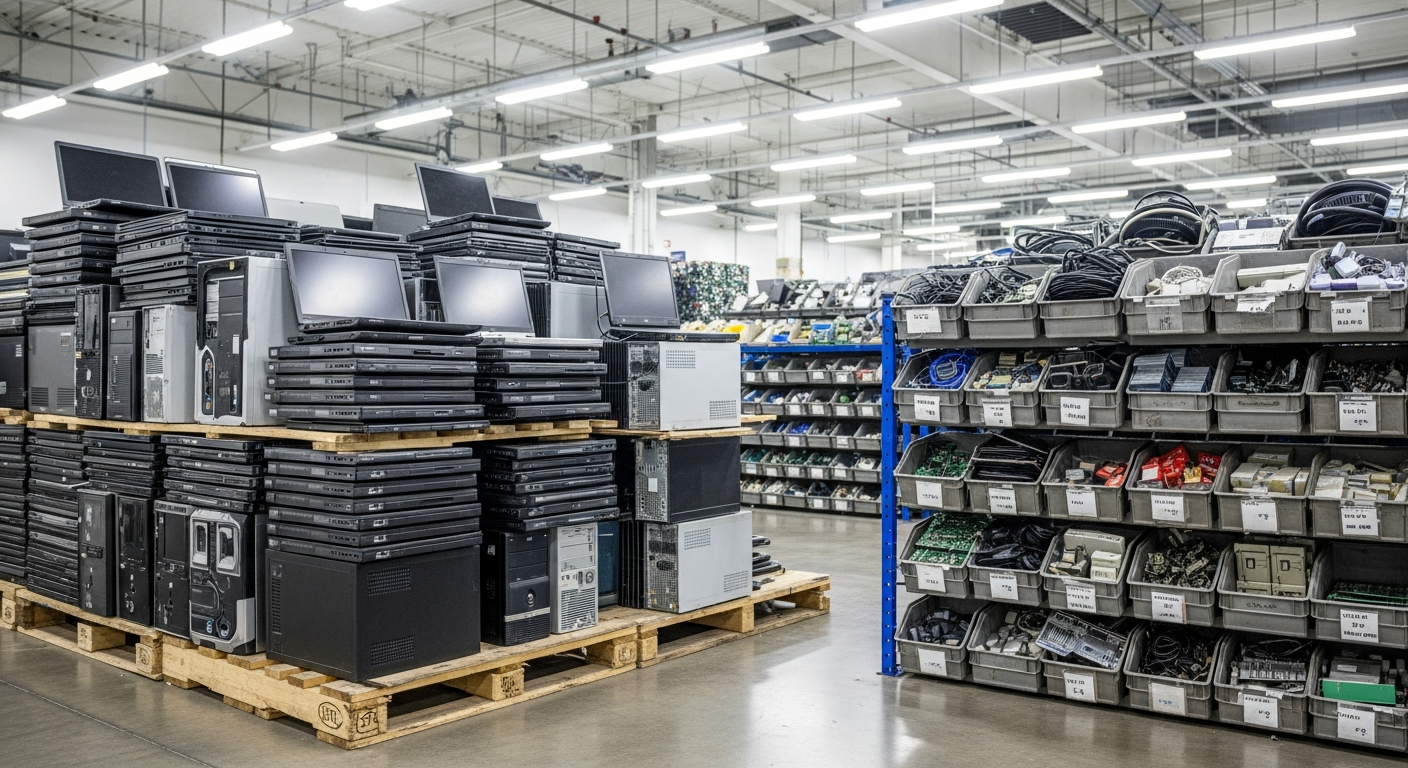
Computer recycling in Arvada is the planned retirement of business desktops, laptops, all-in-ones, and workstations, plus the monitors and peripherals that leave with them. Arvada offices, schools, and public buildings schedule pickup, and Precision E-Cycle processes the equipment at its secure Lincoln, Nebraska facility, with recycling through R2-certified downstream processors.
At retirement, the register often shows one count and the rooms hold another. Arvada's business base is varied: the Census Bureau puts the 2025 population at 122,901, and the Arvada Chamber of Commerce directory shows 588 listings. Whatever the size of your site, a room-by-room count by device type closes that gap.
What Arvada IT and Facilities Teams Gain
An inventory that does the planning
Counting by device type and flagging drives up front lets the review settle volume, accepted items, and record contents before a date is set. Pickup day becomes a handoff instead of a sorting session in your hallway. Nearby sites can be folded into the same plan.
Data devices on their own track
Laptops and desktops that still hold storage are grouped, counted, and handled by a method informed by NIST SP 800-88 Rev. 2. Monitors, keyboards, and cabling go straight to recycling without waiting on that decision. Your team sets the sensitivity, and the method follows it.
Credentials with a stated scope
Precision holds ISO/IEC 27001:2022 for information security, ISO 14001 for environmental management, ISO 9001 for quality, and ISO 45001 for health and safety. Recycled material from Arvada loads goes to downstream processors.
Request Service
Ready to Recycle?
Pickup is free for qualifying business volumes. Schedule yours or contact us with questions.
Related Services
How an Arvada Computer Retirement Moves From Desk to Recycling
Share the Arvada inventory
Send a list by site of the computers, monitors, and peripherals you are retiring, with counts by type and a note on which units still hold drives. The review confirms accepted items, the pickup plan, and which records the project will produce. Include nearby sites if they will retire equipment at the same time.
Separate what holds data
Your team moves laptops, desktops, and loose drives that still contain storage into a labeled group, apart from monitors and accessories. The handling method for that group is matched to the media type and your data sensitivity. Units already wiped by your team stay in the group until the review agrees how to treat them.
Stage the load and hand it off
Equipment waits in one accessible room with the inventory at hand. At pickup the load is counted against the list, the data-bearing group is checked on its own, and your site contact signs the pickup record. Any difference from the inventory can be raised with your contact while everyone is still on site.
Process in Lincoln and close out
At our Lincoln facility the load is received against the pickup record, each computer is serial-logged at intake, and data-bearing devices are handled by the agreed method. Remaining material moves to R2-certified downstream processors, and you receive the serialized report and other records agreed in the review.
What an Arvada Computer Recycling Project Involves and Leaves You With
An end-of-life computer project has two jobs. The first is removing retired desktops, laptops, and monitors from your Arvada space in one organized handoff. The second is leaving a paper trail your IT and compliance teams can file, which matters most for the machines that held data.
Why plan computers apart from the rest of an Arvada office refresh? A monitor or keyboard can go straight to recycling, while a laptop pulled from a former employee's desk may still hold email, customer files, or saved credentials. Planning the two paths separately keeps the easy items moving and gives the sensitive ones the attention they need.
Which computers go in an Arvada recycling load?
- Desktop towers, all-in-ones, iMacs, and high-performance workstations
- Laptops, ultrabooks, MacBooks, and Chromebooks
- Thin clients and terminals from shared desks or front counters
- LCD and LED monitors, keyboards, mice, power supplies, cables, and chargers
Retiring something else?
List anything beyond those categories, including loose batteries, and the project review scopes how each is handled before your Arvada pickup. Residents with a household computer can use the Like New PCs partner drop-off covered in the FAQ below.
See every category of electronics Precision E-Cycle accepts
Arvada residents: household drop-off at Like New PCs, an authorized partner
Office refresh or full clear-out
Where each part of the load ends up
Monitors, peripherals, and cabling are received in Lincoln and moved to downstream processors for material recovery. Data-bearing devices are handled by the agreed method before any material from them is recycled. Computers you flagged for reuse go to the ITAD review instead, so that question is settled apart from IT equipment recycling.
Which Arvada service fits each group of equipment?
- Computers with no reuse value, drives included: computer recycling on this page
- Working units worth a redeployment or reuse review: Arvada IT asset disposition
- Loose drives and media that need destruction on their own: Arvada data destruction
- Printers, copiers, and mixed office electronics from the same move: Denver metro e-waste recycling
Records to request
- A pickup record that reconciles to your inventory counts
- Chain-of-custody documentation from your Arvada site to our Lincoln facility
- A serialized report from intake logging, reconciled to your asset list
- A certificate of destruction covering the data-bearing devices
On a Precision E-Cycle project, each unit is serial-logged on arrival in Lincoln, so the serialized report lines up with your asset register. Auditors usually look for one serial number in three places: the register, the pickup record, and the final report. Record fields and format are agreed in the project review, so share any layout your auditors expect.
Key takeaway
Decide early which computers are recycling, which are reuse candidates, and which are data-bearing. Everything else on an Arvada project follows from those three lists.
Which Colorado Rules Apply When Arvada Organizations Retire Computers?
Two Colorado statutes and one federal guideline shape an Arvada computer retirement, and none of them covers every device. For a typical office refresh, the practical questions are whether any item could end up in a landfill, which machines held personal information, and how their storage is sanitized.
Colorado Electronic Recycling Jobs Act
Under the Electronic Recycling Jobs Act, sections 25-17-301 to 308 of the Colorado Revised Statutes, landfill disposal of covered electronic devices is restricted. Its definition excludes some devices that are part of equipment designed for commercial, industrial, medical, government, and research settings. The act also allows county-level exceptions.
What that means for your inventory
Do not assume every item on your list falls under the landfill restriction, or that none does. Record the county for each Arvada site address and flag any computer built into larger equipment, so the review can talk through how the act applies before pickup.
Colorado's personal information disposal law
Section 6-1-713 applies to covered entities that keep paper or electronic documents containing personal identifying information. It calls for a written disposal policy and for destroying those documents, or arranging their destruction, once they are no longer needed, subject to other law. It does not reach every computer, so know which retired machines held customer or employee records.
How each framework maps to the project
NIST SP 800-88 Rev. 2, published in September 2025, is the current federal media sanitization guideline. For a computer refresh, that means each laptop or desktop drive gets a method matched to its media type and your data sensitivity, rather than one process for the whole load.
What Precision holds
- ISO/IEC 27001:2022 for information security management
- ISO 14001 for environmental management
- ISO 9001 for quality management
- ISO 45001 for occupational health and safety
When choosing a computer recycling partner, compliance teams usually check credential scope and the downstream route before logistics. Precision E-Cycle routes recycled material from Arvada projects to downstream processors. Its records support your obligations under the Colorado statutes above but do not replace your written policy or legal review.
Colorado questions to raise in the review
- Which county each Arvada site is in, such as Jefferson County, and whether a county exception applies
- Whether any computers are built into lab, retail, or industrial equipment
- Which retired machines stored personal identifying information under your policy
- What record your disposal policy expects for each data-bearing device
Computers built into production equipment? See Denver manufacturing ITAD
Key takeaway
The guideline informs Precision's methods; it does not certify any provider. What protects an Arvada organization is the inventory, the separated data-bearing group, and records that tie each step back to your own policy.
What Should an Arvada Site Have Ready Before Its Computers Are Picked Up?
Preparation scales with the site: a single-suite Arvada office can often get ready in one walk-through, while a campus lab or public department may need a plan spanning rooms and buildings.
Before the project review
- Count desktops, laptops, all-in-ones, and monitors for each Arvada site
- Mark which units still contain a drive and which your team already wiped
- Set aside computers you plan to redeploy or want reviewed for reuse
- List any other sites that will retire computers in the same window
Schools and public offices
Education is part of Arvada's mix: Red Rocks Community College lists an Arvada campus and reports total enrollment of 13,540 across the institution. A school lab or public office often retires computers on an academic or fiscal calendar, so name that calendar in the review and plan the inventory around it.
Computer retirement planning for schools and colleges
Inventory fields the review relies on
Where do first inventories fall short? Laptops sit in drawers or with remote staff, spare drives from past repairs wait in a cabinet, and training room machines are forgotten under tables. A quick walk of each Arvada room before the review closes most of those gaps.
Before pickup day
- Stage equipment in one room near an exit, with the data-bearing group labeled and kept apart
- Clear personal items, badges, and written passwords from desks and docking areas
- Note stairs, elevator reservations, loading access, and parking limits at the building
- Name one site contact who can confirm counts and sign the pickup record
Review working computers for reuse with Arvada ITAD
Combining Arvada with nearby sites
Businesses in Arvada and neighbors such as Westminster, Wheat Ridge, Lakewood, and Broomfield schedule pickup, and Precision processes the equipment at its secure Lincoln, Nebraska facility. Listing several sites in one review keeps one pickup plan and one set of records, while each site still gets its own count and pickup record.
On pickup day
The load is counted against your inventory, the data-bearing group is checked separately, and your site contact signs the pickup record before anything leaves. From there the equipment travels to our Lincoln facility for intake, handling by the agreed method, and recycling through downstream processors.
Key takeaway
An Arvada pickup is simplest when the inventory, the labeled data-bearing group, and a named site contact are ready before a date is set. Request a free quote for your Arvada pickup today.
Clearing printers and mixed electronics too? See Denver metro e-waste recycling
Arvada Computer Recycling Questions
Request Service
Ready to Get Started in Arvada?
Get a free quote or send us a message about your project, and we scope pickup and documentation around your site.