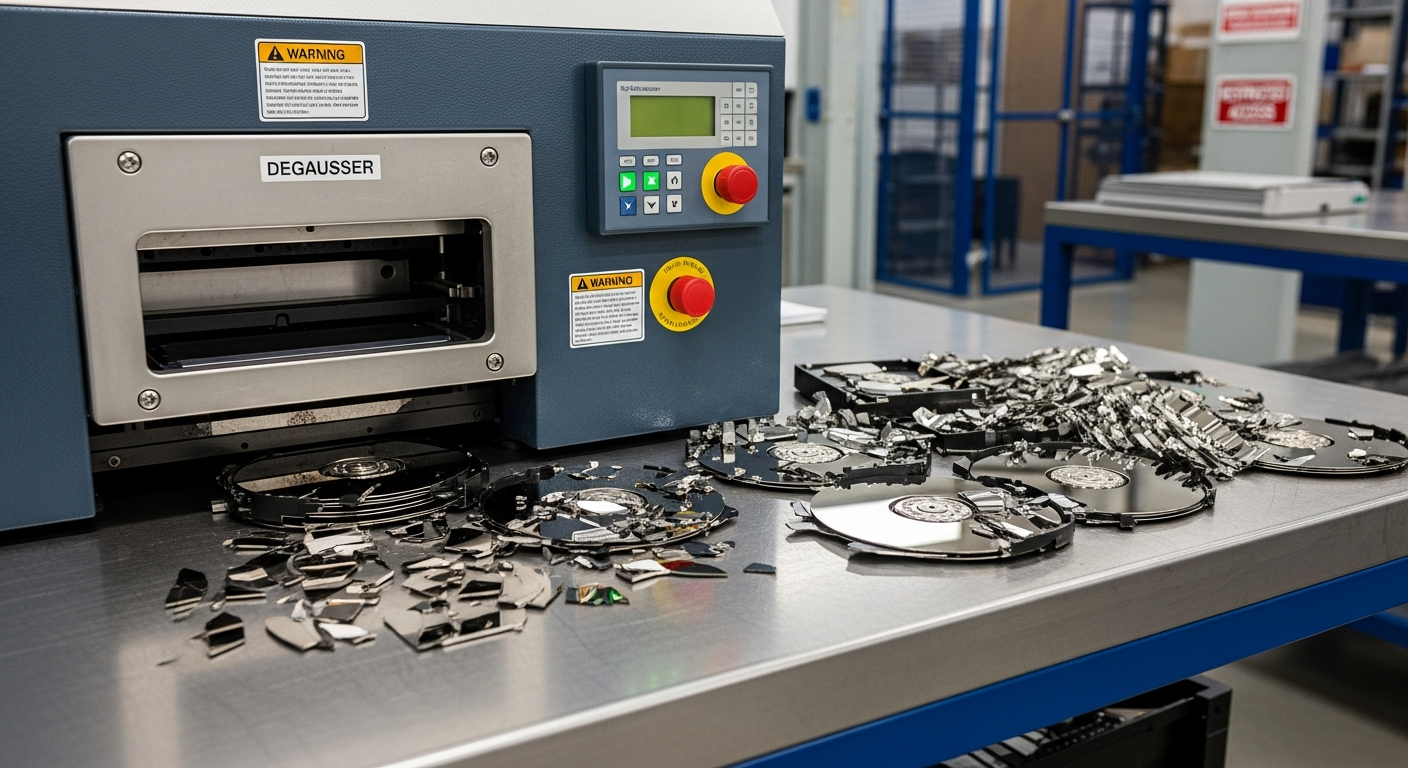
On-Site Data Destruction in Lincoln, NE
When policy says drives cannot leave your Lincoln building intact, Precision runs a scoped, witnessed destruction event on site. Each device is counted against your manifest and recorded before anything leaves, and qualifying business volumes get free pickup of what remains.
What Is On-Site Data Destruction in Lincoln?
On-site data destruction is a witnessed event at your location, where data-bearing media is sanitized or destroyed before it leaves your control. Precision E-Cycle runs it for Lincoln hospitals, financial firms, law offices, and state agencies whose policy or contracts keep intact drives in the building, using methods informed by NIST SP 800-88 Rev. 2.
As Nebraska's capital and the Lancaster County seat, Lincoln has two large hospital systems and a cluster of insurance and financial employers. Their information security officers often face the same bind: a policy forbids intact drives from leaving, while retired hardware waits in storage. Witnessed destruction in place is one control among several, not a legal mandate.
Why Lincoln Security Teams Choose an On-Site Event
Control stays in your building
Media is sanitized or destroyed before it leaves, so intact data does not ride the stretch between your door and a processing floor.
Exceptions surface early
The physical count is checked against your manifest before the event, so a missing drive is found while your witness is still in the room.
ISO 27001 security management
Precision holds ISO/IEC 27001:2022 for information security management, so the event runs inside an audited management system. It also holds ISO 14001, ISO 9001, and ISO 45001.
Request Service
Ready to Recycle?
Pickup is free for qualifying business volumes. Schedule yours or contact us with questions.
Related Services
How a Witnessed Event Runs in Your Lincoln Building
Define the media scope
List the drives, devices, and loose media in scope, where they sit in your building, and how sensitive the data is. Items meant for reuse, or owned by someone else, are flagged at this stage. That list becomes the manifest the event is reconciled against.
Stage and reconcile the count
Your team stages the media in an agreed area. The physical count is reconciled to your manifest, and missing labels or mixed media get a separate decision before any work starts.
Destroy or sanitize while witnessed
The agreed method, aligned with NIST SP 800-88, is applied to each device or media group while authorized staff observe. The method for each media type is agreed with you during scoping.
Record and complete disposition
Device details, method, date, and processing information are recorded so the documentation ties back to the scope. Remaining equipment then continues to recycling or another agreed path, collected by scheduled pickup. The destruction record arrives with the closeout package.
When On-Site Is the Right Control, and What You Keep Afterward
On-site destruction answers one risk: the stretch between your loading dock and someone else's processing floor. When a policy, a customer contract, or an auditor says intact media cannot make that trip, the event happens where the data lives. Otherwise, Lincoln teams have a simpler option: a logged handoff to Precision's own facility, a short local trip away.
Signals that on-site is the better fit
- A written policy that bars intact drives from leaving the premises
- A customer or partner contract that calls for witnessed destruction
- A security review that asks your own staff to observe the event
- Data sensitive enough that any transport exposure is unacceptable
- Access rules that make removing equipment harder than processing it in place
Financial offices in Lincoln
Precision client Nelnet employs 2,500 to 4,999 people in Lincoln, in a financial sector where retiring drives often hold customer information. For firms like these, the first scoping question is whether any contract or internal policy requires destruction to be witnessed.
Disposal planning for banks, lenders, and insurers
Who should be part of the decision
An on-site request tends to pull several people into one decision. The information security officer owns the risk, the privacy or compliance officer owns the policy, and the IT manager stages the drives. The records manager and the facilities manager decide what is on hold and how the team gets into the building.
Witnessed at your site or witnessed at Precision
Comparing mobile shredding vendors in Lincoln? Ask whether the visit is built around paper records and how hard drives will be handled. Drives call for a different conversation about media type, data category, and whether any part of the device will be reused. Security officers typically weigh that conversation, and device-level reconciliation, ahead of convenience.
A witnessed event proves that someone watched. A reconciled count proves what they watched. Without serial or asset numbers tied to your manifest, a witness can confirm that drives were destroyed but not which drives.
Matched to your media
The destruction method, the media types handled at your site, and the equipment used are planned around your media and data before the event, because the right method depends on both.
Records to ask for after the event
- The reconciled manifest used as the starting count
- Device details recorded for each item processed
- The method applied to each media group and the event date
- The names of your staff who observed the work
- A list of exceptions set aside during staging and why
Per NIST SP 800-88 Revision 2, certificate guidance sits in section 4.6, with a sample Certificate of Sanitization in Appendix C. Compliance officers typically expect a certificate of destruction to meet that yardstick. The exact fields Precision records for your event are set with you before the date is booked.
What a certificate should show: certificate of destruction in Lincoln
Key takeaway
For a Lincoln hospital, financial office, or agency, choose on-site when a written rule or a real transport risk demands it. Then judge the event by the record it leaves behind.
Does Any Nebraska or Federal Rule Require On-Site Destruction?
No. HIPAA, the GLBA Safeguards Rule, the FTC Disposal Rule, and Nebraska Revised Statute 87-808 ask for secure disposal and vendor oversight, but none says where destruction must happen. That choice is left to your own risk assessment, so a witnessed event is a control you select rather than a mandate.
Healthcare is the clearest Lincoln case for a witnessed event. CHI Health St. Elizabeth is a 260-bed regional medical center in the city, and clinical refreshes retire devices that hold patient data. The HIPAA Security Rule at 45 CFR 164.310(d) requires policies for the disposal and re-use of that hardware and media.
Disposal planning for hospitals and clinics
Each rule, and the evidence an on-site event produces
Lincoln's financial sector includes insurance employers such as Ameritas, and firms like it hold consumer information on drives that eventually retire. For financial institutions under the GLBA Safeguards Rule, section 314.4(f) adds a duty to oversee service providers by contract. A witnessed event and its record are one practical form that oversight can take.
The FTC Disposal Rule reaches any business that keeps consumer report information. Its own examples include contracting, after due diligence, with a party in the business of record destruction. A pre-event scope review is a natural place to do that diligence.
Nebraska's own disposal statute
Nebraska Revised Statute 87-808 applies to any business in the state that owns, licenses, or maintains computerized personal information about Nebraska residents. It asks for safeguards when that information is disposed of, plus contract terms with outside providers who receive it. Meeting GLBA or HIPAA rules, where they apply, satisfies the section.
Is on-site shredding enough for every drive?
Not for every drive. According to NIST SP 800-88 Revision 2, section 3.1.3, shred and pulverize techniques "should be avoided for anything but the lowest security categories of data." The same section warns that bending, cutting, or drilling may leave portions of media readable with laboratory techniques. The NIST FAQ for Revision 2 sorts the remaining options by security category.
- Lowest security categories: shred and pulverize remain an option
- Magnetic drives at medium or high: high-powered degaussers on an evaluated products list for magnetic media
- SSDs and flash at medium or high: techniques such as incineration or melting
- Partial damage such as drilling or bending: portions may stay readable
- Every category: the method is matched to media type and data sensitivity
Precision's position
Precision E-Cycle's methods for Lincoln on-site events are informed by NIST SP 800-88 Rev. 2, and each media group gets a method matched to its type and your data sensitivity. If a higher category calls for a process better suited to Precision's Lincoln facility, you hear that before the event, along with the option of a witnessed session there.
Verification belongs in the record
Revision 2 treats sanitization as an organizational program and adds verification and validation to it. For an on-site event, the record should show how each result was checked, not only that a method ran. Ask how verification is documented for each media group.
What to ask before you book an on-site event
- Which media types can be processed at our site, and which cannot?
- How is the method chosen for each media group and data category?
- How is the count reconciled to our manifest before work starts?
- Which fields will the destruction record carry for each device?
- How is verification of each result documented and handed over?
NIST SP 800-88 Revision 2 says degaussing is not considered an approved destroy sanitization technique. If degaussing appears in a plan for magnetic media, ask what step follows it and how the result is verified.
How each media type is sanitized: Lincoln data destruction
Key takeaway
Choose witnessed destruction in your building for control, then let the media type and data category, not the location, decide the method.
How Should a Lincoln Building Prepare for a Witnessed Event?
A Lincoln building is ready when four things are settled before the team arrives. Precision's on-site engagements start with the same requests: an authorized contact, a staging area, an agreed way to reconcile the count, and separation of media owned by others or under a retention hold.
Preparation checklist for your team
- Name the authorized contact who signs for the scope and the record
- Choose a staging area your witness can observe without interruption
- Export a manifest with serial or asset numbers where you track them
- Set aside any media under a legal or records retention hold
- Separate leased or third-party media so it gets its own decision
Wondering what else belongs on a Lincoln scope list? Printers, copiers, network appliances, and backup media can all hold data, so include them now rather than finding them on the day.
Holds and borrowed media
Media under a retention hold is easy to miss. Destroying a drive tied to an open matter, audit, or investigation creates a new problem. Flag it in the scope, keep it out of the staging area, and note it on the exception list. Leased equipment raises a similar question, because the lessor may have its own return terms.
Who does what during the event
Hospital events
Precision E-Cycle counts Lincoln-headquartered Bryan Health among its clients, and hospital refreshes retire clinical and administrative devices alike. Clinical sites often need staging away from patient areas, a detail settled during scoping so a witnessed event stays clear of care.
On the day, in order
- Check-in with your authorized contact and a walk to the staging area
- A physical count reconciled line by line to your manifest
- Exceptions logged and set aside with the reason noted
- The agreed method applied to each media group while your witness observes
- A review of the record before the remaining equipment leaves
Lincoln's mix of buyers means the same event can look very different from one building to the next. A clinic may stage a cart of laptops in a back office. A state agency may need escorts and sign-in at a secured building. Scoping those differences early keeps the day itself short and predictable.
Witnessed events for state agencies
State government, with 5,000 to 7,500 employees in Lincoln, follows NITC Technical Standard 8-906 when agency media leaves service. The standard calls for physical destruction or secure overwrite of media holding high or moderate impact information, backed by certificates of destruction. A witnessed on-site event gives an agency direct observation in addition to the certificate.
Agency paperwork
Procurement and records staff at state, Lancaster County, and city offices may want the scope, the witness names, and the certificate kept in one file. Agree on who receives the record, and in what form, during scoping rather than on the day.
After the scoped media is processed
Once the media is processed and recorded, the remaining equipment continues to recycling or another agreed disposition path. In Lincoln, that equipment can leave by scheduled pickup or by drop-off at Precision's own Lincoln facility. Recycled material is routed to R2-certified downstream processors.
The closeout pairs the destruction record with the disposition of the remaining equipment. Your records owner then files one package against the vendor contract instead of two loose documents that have to be matched later.
When shredding fits the data: hard drive shredding in Lincoln
Key takeaway
A Lincoln on-site event runs cleanly when the count, the witness, and the exceptions are settled before the team walks in.
Lincoln On-Site Destruction Questions
Request Service
Ready to Get Started in Lincoln?
Get a free quote or send us a message about your project, and we scope pickup and documentation around your site.