Data Destruction Lincoln, NE
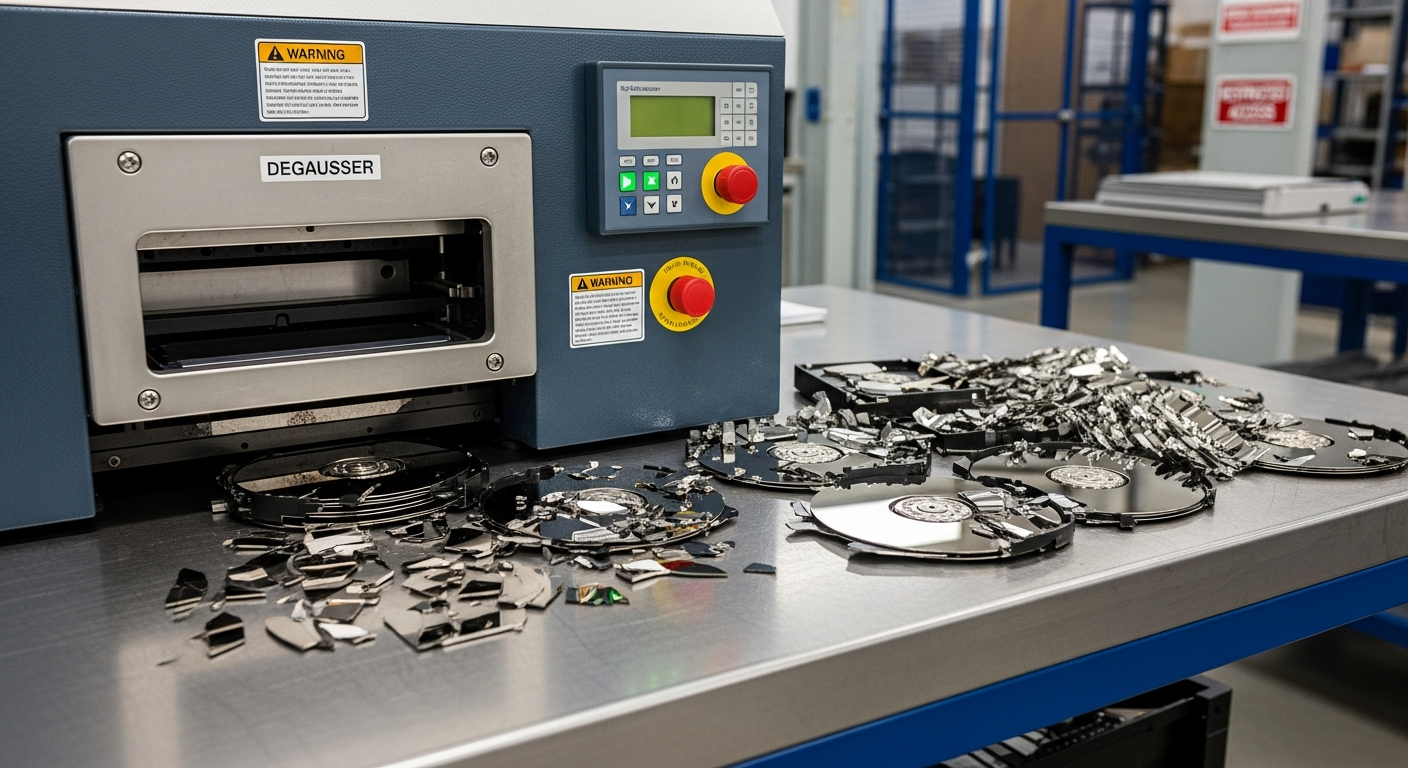
Data destruction informed by NIST SP 800-88 Rev. 2 for hard drives, SSDs, and servers at our Lincoln processing facility, with the serialized documentation agreed during scoping. Free pickup for qualifying business volumes brings the drives to us.
Certified Data Destruction in Lincoln, Nebraska
Searching for electronics recycling near you in Lincoln, NE? Precision E-Cycle coordinates IT asset disposition with R2-certified downstream vendors where applicable. Where included in the confirmed service scope, eligible data-bearing equipment may be sanitized or physically destroyed using methods informed by NIST 800-88. Lincoln businesses can schedule pickup across the metro, free for qualifying business volumes, with equipment processed at our secure Lincoln, Nebraska facility. Get a free quote to start.
Precision E-Cycle performs data destruction aligned with NIST SP 800-88 Rev. 2 at our processing facility in Lincoln. We sanitize hard disk drives, SSDs, NVMe drives, magnetic tape, and mobile storage with methods chosen by media type and your requirements, such as verified overwrite, cryptographic erase, or physical destruction. Degaussing applies only to magnetic media.
Lincoln organizations in healthcare, government, finance, and education rely on our documented destruction process to support their HIPAA, SOX, FERPA, GLBA, and NIST-related audit obligations. Each engagement produces the serialized documentation agreed during scoping, identifying each device by serial number and method.
Why Lincoln Organizations Choose Our Data Destruction
Aligned with NIST SP 800-88
Our process is aligned with NIST SP 800-88 Rev. 2 guidelines. The COD we issue specifies the media type, destruction method, and the NIST standard applied for each device.
Compliance Across Frameworks
HIPAA, SOX, FERPA, GLBA, FACTA, and Nebraska data security statutes all expect disposal safeguards. Our records support your documentation obligations under each of them from a single engagement.
Our Own Lincoln Facility
Your data stays in Nebraska, processed at our own secure Lincoln facility rather than shipped to an unknown one. Drop off or schedule a pickup.
Request Service
Ready to Recycle?
Pickup is free for qualifying business volumes. Schedule yours or contact us with questions.
Related Services
Our Lincoln Data Destruction Process
Schedule or Drop Off
Schedule a pickup or bring drives directly to our Lincoln facility. We accept drives with or without the parent device.
Intake and Serial Logging
Every drive or device is logged by serial number and model before destruction begins. You receive a copy of the intake record.
Method Matched to the Media
Each piece of media is sanitized using a method informed by NIST SP 800-88 Rev. 2 and chosen by media type, such as verified overwrite or cryptographic erase for reuse-eligible drives, or shredding for end-of-life media. Degaussing is used only on magnetic media and does not work on SSDs.
Certificate Issued After Processing
The serialized documentation agreed during scoping, identifying each device by serial number, method, and date, is delivered digitally after processing.
Choosing the Right Sanitization Method for the Media
NIST Special Publication 800-88 Revision 2 defines three sanitization tiers, and the difference between them is the difference between a defensible disposal and an expensive assumption. Clear is a logical overwrite that defeats casual recovery. Purge is a cryptographic erase or a verified block-level overwrite that defeats laboratory recovery. Destroy is physical destruction. The standard does not say pick one and apply it everywhere. It says match the tier to the media and to the sensitivity of what the media held.
In practice that means a mixed load leaving a Lincoln office gets sorted before anything happens to it. Spinning hard drives accept a verified Purge-level overwrite, and where a client's policy calls for Destroy, they are shredded instead. Solid-state media is cryptographically erased through the drive's own Secure Erase or Sanitize command, because wear-leveling distributes writes across NAND cells in a way that makes a conventional overwrite pass unreliable even when it reports success. Backup tape, optical media, and mobile devices with soldered storage go to physical destruction because nothing else is verifiable.
Any drive that fails verification is shredded rather than passed through. That rule matters more than it sounds. A verification failure is not a rare event on end-of-life hardware, and a vendor whose process has no defined path for a drive that will not verify is a vendor who is either quietly discarding it or quietly shipping it downstream intact.
Who Retires Data-Bearing Media in Lincoln, and Why It Is Different Each Time
Lincoln institutions that retire data-bearing media carry obligations that are not interchangeable. Bryan Health and CHI Health St. Elizabeth retire clinical workstations, imaging peripherals, and mobile devices that hold protected health information under HIPAA 45 CFR 164.310(d), and their disposal evidence has to survive an Office for Civil Rights review. Nelnet, Ameritas, and Assurity Life operate under the Gramm-Leach-Bliley Safeguards Rule and the FACTA Disposal Rule, where the question is whether consumer financial data was rendered unreadable and whether you can prove it.
The public sector adds a third pattern. Nebraska State Capitol agencies and the Nebraska Public Power District dispose under procurement standards that reference NIST 800-88 by name, which means the method has to be nameable and the record has to be serialized before an asset can be written off. The University of Nebraska-Lincoln, Southeast Community College, and Lincoln Public Schools carry FERPA obligations under 20 U.S.C. 1232g across student device fleets that turn over on academic and budget calendars rather than continuously.
The operational consequence is that a single destruction policy applied across all of them is wrong for most of them. A healthcare provider and a school district can both meet their obligations and still need different tiers, different documentation depth, and different handling of devices whose storage is not obvious from the outside. We scope the method against what the media actually held rather than against what category of organization is retiring it.
Chain of Custody From Your Dock to the Certificate
The destruction step is rarely where disposal programs fail. The handoff is. Every transfer between a collector, a processor, and a downstream vendor is a point where serial-level tracking can quietly degrade into weight-level tracking, and once that happens the paperwork can no longer answer a question about a specific asset. Precision E-Cycle collects, transports, and sanitizes in one chain out of our Lincoln facility, so the serial that comes off your asset register is the serial that appears on the certificate.
Collection runs on tamper-evident containers and a manifest signed at both ends. The technician who loads the media is the technician who transports it, which removes the intermediate handling step where custody records typically break down. Media that has not yet reached intake is held in a locked secure area rather than staged on an open dock. Sanitization happens before any disassembly or downstream movement begins, so drives are sanitized before they leave our control.
What you receive afterward is the serialized documentation agreed during scoping, such as per-device Certificates of Destruction, an itemized manifest, and downstream processing records showing where recovered material went. Coverage runs from Lincoln through Lancaster County and the surrounding communities including Waverly, Hickman, Bennet, Seward, York, Milford, Beatrice, and Nebraska City, and businesses farther out can request a free quote. Organizations with sites in more than one of our markets are handled under a single point of coordination, with documentation broken out by physical location rather than aggregated, because an auditor reviewing one site needs that site's assets.
Data Destruction in Lincoln: Common Questions
Request Service
Ready to Get Started in Lincoln?
Get a free quote or send us a message about your project, and we scope pickup and documentation around your site.