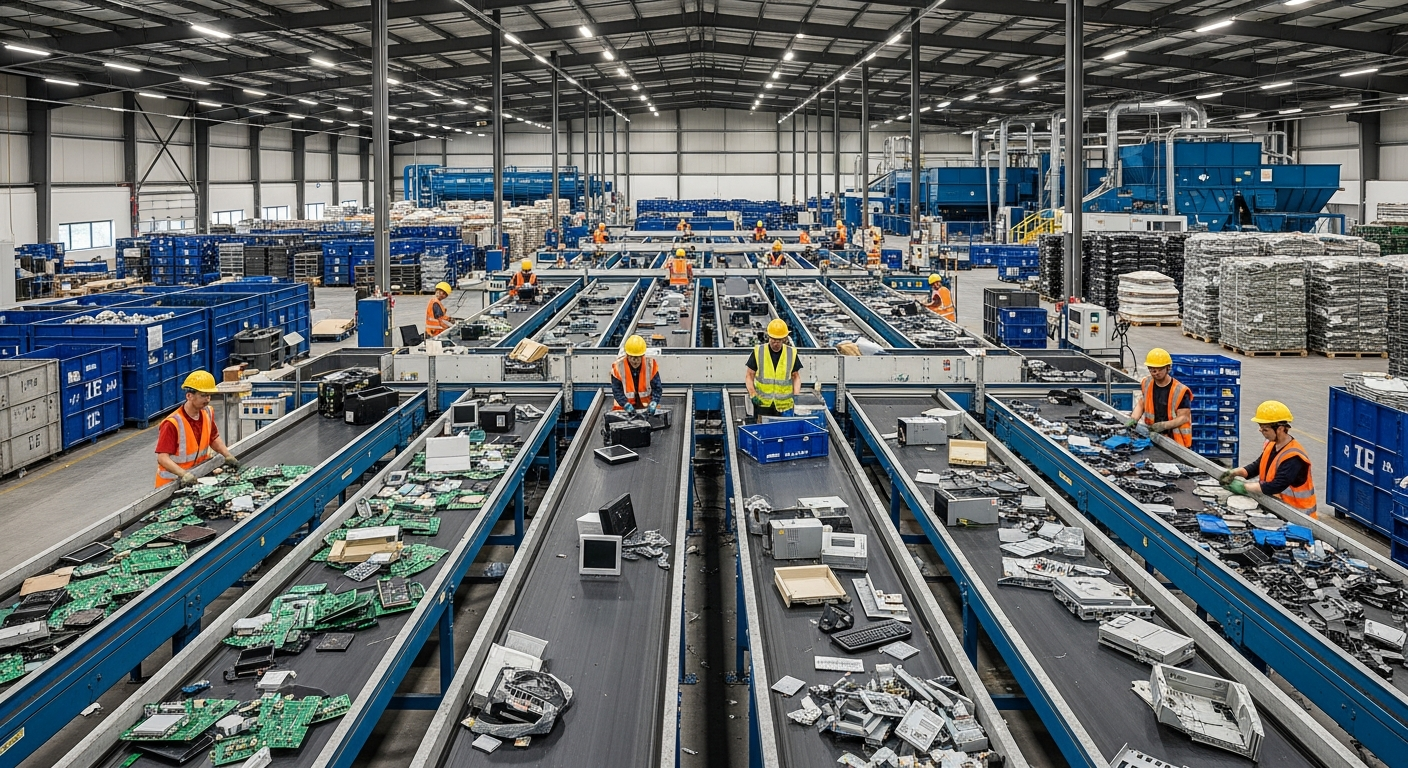
IT Asset Disposition in Kansas City, MO
Retiring a mixed fleet of laptops, servers, phones, and network gear from a Missouri-side office or campus? Precision E-Cycle inventories each asset, settles reuse or end of life before any data is touched, and processes everything in Lincoln. Pickup is free for qualifying business volumes. Request a free quote before anything moves.
What Is IT Asset Disposition for a Kansas City Organization?
IT asset disposition (ITAD) is the managed retirement of IT equipment, from a serialized inventory through data sanitization, a reuse or recycling decision, and a final report. Precision E-Cycle provides it to Kansas City, MO organizations with pickup, sanitization informed by NIST SP 800-88 Revision 2, and all processing in Lincoln, Nebraska.
For an asset manager, the hard part of a refresh is proving what happened to every serial number, so finance can close retired assets and security can answer an auditor. Recycling ends when equipment leaves the building; ITAD ends when each device has a documented outcome, which matters on the Missouri side, where organizations cannot legally landfill certain electronics.
What Kansas City IT, Finance, and Compliance Teams Get From ITAD
One record for every asset
Final reporting is reconciled against the list you sent before pickup, so finance can close retired assets and security can match each certificate to a device. We tailor report and certificate fields to your auditor.
Reuse weighed before destruction
Every asset gets a reuse or end-of-life decision before its data is sanitized, so working equipment is not shredded by default and hardware with no reuse path is recycled through R2-certified downstream processors.
A certified security management system
Precision holds ISO/IEC 27001:2022 for information security management, along with ISO 14001, ISO 9001, and ISO 45001, so data-bearing devices move through documented management systems from pickup to final report.
Request Service
Ready to Recycle?
Pickup is free for qualifying business volumes. Schedule yours or contact us with questions.
Related Services
How Does a Kansas City ITAD Project Run, From Asset List to Report?
Asset list and scope review
You send an export of the asset register for the equipment being retired, with serial numbers, asset tags, device types, and encryption status. We scope the items, schedule your pickup, and set the fields the final reports will carry.
Reuse or end-of-life decision
Each asset is marked as a reuse candidate or as end of life before any data is handled. Reuse candidates need a sanitization method that leaves the device working, while end-of-life media can be destroyed, and every method is matched to media type and your data sensitivity.
Counted pickup at your site
At your Missouri-side site, equipment is counted against the serialized list with your site contact, and chain of custody documentation starts at that count. The load then travels to Lincoln, where every device is processed. Pickup at your site is free.
Sanitize, route, and report
In Lincoln, data-bearing devices are sanitized or destroyed by the agreed method. Reuse candidates are evaluated under terms set in the project review, the rest goes to R2-certified downstream processors, and the final report is reconciled to your original list at the detail agreed in review.
What a Kansas City ITAD Project Covers and the Records It Leaves
Every ITAD project starts with a list of each laptop, desktop, server, switch, phone, and loose drive being retired, each needing a destination and a data record. For a Kansas City office refresh, or a lab turnover at a college such as Metropolitan Community College, with 14,507 credit students in fall 2025, that list is the spine of every document.
Reuse or end of life: the decision each asset gets
Under NIST SP 800-88 Revision 2, reuse is a key sanitization decision, whether a device moves to another department, a donation program, or refurbishment. Media control also changes when a device returns from a lease, is donated or resold, or goes to recycling. That is the real fork in ITAD: a reuse candidate needs a method that leaves it working.
Decide before anything is destroyed
A destroyed drive cannot be reused, and a device marked for reuse should not be shredded by default. IT asset managers choosing a disposition partner can ask whether that decision is recorded for each asset before pickup.
Records an ITAD project should leave behind
- A serialized asset report that reconciles to the list you sent before pickup
- Certificates of destruction or sanitization for data-bearing devices
- A chain of custody record that begins with the count at your site
- A recycling record for equipment routed to R2-certified downstream processors
According to Revision 2 section 4.6, a certificate of sanitization should be completed for each sanitized storage device, and its fields make a good benchmark when comparing ITAD vendors. The Appendix C sample form adds one more field that matters in ITAD: media destination, such as internal reuse, external reuse, a recycling facility, or the manufacturer.
- Manufacturer, model, and serial number, plus your property number if you use one
- Media type and media source, such as the host computer
- Sanitization method (clear, purge, or destroy) and the technique used
- The tool and its version, and how the result was verified
- Name, title, date, location, contact, and signature of the person verifying
- Media destination: internal reuse, external reuse, recycling, or the manufacturer
Records built around your audit
We tailor the fields on Precision's certificates and asset reports to your auditor during scoping. Security teams preparing for an audit can request each field by name, in writing, before a device leaves your site.
Equipment that needs a separate conversation
The Kansas City National Security Campus, which makes about 80 percent of the nonnuclear components in the U.S. nuclear stockpile, makes defense manufacturing a notable part of the local technology workforce. Classified and controlled federal media follow federal rules outside a standard ITAD project, so contractors holding that equipment should plan it apart from an ordinary office or lab retirement.
Some items on a retirement list also need a check of their own. Laptops, desktops, servers, network gear, printers, smartphones, tablets, and loose drives appear on Precision's accepted list; list any CRTs, loose batteries, and appliances too, and we plan a route for each.
Key takeaway
An ITAD project for a Missouri-side site is complete when every serial number on your list has a recorded data method and a recorded destination.
Which Missouri and Federal Rules Shape a Kansas City ITAD Program?
Five sets of rules shape a Missouri-side ITAD program: the DNR landfill restriction, HIPAA device and media controls, the GLBA Safeguards Rule, the FTC Disposal Rule, and Missouri's local records directives. Missouri DNR says organizations in the state cannot legally discard certain electronics in Missouri landfills, citing RSMo 260.350 to 260.430.
Reuse is a recognized path
DNR's PUB2333 fact sheet says computer monitors, circuit boards, and other electronics contain heavy metals, so they "cannot legally be disposed in Missouri landfills by businesses." It lists reuse among the ways to manage them, so the reuse decision carries weight here. The fact sheet does not address data; that rests on federal rules and NIST guidance.
Federal rules and what an ITAD record supports
The metro's healthcare sector, led by systems such as Children's Mercy, a 408-bed pediatric health system, retires laptops, workstations, and mobile devices that can hold ePHI. For a covered entity, media re-use matters as much as disposal, because a redeployed or donated device must have its ePHI removed first. Precision's records support, but never replace, its own documentation.
Financial services and service provider oversight
The Federal Reserve Bank of Kansas City has its head office here and serves the Tenth District, anchoring a financial sector shaped by disposal and vendor oversight rules. Covered examples in the FTC's Safeguards Rule guidance include mortgage lenders, finance companies, collection agencies, and tax preparers. Section 314.4(f) asks them to select, contract with, and monitor capable providers.
Due diligence the FTC describes
The FTC's Disposal Rule guidance gives due diligence examples such as reviewing an independent audit of a disposal company, checking its references, and reviewing its security policies. An ITAD vendor's documents and its written answers from the project review belong in that file.
Kansas City financial institution electronics recycling and ITAD
Public agencies, schools, and local records
Jackson County runs its downtown courthouse here, and county offices, school districts, and other local agencies retire equipment that can hold public records. Under RSMo 109.255, Missouri issues directives to guide local officials on destroying local records, with advice from the board of record control. Records on a retired device follow those directives before the hardware itself is disposed of.
Breach exposure, not a disposal mandate
RSMo 407.1500 is Missouri's breach notification law, and it contains no records destruction requirement. It does exclude encrypted, redacted, or otherwise unreadable data from personal information, so a drive that leaves your control unsanitized carries breach exposure worth planning around.
How the sanitization method is chosen
- Under Revision 2 section 3.1.3, shredding and pulverizing should be avoided for anything but the lowest security categories of data
- Degaussing is not an approved destroy technique, and it should not be used on SSDs or other non-magnetic media
- A reuse candidate needs a clear or purge method that leaves the device working
- Each sanitized storage device should have its own certificate of sanitization
Kansas City data destruction methods and records
Key takeaway
On the Missouri side, a complete ITAD record answers two questions at once: where the hardware went instead of a landfill, and how the data on it was made unreadable.
Preparing a Kansas City Fleet for an ITAD Pickup
What should your team send before the project review? An export of the asset register for the equipment being retired, with each line marked as a reuse candidate or end of life and leased units flagged. We then scope the items and schedule pickup at your Missouri-side site.
- Serial numbers and asset tags for every laptop, desktop, server, and network device
- A reuse or end-of-life mark on each line, set by your IT and security leads
- Leased equipment flagged, with the lessor's return terms noted
- A separate count of loose hard drives, SSDs, flash drives, and tape
- Encryption status for each device class on the list
- Any CRTs, batteries, or appliances, flagged for review before pickup
Holds to clear before equipment leaves
Some devices hold information your organization still has to keep. The GLBA Safeguards Rule allows retention past two years for a legitimate business need or a legal requirement, and public agencies follow Missouri's local records directives. Clear those holds with records and legal staff before a device goes on the retirement list.
Two states, two sets of rules
The Missouri DNR landfill restriction applies to sites in Missouri. If a project also includes offices on the Kansas side of the metro, list those addresses separately, because they follow Kansas law and are covered on the Kansas City, Kansas pages.
What happens on pickup day
Searching for IT asset disposition near me from a Jackson County office or a Northland server room? Pickup is arranged at each Missouri-side address, where equipment is counted against your serialized list with your site contact, opening the chain of custody. The load then goes to our Lincoln facility for processing.
Kansas City's Northland is a growing data center market and home to the 882 acre Golden Plains Technology Park. Hyperscale operators run their own disposition programs, so the local relevance is the colocation and enterprise server footprint around them. When a disposition project reaches that kind of hardware, the pages below cover it in more depth.
Kansas City server disposal for individual rack retirements
Kansas City data center decommissioning for full room closures
After processing
What comes back after processing? Reports tied to the serial numbers on your original list, which finance and procurement teams can use to close asset records and document write-offs while security files the certificates with its disposal records. Items evaluated for reuse are reported under the terms set in the project review.
Recovering value from retired equipment: Kansas City IT asset liquidation
Key takeaway
A serialized list with a reuse or end-of-life mark on every line is what turns an equipment pickup into a documented ITAD project.
Kansas City ITAD Questions
Request Service
Ready to Get Started in Kansas City?
Get a free quote or send us a message about your project, and we scope pickup and documentation around your site.