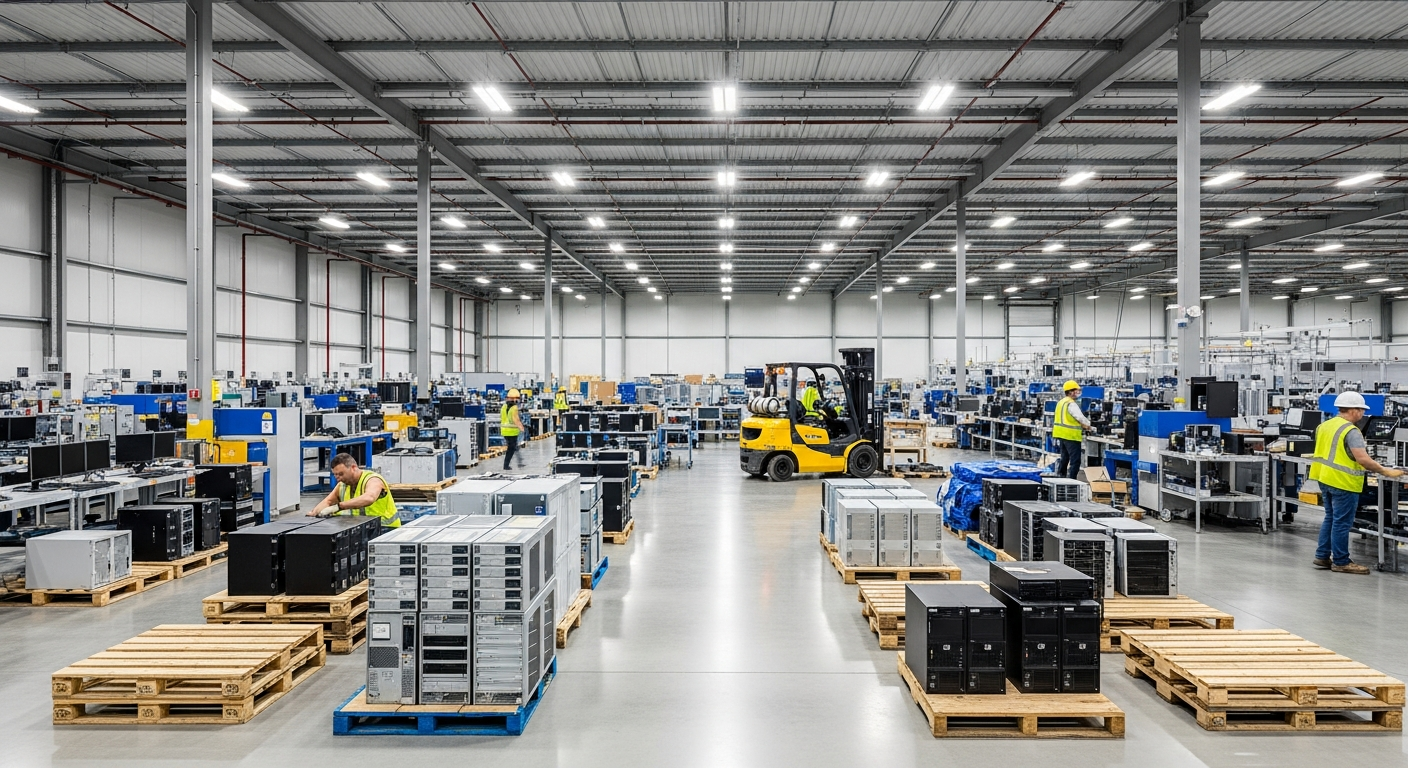
Mixed E-Waste Pickup and Recycling in Lincoln, NE
Clear a Lincoln storeroom of mixed electronics through a sorted, documented recycling path. Nebraska treats business e-waste differently from household electronics, and the process is built around that difference. Schedule free pickup for qualifying business volumes and clear the room.
What Does Business E-Waste Recycling Mean in Lincoln?
E-waste recycling is the collection, sorting, and recycling of electronics an organization no longer uses, and Precision E-Cycle provides it in Lincoln, NE for businesses, schools, churches, nonprofits, and farms. Data-bearing devices are cleared first, applicable material goes to R2-certified downstream processors, and Nebraska regulates organizational e-waste under Title 128, Chapter 25.
For a facilities manager clearing a Lincoln storeroom, the first question is who generated the electronics. Under DWEE Guidance Document 09-004, household electronics may go to a permitted landfill, while electronics from businesses, agencies, schools, churches, farms, and hospitals are regulated. The second question is how long they have waited, because DWEE expects a handler to prove it.
Why Lincoln Organizations Recycle E-Waste This Way
Built for business e-waste
DWEE 09-004 treats organizational electronics differently from household items. The process starts on the organizational side, with labeled, dated storage.
A short local trip
Precision's own facility serves Lincoln, so a mixed load makes a short trip from your storeroom to the first sort, and the handoff is recorded when it leaves your custody.
Management systems on record
Precision holds ISO 14001:2026 for environmental management and ISO/IEC 27001:2022 for information security, alongside ISO 9001 and ISO 45001.
Request Service
Ready to Recycle?
Pickup is free for qualifying business volumes. Schedule yours or contact us with questions.
Related Services
How Does a Lincoln E-Waste Clean-Out Work?
Take stock of the pile
List what is waiting by device type and rough count, and mark anything that stores data. Note batteries, lamps, and broken screens separately so each stream has a plan.
Choose drop-off or pickup
Bring the load to Precision's own Lincoln facility, or schedule a pickup. Request a free quote and we spell out accepted items, collection details, and any other cost up front.
Separate and clear data
Data-bearing devices are pulled from the general electronics. Their media is sanitized or destroyed with methods informed by NIST SP 800-88, matched to media type and sensitivity.
Recycle and file the record
Applicable material goes to R2-certified downstream processors. You receive a downstream disposition summary for partner-routed material to file beside your own storage log.
What Goes Into a Lincoln E-Waste Load and What Comes Back
A Lincoln e-waste load is rarely one kind of device, whether it comes from a state agency office (state government employs 5,000 to 7,500 people in Lincoln) or a shop on a Lancaster County farm. A typical clean-out mixes towers, monitors, printers, desk phones, keyboards, and cables, so recycling it well starts with separating streams.
Four streams inside one mixed load
Are laptops or phones in the pile? Check them first. According to EPA, batteries should come out of electronics before recycling because they may need a separate path, and lithium-ion batteries do not belong in household garbage or recycling bins.
What records should an e-waste file hold?
- Your own inventory of the load, by device type and count
- Your storage log showing when accumulation began
- The handoff record from drop-off or pickup day
- Precision's downstream disposition summary for partner-routed material
- Certificates of destruction for data-bearing media, with fields tailored to your file during scoping
The disposition summary covers material Precision routes through downstream partners. It is a different document from a certificate of destruction, which applies to data-bearing media. Ask for each one by name so your file holds both. If your organization is a large quantity handler, DWEE 09-004 also asks for shipment records kept at least three years.
Records for data-bearing media: certificates of destruction in Lincoln
Why the file matters
DWEE 09-004 expects a business handler to show how long electronic items have been held. Facilities managers typically file a dated inventory beside the disposition summary, showing when the load started and where it went.
Lincoln's campuses show how large these streams get. Southeast Community College enrolls more than 10,500 students across its Beatrice, Lincoln, and Milford campuses. Campus labs, offices, and classrooms all feed the same mixed pile, which is why sorting before collection pays off.
Desktop and laptop fleets: computer recycling in Lincoln
Key takeaway
A mixed load is four jobs at once. Name the general electronics, the data-bearing devices, the batteries and lamps, and any broken screens before anything is boxed.
Which Nebraska Rules Apply to Business Electronics in Lincoln?
Nebraska regulates electronic waste from businesses, agencies, schools, churches, and farms under Title 128, Chapter 25, and DWEE Guidance Document 09-004, revised in November 2025, explains how. The state has no named e-waste act, no producer responsibility law, and no landfill ban on electronics, so that guidance is the document to follow.
Household electronics compared with organizational e-waste
Organizations the guidance names
The list is broader than many Lincoln organizations expect. Churches, charitable organizations, colleges, farms, and ranches are named alongside businesses and hospitals. A congregation clearing its office or a Lancaster County farm retiring a shop computer is a regulated handler, not a household.
Schools are on the list
Schools and colleges are named in the guidance, so their classroom and office electronics are organizational electronic waste. That reaches from Lincoln Public Schools, a Precision client with 5,000 to 7,500 employees, to every private school, college, and parish office in the city.
Classroom and campus equipment: school electronics recycling in Lincoln
Storage and labeling while items wait
- Keep items in structurally sound containers
- Store broken CRTs inside a building or in a closed container
- Mark items or containers Universal Waste Electronic Item(s), Waste Electronic Item(s), or Used Electronic Item(s)
- Hold items no longer than one year unless they are being collected for recycling
- Be able to show how long each item or container has been held
Small or large quantity handler: which one is your organization?
Either way, the storage rules above still apply. A labeled bin with a start date written on it covers much of what the guidance asks, and the handoff record from collection day is worth keeping even where no shipment log is required.
Data still on the devices
Nebraska Revised Statute 87-808 asks a business holding computerized personal information about Nebraska residents to protect it at disposal. It also calls for a contract with any outside provider that receives the data. For an e-waste load, that means data-bearing devices are separated and documented before recycling.
How can you tell real recycling from sham recycling?
DWEE 09-004 names "lack of transparency related to the recycling process, destinations of materials, and rate of recycling" as key indicators of sham recycling. Precision addresses the destination question with a downstream disposition summary for partner-routed material, and it routes applicable material to R2-certified downstream processors.
- Where does material go after the first sort?
- Which standard do the downstream processors hold?
- What document comes back for partner-routed material?
- How are data-bearing devices separated and cleared?
- Which management system certifications does the recycler hold itself?
Precision's own management systems are certified to ISO 14001:2026, ISO/IEC 27001:2022, ISO 9001:2015, and ISO 45001:2018. Office managers comparing electronics recyclers typically put the downstream answer first, because it shows where the material actually went.
Management system certificates and scope
Key takeaway
Nebraska does not ban electronics from its landfills, but it does regulate business e-waste. Run the storeroom like a universal waste accumulation area and keep the paperwork that proves it.
How Do You Prepare a Lincoln Storeroom for Drop-Off or Pickup?
Prepare a storeroom by counting the load, marking data-bearing devices, and labeling each container with the date accumulation began. Then choose drop-off or a scheduled pickup. Lincoln businesses can drop off right at Precision's own facility, and that local handoff keeps a regulated load documented from shelf to processor.
Before collection day
- Count items by type and mark anything that stores data
- Remove batteries where you safely can and bag them separately
- Box cables, keyboards, and small parts in sturdy containers
- Label each container and write the date accumulation began
- Check the accepted items list and flag anything unusual
Check accepted items before you pack
Clearing one closet or a whole building? Small offices, churches, and farm shops usually find drop-off simplest, since Precision's own facility serves Lincoln directly. Scheduled pickup suits a school, an agency floor, or a warehouse load too large for one vehicle. Either way, the handoff is recorded when equipment leaves your custody.
Driving it over yourself
If your staff haul the load to drop-off, DWEE 09-004 treats your organization as a universal waste transporter for that trip. Keep items contained and labeled in the vehicle, just as they were on the shelf.
When part of the load needs a different path
- Server rooms and storage arrays follow a server disposal plan
- Equipment with resale potential goes through ITAD review first
- Staff household electronics go to Nebraska Recycling Council resources
- Batteries and lamps follow universal waste handling under 40 CFR Part 273
- Items outside the accepted list are scoped in your quote
Racks and storage: server disposal in Lincoln
Home electronics from staff
Keep staff home electronics out of an office load. The City of Lincoln's solid waste FAQ notes that a number of recyclers, nonprofits, and retailers take computer and television equipment, and DWEE points households to the Nebraska Recycling Council's statewide guide.
How a mixed load is sorted at Precision
Precision's electronics recycling work on a mixed load starts by setting data-bearing devices apart, and their media is sanitized or destroyed before anything else happens. The rest is sorted by stream for recycling. Applicable material then moves to downstream partners, and the disposition summary closes your record.
Equipment that may still have value: Lincoln ITAD
Key takeaway
Sort, label, date, and document. A Lincoln e-waste load prepared that way moves through drop-off or pickup with a record that fits how Nebraska treats business electronics.
Lincoln E-Waste Recycling Questions
Request Service
Ready to Get Started in Lincoln?
Get a free quote or send us a message about your project, and we scope pickup and documentation around your site.