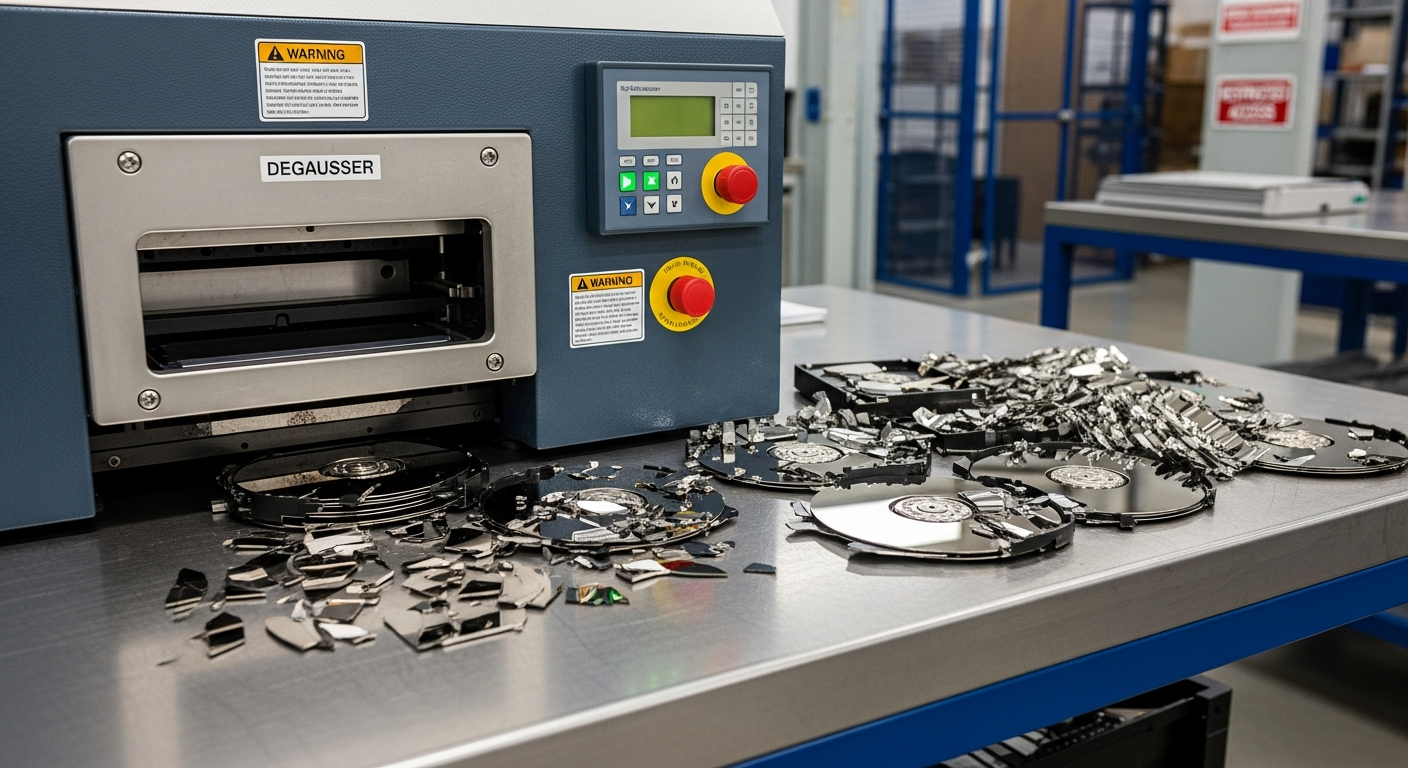
How should organizations handle secure IT asset disposition? Precision E-Cycle coordinates IT asset disposition with R2-certified downstream vendors where applicable. Where included in the confirmed service scope, eligible data-bearing equipment may be sanitized or physically destroyed using methods informed by NIST 800-88. This guide covers the practices that protect your business and the documentation that may apply to accepted equipment.
When a laptop is retired, a server is replaced, or a hard drive is pulled from service, most organizations assume the data is gone. It often is not. Standard deletion and even basic formatting routines leave data forensically recoverable. NIST Special Publication 800-88, now in Revision 2, exists precisely because of this gap between assumption and reality.
What NIST 800-88 Actually Requires
Published by the National Institute of Standards and Technology, NIST 800-88 defines three sanitization categories that apply depending on the sensitivity of the data a device held and the classification of the media itself.
- Clear applies logical techniques to sanitize data in all addressable storage locations. This means overwriting with a new value. It is appropriate only for lower-sensitivity data on reusable media.
- Purge applies physical or logical techniques that render target data recovery infeasible using state-of-the-art laboratory techniques. Cryptographic erase and overwriting meeting specific patterns qualify here.
- Destroy physically ruins the media so it cannot be reused and data cannot be recovered. Shredding, disintegration, pulverization, and incineration fall into this category. Degaussing is a Purge technique for magnetic media only.
The standard also requires organizations to maintain media sanitization records and issue a Certificate of Data Destruction (COD) that documents what was sanitized, when, by whom, and by which method. For organizations operating under HIPAA, SOX, GLBA, or FERPA, that documentation is not optional.
Why Simply Deleting Files Is Not Enough
When you delete a file on a standard hard drive, the operating system removes the reference to that file but the underlying data remains on the disk until that sector is overwritten by something new. On solid-state drives, the situation is more complicated. NAND flash memory uses wear-leveling algorithms that distribute writes across the drive, which means overwritten sectors may not correspond to where data was actually stored. A Purge-level method, such as a cryptographic erase of the encryption key on a self-encrypting drive, is the recommended approach for SSDs.
According to IBM's 2024 Cost of a Data Breach Report, the average cost of a data breach reached $4.88 million. A significant share of breaches involve improperly disposed media. The arithmetic is straightforward: the cost of certified data destruction is a small fraction of the liability exposure.
What a Certificate of Data Destruction Covers
A proper COD issued by a certified recycler should include the make, model, and serial number of each device processed, the sanitization method applied, the date of processing, and the name of the organization performing the work. This document becomes part of your compliance record and should be retained for a minimum of three years, or longer depending on your industry's regulatory requirements.
Organizations that are audited under HIPAA face specific obligations under 45 CFR 164.310(d)(2)(i), which requires policies for the disposal of electronic protected health information. Producing a COD during an audit demonstrates that your organization exercised reasonable care during the disposal of devices that touched PHI.
Choosing a Recycler That Meets the Standard
Not all electronics recyclers perform data destruction at the level NIST 800-88 requires. When evaluating a partner, ask specifically whether their processes are audited and documented, whether they issue individual CODs by serial number, and whether their downstream partners are R2-certified. Verbal assurances are not compliance documentation.
Precision E-Cycle partners with R2-certified downstream processors and may provide processing documentation for accepted equipment. Whether you are retiring a fleet of laptops, decommissioning servers, or disposing of storage arrays, our intake process is designed to document the applicable scope.
How Method Selection Actually Works in Practice
The decision between Clear, Purge, and Destroy is not arbitrary. NIST 800-88 ties it to two factors: the security categorization of the data the media held under FIPS 199 (Low, Moderate, or High), and whether the media will leave organizational control. Media that held Low-impact data and is staying inside the organization can usually be sanitized at the Clear level. Media that held Moderate-impact data and is leaving organizational control should be Purged at minimum. Media that held High-impact data, or media whose categorization is uncertain, should be Destroyed. This last category covers most healthcare, financial services, and government workloads, which is why physical destruction has become the default for those sectors regardless of media type.
Method selection also depends on the underlying media. Magnetic hard drives accept overwriting at the Purge level when the drive supports it and the operation completes successfully. Solid-state drives, USB flash media, and embedded flash storage do not accept overwriting reliably because of wear leveling and over-provisioning. For these, the realistic options are cryptographic erase on self-encrypting drives, the ATA Sanitize Device feature when supported, or physical destruction. Optical media, magnetic tape, and removable media each have their own appropriate methods in the media-specific guidance the standard points to.
For self-encrypting drives in particular, cryptographic erase has become the default Purge-level method because it completes in seconds rather than the hours required to overwrite a full disk. The procedure replaces the on-drive Media Encryption Key, which renders all stored ciphertext unreadable without restoring the original key, an operation that is computationally infeasible against AES-256 protected media. Mobile devices typically combine cryptographic erase with a factory reset that wipes the keystore, and modern smartphones running iOS or Android encrypt by default so that a verified factory reset achieves Purge-equivalent assurance for most consumer-grade scenarios. Optical media (CD, DVD, Blu-ray) cannot be Purged because the substrate is write-once or write-limited, so the standard mandates physical Destroy methods such as shredding, grinding, or incineration to a particle size that gives reasonable assurance the data cannot be reconstructed. Picking the right method up front avoids the common ITAD failure mode where devices are routed through a generic overwrite workflow that does not actually sanitize the media in question.
What Verification and Documentation Actually Look Like
NIST 800-88 explicitly distinguishes between performing sanitization and verifying it. Verification is a separate step that confirms the sanitization actually completed as intended. For overwriting-based methods, verification typically samples sectors across the drive and confirms they hold the expected pattern. For cryptographic erase, verification confirms the encryption key has been replaced and the drive no longer decrypts the original data. For physical destruction, verification typically takes the form of witnessed destruction, photographic documentation, or both.
Documentation is not just the Certificate of Destruction. The full record set includes the sanitization method specification, the operator who performed the work, the date and location, the verification results, and the final disposition of the media (recycled, returned, or retained for further processing). Organizations operating under formal compliance programs typically file this full record set rather than just the Certificate. For audit-driven sectors, the full record set is what an examiner asks for, not the cover document.
Practical Steps for Your Next Refresh Cycle
- Catalog every device leaving your environment by make, model, and serial number before it leaves your facility.
- Confirm in writing which sanitization method will be applied and whether it meets NIST 800-88 Purge or Destroy requirements for the data classification involved.
- Collect and store CODs for every device processed.
- Include your ITAD partner's certifications in your vendor management documentation.
- Schedule destruction witnesses or request process photos when device sensitivity is particularly high.
Data destruction is not a checkbox. It is a documented, verifiable process. Organizations that treat it as such are the ones whose audits resolve cleanly and whose risk exposure stays manageable. If your current disposal process does not produce a COD for every device, that gap is worth closing before your next compliance review.