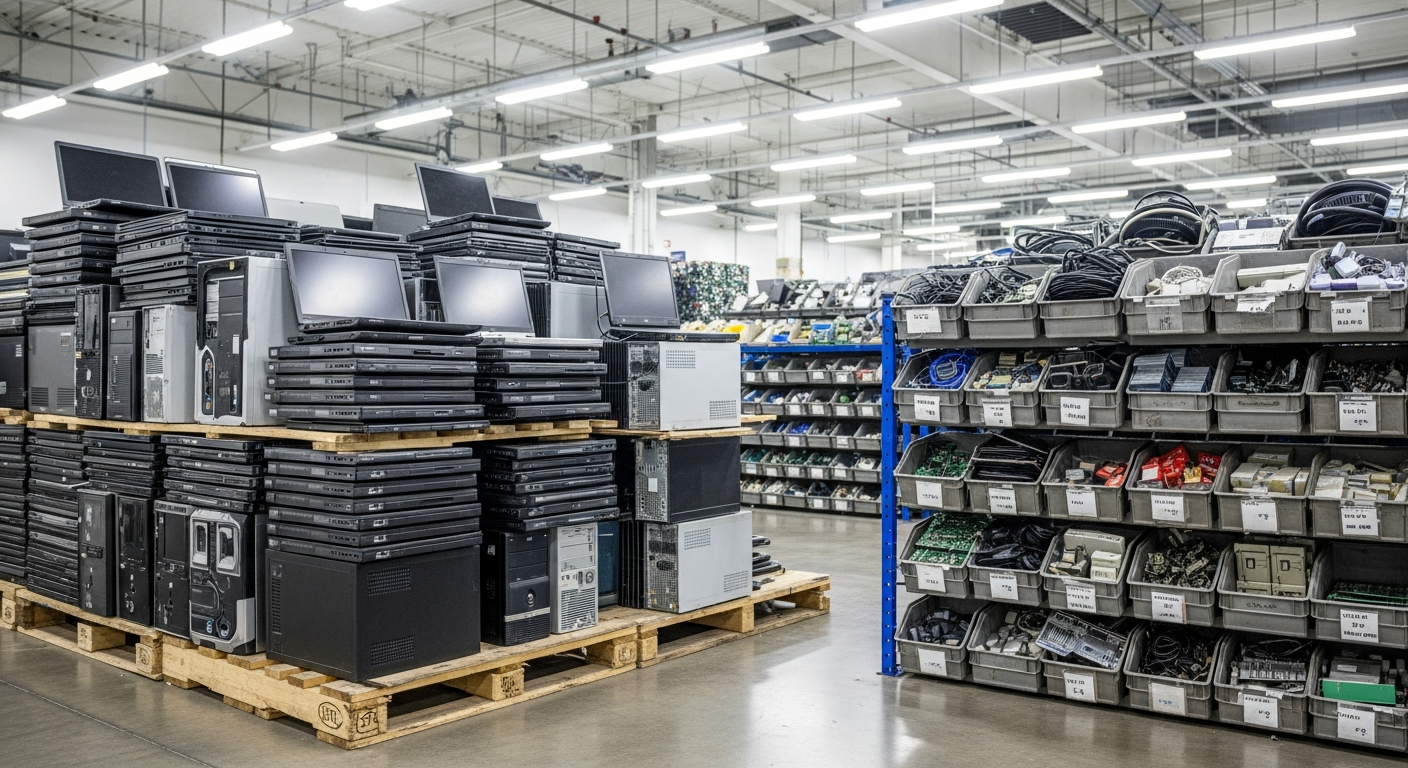
How should organizations handle secure IT asset disposition? Precision E-Cycle coordinates IT asset disposition with R2-certified downstream vendors where applicable. Where included in the confirmed service scope, eligible data-bearing equipment may be sanitized or physically destroyed using methods informed by NIST 800-88. This guide covers the practices that protect your business and the documentation that may apply to accepted equipment.
A retired laptop is not waste. It is a concentrated package of recoverable materials: aluminum in the chassis, copper in the wiring and heat sinks, gold and palladium on the circuit board, rare earth elements in the display, and lithium and cobalt in the battery. The laptop recycling lifecycle is the process that extracts these materials safely while eliminating data risk. Understanding that lifecycle helps organizations appreciate why documented recycling costs more than casual disposal and why the difference is worth it.
Collection and Intake
Collection begins with secure transport from the client's facility to the processing center. Serialized manifests track every device from departure through arrival. At intake, devices are scanned against the manifest and sorted by type, condition, and data-bearing status. Laptops with intact storage receive a data security classification that determines whether they will be sanitized for remarketing or destroyed for material recovery.
Data Destruction and Battery Removal
Data destruction is the first processing step. For laptops with functional drives, NIST 800-88 aligned sanitization is performed and verified. For laptops with failed drives or unknown histories, physical destruction through shredding is the default. After data security is confirmed, technicians remove the battery. Lithium-ion cells are separated immediately and placed in temperature-controlled, fire-safe storage pending specialized recycling.
Battery removal is a critical safety step. Damaged or punctured lithium-ion cells can enter thermal runaway, a self-sustaining reaction that produces temperatures exceeding 1,000 degrees Fahrenheit. In 2023, the EPA documented multiple fires at recycling facilities caused by improperly handled batteries. Certified ITAD facilities have the training, equipment, and protocols to prevent these incidents.
Manual Disassembly and Sorting
After data destruction and battery removal, laptops are manually disassembled into component categories: circuit boards, hard drives or SSDs, memory modules, displays, keyboards, plastic housings, metal frames, cables, and small mixed components. Manual disassembly is labor-intensive but necessary because automated shredding of whole laptops creates cross-contamination between material types and loses recoverable value.
Sorting accuracy determines downstream value. A circuit board sent to a general metal processor loses the gold and palladium that a specialized smelter would recover. A display sent to a plastic grinder loses the indium and rare earth phosphors that a display recycler would extract. Trained technicians sort each component into the correct stream.
Component Recovery
Functional components are tested and graded for reuse. Memory modules, displays, and keyboards in good condition may be sold as replacement parts or bundled with refurbished units. Non-functional components are routed to material recovery. The component recovery step captures value that would be lost if the entire laptop were shredded as a single unit.
Commodity Metal Extraction
Circuit boards are the highest-value material stream. A metric ton of laptop circuit boards contains approximately 200-250 grams of gold, along with silver, palladium, and copper. Specialized smelters using pyrometallurgical and hydrometallurgical processes recover these metals at rates up to 95% for gold and 90% for copper. The recovered metals are refined to purity standards and re-enter the manufacturing supply chain.
Aluminum chassis and copper heat sinks are sorted by alloy type and sent to commodity metal processors. Steel frames go to ferrous metal recycling. The U.S. Geological Survey estimates that recycling aluminum requires 95% less energy than primary production, making laptop chassis recovery both economically and environmentally valuable.
Plastic and Housing Recycling
Plastic housings are ground into pellets and sorted by resin type using near-infrared identification. ABS, polycarbonate, and polypropylene are the most common laptop plastics, each with different recycling pathways. Sorted pellets are sold to manufacturers as feedstock for new products, closing the material loop. Unsorted or contaminated plastic is routed to energy recovery where feasible, through R2-certified downstream processors where applicable.
Downstream Accountability and Reporting
R2-certified downstream facilities may track applicable material streams to their final destination. Clients can request documentation showing how much of each material type was recovered, which downstream partners processed it, and what certifications those partners hold. This transparency helps distinguish documented recycling from informal disposal.
Why Whole-Unit Shredding Wastes Value
Some disposal vendors feed entire laptops into a shredder without disassembly. It is fast and cheap for the vendor, but it destroys most of the recoverable value and creates real hazards. Shredding a laptop with its battery still installed is the leading cause of recycling facility fires, because punctured lithium-ion cells ignite inside the shredder where suppression is hardest. Whole-unit shredding also mixes aluminum, steel, plastic, and circuit board fragments into a single contaminated stream, which downstream processors pay far less for than cleanly separated materials.
The economics tell the story. A cleanly separated circuit board stream commands specialized smelter pricing for its gold and palladium content. The same boards shredded into mixed fragments lose a meaningful share of that recovery to cross-contamination. Displays shredded whole release their materials into streams where indium and phosphors cannot be captured at all. When a vendor quotes a surprisingly low price for laptop disposal, whole-unit shredding is often how they afford it. Ask specifically whether batteries are removed before size reduction and whether boards are sorted as a separate stream.
One more variable deserves attention: condition discipline during service life. Fleets managed with cases, docking stations, and prompt repair of cracked screens grade one or two tiers higher at retirement than fleets where damage accumulates unaddressed. The grading difference compounds across hundreds of units, and it costs nothing extra at retirement time because the investment happened during the useful life. IT asset managers who see disposal recovery as part of total cost of ownership, rather than found money at the end, consistently recover more from identical hardware.
How Fleet Size Affects Recovery Economics
The lifecycle steps are identical whether you retire ten laptops or a thousand, but the economics shift with volume. Small batches carry proportionally higher logistics and handling costs, so material recovery on a handful of older units may not offset the processing fee. That is normal and does not mean you are being overcharged; it means transport, intake, data destruction, and documentation have fixed costs that a small load spreads across few devices.
At fleet scale, the picture improves quickly. Consolidated pickups reduce per-unit transport cost, uniform models speed up disassembly and grading, and remarketing candidates appear in quantities that attract wholesale buyers. Organizations on a three or four year refresh cycle often find that a well-timed fleet retirement recovers enough value to fund a meaningful share of the disposal program. The practical advice: batch your retirements rather than trickling devices out one at a time, keep chargers and documentation with remarketing candidates, and retire fleets before they age past the point where the resale market loses interest.
Precision E-Cycle provides complete laptop recycling with serialized data destruction, safe battery handling, and documented material recovery. Schedule a pickup for your retired fleet and request a Certificate of Destruction plus downstream accountability records for your batch.