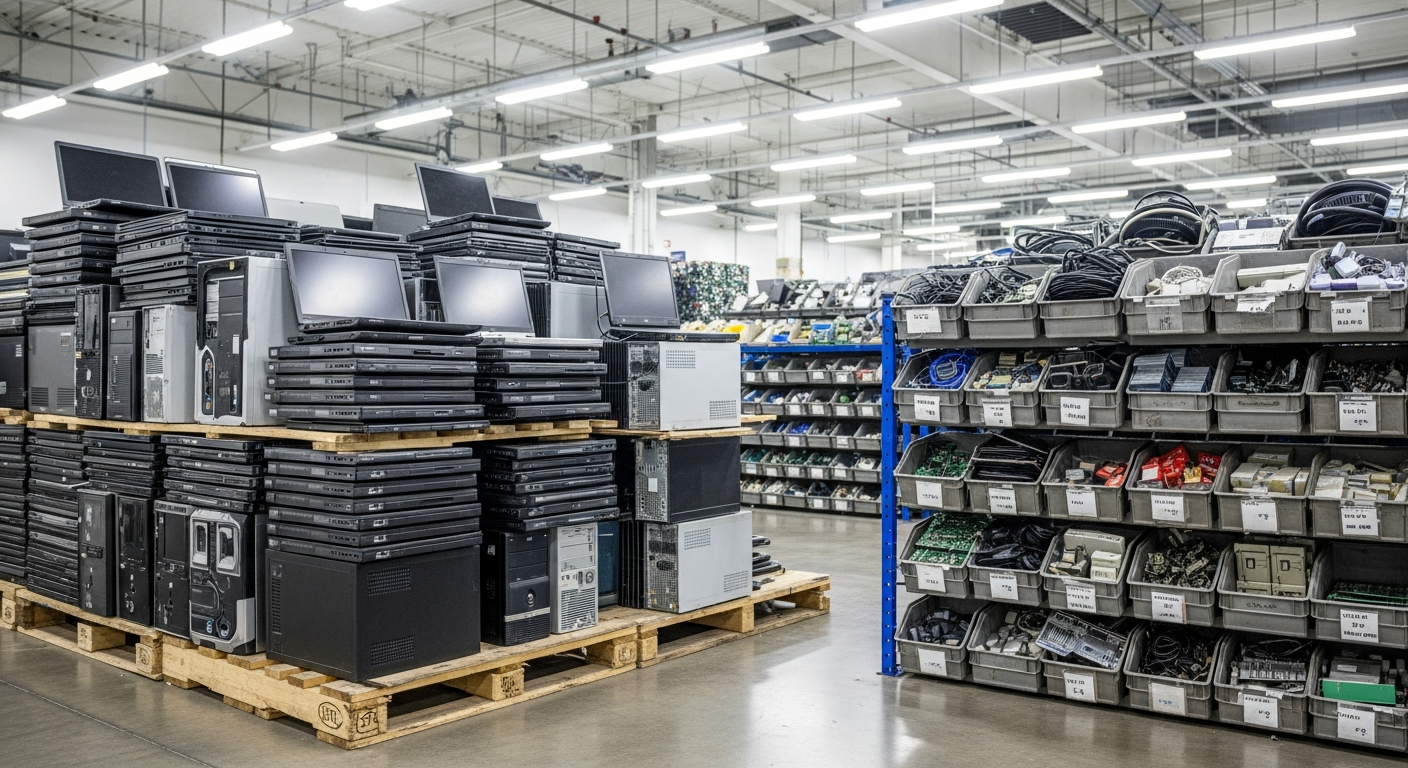
How should organizations handle secure IT asset disposition? Precision E-Cycle coordinates IT asset disposition with R2-certified downstream vendors where applicable. Where included in the confirmed service scope, eligible data-bearing equipment may be sanitized or physically destroyed using methods informed by NIST 800-88. This guide covers the practices that protect your business and the documentation that may apply to accepted equipment.
K-12 Chromebook Refresh: How School Districts Manage Device Disposal at Scale
A single school district can own tens of thousands of student devices. Chromebooks, laptops, tablets, and desktop workstations accumulate across buildings and grade levels until a refresh cycle forces the IT department to confront the retirement problem. For many districts, the scale is the challenge. Retiring five hundred devices in one summer is manageable. Retiring five thousand requires logistics, documentation, and a data destruction partner that can process volume without compromising compliance. This guide covers how K-12 districts manage device refresh cycles with FERPA-aligned data destruction and district-wide coordination.
Precision E-Cycle helps school districts manage large-scale device retirement with serialized documentation and logistics support. Our services include coordinated pickup scheduling, building-by-building inventory tracking, and Certificates of Destruction that support district audit requirements.
K-12 districts typically refresh Chromebooks and laptops every three to five years, retiring five hundred to five thousand devices per cycle. Summer break is the primary window because buildings are accessible without classroom disruption. Precision E-Cycle provides coordinated pickup, building-by-building inventory tracking, and serialized Certificates of Destruction for the devices in scope.
The Scale of K-12 Device Retirement
The device population in a K-12 district is larger than most IT directors initially realize. A district with twenty schools and a one-to-one Chromebook program might have fifteen thousand student devices in circulation. Add teacher laptops, lab workstations, library computers, administrative desktops, and special education equipment, and the total can approach twenty thousand.
Refresh cycles vary by device type. Chromebooks typically last three to four years before battery degradation and performance decline make them unsuitable for classroom use. Teacher laptops may last four to five years. Lab workstations and administrative desktops may last five to six years. The result is that a district is almost always in some phase of retirement, with multiple device classes reaching end-of-life in overlapping waves.
The scale creates a logistics problem that most districts are not equipped to handle internally. Storing thousands of retired devices is impractical. Processing them one at a time is time-prohibitive. Transporting them to a recycler requires coordination with facilities, security, and transportation teams. The solution is a structured ITAD program with a partner that can handle volume and produce documentation at scale.
FERPA and District Information Security Policy
The Family Educational Rights and Privacy Act does not directly regulate device disposal, but it creates an obligation that districts address through their information security policies. FERPA requires that educational agencies and institutions protect the privacy of student education records. For electronic records, this means that any device that may have stored student information must be sanitized before it leaves the district's control.
District information security policies typically address device retirement by requiring data destruction for all storage media, regardless of whether the device was used by a student, teacher, or administrator. The standard is usually NIST SP 800-88 Rev. 2, with Purge or Destroy methods required for devices leaving the district's control. The policy should also specify the documentation required, which is typically a Certificate of Destruction with serial-level detail.
State education departments may impose additional requirements. Some states require districts to maintain records of device disposal for audit purposes. Others require districts to report the number of devices retired annually. Districts should verify their state requirements and ensure their ITAD program produces the necessary documentation.
FERPA requires districts to protect the privacy of student education records, which means any device that may have stored student information must be sanitized before leaving district control. District information security policies typically require NIST 800-88 aligned destruction and serial-level Certificates of Destruction for all retired devices.
Summer Logistics: The Primary Disposal Window
The K-12 calendar creates a natural disposal window during summer break, when buildings are accessible but classrooms are empty. This window typically runs from early June through late July, giving districts approximately eight to ten weeks to collect, inventory, and transport retired devices before the new school year begins.
The logistics challenge is coordinating across multiple buildings. A district with twenty schools may have devices stored in twenty different locations, each with its own loading dock, security protocol, and access schedule. The ITAD partner must be able to schedule pickups at multiple sites within a compressed timeframe and produce documentation for each site separately.
Districts that manage large refreshes successfully typically use a phased approach. Phase one involves collecting devices from elementary schools in early June. Phase two addresses middle schools in mid-June. Phase three handles high schools in late June. Phase four addresses any remaining devices and cleanup in July. Each phase produces its own inventory and Certificate of Destruction set, which keeps documentation organized and audit-friendly.
Inventory and Tracking at District Scale
Inventory management is the operational foundation of a successful K-12 device retirement program. Each device must be tracked from the classroom to the recycler with enough detail to satisfy audit requirements and parent information requests. The inventory should include the device make, model, and serial number, the building and room where it was used, the grade level or department assignment, and the condition assessment at retirement.
Many districts use their existing asset management systems to track retired devices. Systems such as Incident IQ, Frontline, or custom inventory databases can export device lists that the ITAD partner uses to generate pickup manifests and Certificates of Destruction. The key is ensuring that the asset data includes serial numbers and location codes that map to the physical devices being retired.
For districts without a formal asset management system, a spreadsheet-based inventory is a viable starting point. The ITAD partner can provide a template that the district populates with device details and returns before the pickup. The partner then uses the template to generate the pickup manifest and the Certificate of Destruction.
Data Destruction for Student Devices
Student devices such as Chromebooks and tablets store a surprising amount of sensitive data. Browser history, cached passwords, downloaded files, and synced account data can all persist on the device even after a factory reset. For districts, this means that every retired student device must be sanitized to a standard that prevents data recovery.
Chromebooks are relatively straightforward because they are designed for cloud-centric operation. A powerwash factory reset removes the local user profile and returns the device to its out-of-box state. However, a powerwash does not guarantee that all data is unrecoverable, especially if the device was modified or rooted. For districts with strict security requirements, physical destruction of the storage module may be the preferred method.
For Windows and Mac laptops, the sanitization process is more involved. NIST 800-88 Purge methods such as cryptographic erase or secure overwriting are typically required. For devices with self-encrypting drives, cryptographic erase is the fastest and most reliable method. For devices without encryption, secure overwriting with verification is the standard approach.
Documentation for State Audits
State education departments and auditors routinely examine district technology expenditures and asset management practices. A Certificate of Destruction with serial-level detail is the primary document that demonstrates responsible device retirement. The certificate should include the make, model, and serial number of each device, the sanitization method applied, the date of processing, and the name of the organization performing the work.
Districts should retain disposal documentation for at least the duration of the device lifecycle plus any state-mandated retention period. For a device that was used for four years, the district should retain the Certificate of Destruction for at least four years after retirement, or longer if state requirements dictate. Some districts retain disposal records for seven years as part of their broader records management policy.
If your district does not produce a serial-level Certificate of Destruction for every retired device, that gap will surface during your next state audit. Schedule a district-wide pickup and request sample documentation to evaluate your readiness. View our ISO certifications to verify our active quality and environmental management credentials.
Cost Planning and Budget Cycles
Device retirement is not free. Districts must budget for ITAD services, transportation, and any staff time required for inventory and coordination. The cost per device varies based on the service level, the volume, and the distance to the processing facility. For large districts, economies of scale can reduce the per-device cost significantly.
Budget planning should begin during the procurement cycle for the replacement devices. If a district is buying five thousand new Chromebooks, the budget should also include the cost of retiring the old fleet. Some districts build ITAD costs into their technology levy or bond proposals, which gives them a dedicated funding source for retirement services.
Districts should also consider the hidden costs of poor disposal practices. Devices that are stored indefinitely consume warehouse space, create clutter, and may lose value if they are not processed promptly. Devices that are discarded improperly create liability exposure under state environmental regulations and FERPA. A structured ITAD program with a reliable partner keeps these hidden costs in check.
Choosing an Education ITAD Partner
When evaluating an ITAD partner for K-12 disposal, ask specific questions about their experience with education clients. Have they handled district-scale retirements? Can they schedule multi-site pickups within a compressed summer window? Do they provide serialized Certificates of Destruction? Can they integrate with the district's asset management system?
Precision E-Cycle provides K-12 ITAD services with coordinated multi-site pickup, building-by-building inventory tracking, and serialized Certificates of Destruction. Request a district consultation or schedule a pickup to evaluate our summer logistics and documentation against your audit requirements. View our ISO certifications to verify our active quality and environmental management credentials.