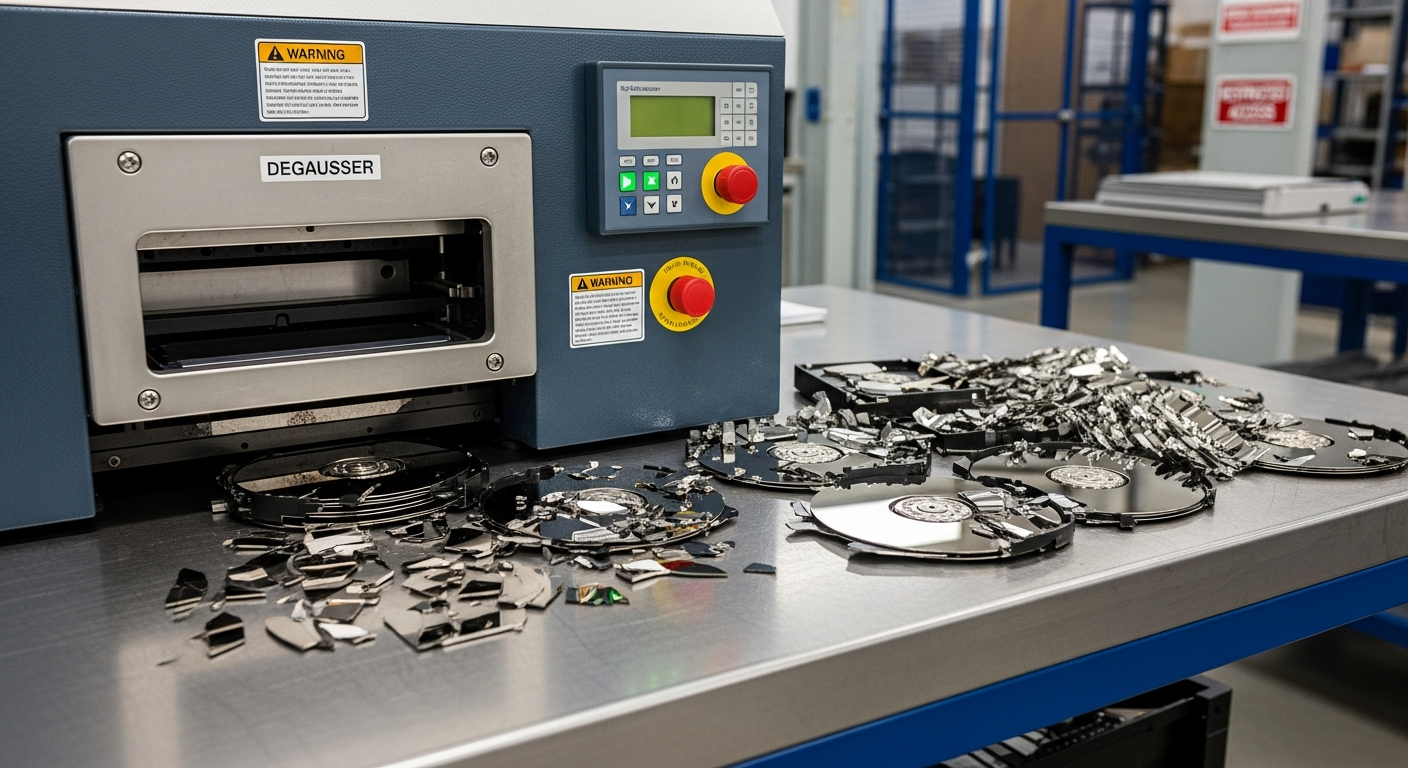
How should organizations handle secure IT asset disposition? Precision E-Cycle coordinates IT asset disposition with R2-certified downstream vendors where applicable. Where included in the confirmed service scope, eligible data-bearing equipment may be sanitized or physically destroyed using methods informed by NIST 800-88. This guide covers the practices that protect your business and the documentation that may apply to accepted equipment.
Hard drive destruction is not a single method. It is a choice between shredding, which produces visible particle-sized evidence, and degaussing, which uses magnetic fields to scramble data without immediate physical destruction. The choice between them depends on the risk profile of the data, the audit requirements of the organization, and the practical constraints of volume and cost. Understanding the difference is essential for IT teams responsible for data sanitization decisions.
How Shredding Works
Shredding is a mechanical process that physically destroys hard drives by cutting them into small pieces. Industrial shredders use hardened steel blades to slice drives into strips or particles, typically reducing them to pieces under 2mm in size. This particle size meets NIST 800-88 Destroy requirements and is sufficient to render magnetic data unrecoverable by any known laboratory technique.
The output of shredding is both data destruction and physical evidence. Auditors can witness the process, photograph the results, and retain samples for verification. This dual output is why shredding has become the default method for high-security environments: it provides the highest level of assurance because the media itself no longer exists.
How Degaussing Works
Degaussing uses a powerful magnetic field to disrupt the magnetic domains on a hard drive's platters. The field strength required to saturate modern hard drives is substantial, which is why NSA-listed degaussers meeting the Evaluated Products List (EPL) standards are the accepted benchmark. A properly degaussed drive has its data scrambled beyond recovery, but the drive itself may appear physically intact. NIST 800-88 classes degaussing as a Purge technique for magnetic media only, while shredding is a Destroy method.
Degaussing is faster than shredding for individual drives and operates with less noise and dust. It is suitable for environments where physical destruction is impractical or where the drives will be destroyed in a subsequent step. However, degaussing does not produce the same visual evidence as shredding, which makes it harder to verify without specialized equipment.
Assurance Level Comparison
Shredding provides higher assurance because it eliminates the media entirely. There is no theoretical recovery method for shredded particles under 2mm. Degaussing provides high assurance but requires verification that the field strength was sufficient for the specific drive type. Older degaussers may not generate adequate field strength for high-density modern drives, and verification requires a separate measurement step.
For High-impact data under FIPS 199, shredding is the recommended default because it provides both maximum data elimination and physical evidence. For Moderate-impact data, degaussing may be acceptable if performed with an NSA-listed degausser and verified. For Low-impact data on reusable media, neither method is necessary; overwriting at the Clear level is sufficient.
Verification Methods for Each
Shredding verification is straightforward: witness the process, photograph the output, and measure particle size. Some organizations retain a sample of shredded material for laboratory confirmation. Degaussing verification is more complex: it requires measuring the degausser's field strength with a calibrated gauss meter, confirming that the strength exceeds the drive's coercivity rating, and documenting the measurement. Without this verification, a degaussing claim is unproven.
Cost and Speed Tradeoffs
Degaussing is faster per drive: a single degausser cycle takes seconds, while shredding takes longer depending on the shredder's capacity. For high-volume environments processing thousands of drives, degaussing followed by bulk shredding may be the most efficient workflow. For lower volumes, direct shredding eliminates the verification complexity of degaussing.
Cost varies by method and scale. Degausser purchase or rental, calibration, and verification equipment add fixed costs. Shredding has lower equipment requirements but higher per-drive processing time. Organizations with mixed risk profiles may use both methods: degaussing for Moderate-risk bulk batches and shredding for High-risk individual drives.
When to Choose Which Method
Choose shredding when: the data classification is High under FIPS 199, the drive history is unknown, the audit requires witnessed destruction, or the organization prefers maximum physical evidence. Choose degaussing when: the data classification is Moderate, the drives will be destroyed in a subsequent step, volume is high and speed matters, and verification equipment is available.
Sequential Methods for Maximum Assurance
Some organizations use both methods sequentially: degauss first to eliminate data, then shred to eliminate the media and provide visual evidence. This approach combines the speed of degaussing with the assurance of shredding. It is appropriate for the highest-security environments where no single method provides sufficient confidence.
What Happens to Shredded Material
Destruction is not the end of the story, and the downstream path of shredded drives matters for both security and environmental accountability. Shredded hard drive material is a mixed stream of aluminum platters or glass substrates, steel casings, magnets containing rare earth elements, and circuit board fragments. Certified processors separate these fractions after shredding: ferrous metal is pulled magnetically, aluminum is separated by eddy current, and board fragments are routed to precious metal smelters. The rare earth magnets, primarily neodymium, are increasingly captured as their recovery economics improve.
From a security standpoint, the mixing itself adds assurance. Fragments from thousands of drives across many clients are commingled in the output stream, so even the theoretical reconstruction attack that small shred sizes already defeat becomes meaningless. Ask your vendor what shred size their equipment produces and where each output fraction goes. A processor who can name the downstream smelter and the shred specification is describing a real process; one who says the material "gets recycled" is describing a hope.
Documentation should also record the verification step, not just the destruction event. A certificate that states the method, the date, and the serial number is good; one that also records how completion was verified, whether by particle inspection, coercivity confirmation, or read-attempt testing, is better, because it answers the follow-up question auditors increasingly ask. Request the fuller format from your vendor; most certified processors already capture the data and will include it on request.
Common Misconceptions About Both Methods
Three misconceptions cause most method-selection mistakes. The first is that degaussing works on everything. It does not: solid state drives, flash media, and hybrid drives store data in memory cells that magnetic fields do not touch. Degaussing an SSD accomplishes nothing while producing a device that looks just as destroyed as a degaussed spinning drive. Media type identification before method selection is not optional.
The second misconception is that shredding is always sufficient regardless of shred size. Standard shred widths are appropriate for most commercial risk profiles, but organizations handling classified or exceptionally sensitive data specify smaller particle sizes or disintegration, because larger platter fragments retain readable regions under laboratory conditions. Match the particle specification to the data sensitivity, and put it in the contract. The third misconception is that a destroyed drive needs no documentation because the destruction is self-evident. An auditor cannot inspect a pile of fragments and match it to your asset register. The serial-level certificate, recorded before destruction and verified after, is what turns physical destruction into provable compliance.
Precision E-Cycle provides both shredding and degaussing services with NIST 800-88 alignment, witnessed destruction options, and serialized Certificates of Destruction. Schedule a consultation to evaluate which method matches your risk profile and audit requirements.