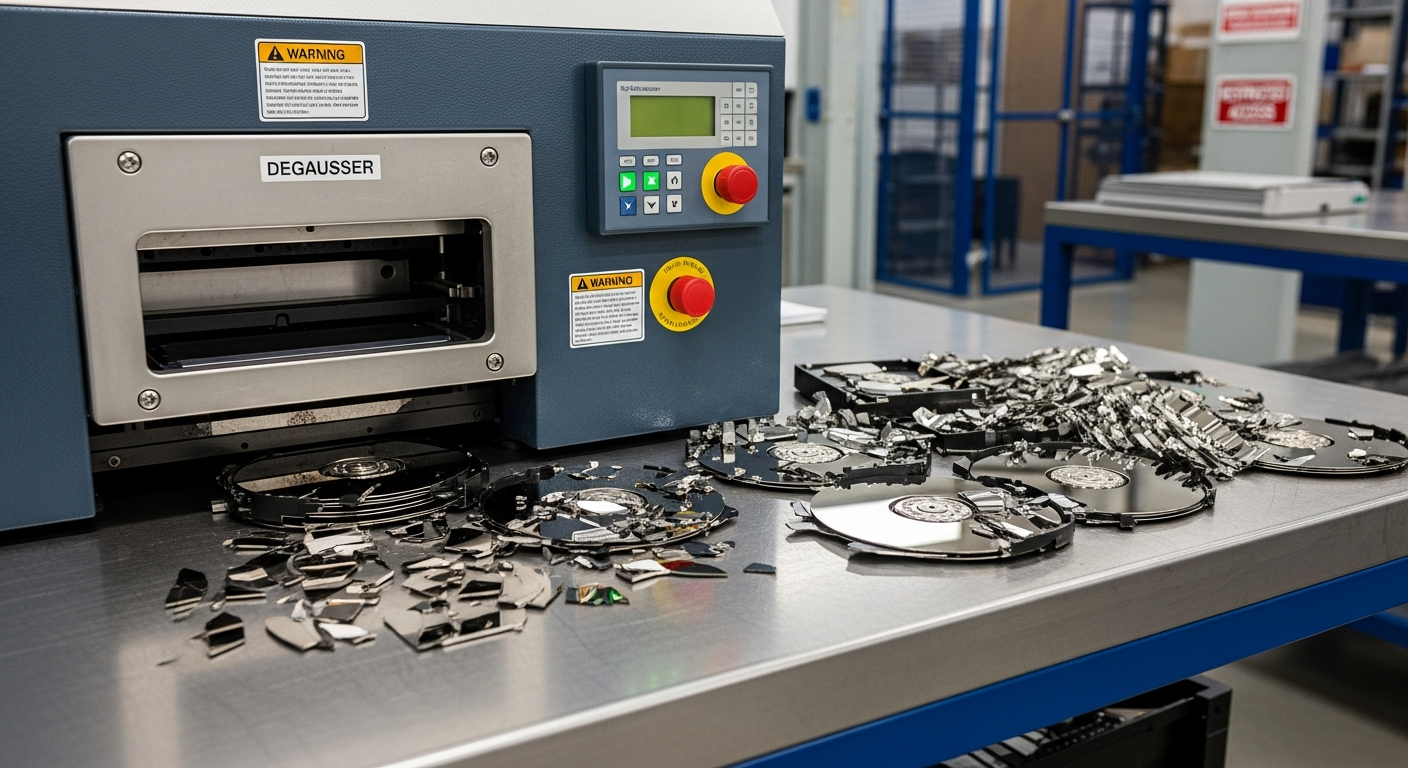
How should organizations handle secure IT asset disposition? Precision E-Cycle coordinates IT asset disposition with R2-certified downstream vendors where applicable. Where included in the confirmed service scope, eligible data-bearing equipment may be sanitized or physically destroyed using methods informed by NIST 800-88. This guide covers the practices that protect your business and the documentation that may apply to accepted equipment.
Hard Drive Data Erasure Standards Explained: NIST 800-88 for Every Organization
When an organization retires a hard drive, the first question is usually whether the data is gone. The honest answer is that it depends on how the drive was erased. NIST Special Publication 800-88, now in Rev. 2, exists because the difference between deletion and destruction is enormous, and the wrong choice can leave data forensically recoverable. For IT directors, compliance officers, and security teams, understanding the three sanitization levels defined by NIST 800-88 is the foundation of a defensible data destruction program.
Precision E-Cycle applies NIST 800-88 aligned sanitization methods to data-bearing devices in scope, from magnetic hard drives to solid-state storage to embedded flash media. This guide explains what each sanitization level means, which media types require which methods, and how to build a program that auditors can verify.
NIST SP 800-88 Rev. 2 defines three sanitization levels: Clear applies logical techniques for lower-risk data on reusable media, Purge renders data recovery infeasible using state-of-the-art laboratory techniques, and Destroy physically ruins the media. The right choice depends on the data sensitivity under FIPS 199 and whether the media will leave organizational control.
Why Data Erasure Is Not One-Size-Fits-All
The assumption that all data erasure is the same is common and costly. A standard file deletion removes the operating system's reference to the file but leaves the underlying data on the disk. A quick format rewrites the file system metadata but does not touch the data sectors. Even a full format that overwrites every sector may not reach all data on a solid-state drive because of wear-leveling algorithms that distribute writes across the media.
NIST 800-88 addresses this gap by defining three distinct sanitization levels that organizations can select based on the sensitivity of the data and the disposition of the media. The standard also provides specific methods for each media type, which means that the right erasure approach for a magnetic hard drive is different from the right approach for an SSD, a USB flash drive, or optical media.
The standard is referenced by HIPAA, PCI DSS, FISMA, and numerous state privacy laws, which means that organizations operating under any of these frameworks typically look to NIST 800-88 or an equivalent standard. For auditors, the standard is the benchmark against which they evaluate an organization's disposal practices.
Clear, Purge, and Destroy: What Each Means
NIST 800-88 defines three sanitization categories that apply depending on the sensitivity of the data and the classification of the media. Clear applies logical techniques to sanitize data in all addressable storage locations. This means overwriting with a new value, typically using a pattern such as zeros, ones, or a random sequence. Clear is appropriate only for lower-sensitivity data on reusable media that remains within the organization.
Purge applies physical or logical techniques that render target data recovery infeasible using state-of-the-art laboratory techniques. For magnetic hard drives, this means overwriting with a specific pattern that meets the standard's requirements, or degaussing to a field strength that renders the media unusable. For self-encrypting drives, Purge can be achieved through cryptographic erase, which replaces the encryption key and renders all stored data unreadable.
Destroy physically ruins the media so it cannot be reused and data cannot be recovered. Shredding, disintegration, and incineration are the primary Destroy methods. Destroy is required for the highest assurance scenarios, such as classified data, devices with unverifiable sanitization capabilities, or media whose security categorization is uncertain.
Clear applies logical overwriting for lower-risk data on reusable media within the organization. Purge renders data recovery infeasible and is required for Moderate-risk data or media leaving organizational control. Destroy physically ruins the media and is required for High-risk data or when the media categorization is uncertain. Precision E-Cycle applies the appropriate NIST 800-88 level based on the data sensitivity and media type.
Hard Drives: Magnetic Media
Magnetic hard drives are the most straightforward media type for sanitization because they use a linear addressing scheme that maps logical sectors to physical locations on the disk. This means that an overwrite pass that writes to every logical sector will, in fact, overwrite the data stored in those sectors.
For Clear-level sanitization, a single overwrite pass with a fixed pattern such as zeros is sufficient for lower-sensitivity data on reusable media. For Purge-level sanitization, the standard recommends a multi-pass overwrite with verification. The specific pattern depends on the drive's interface and capabilities. SATA and SAS drives typically support vendor-specific secure erase commands that perform a factory-level overwrite in a single operation.
Degaussing is another Purge method for magnetic hard drives. A degausser applies a strong magnetic field that disrupts the magnetic domains on the disk, rendering the data unrecoverable. Degaussing is fast and effective, but it also renders the drive unusable, which means it is only appropriate for media that will be destroyed rather than reused.
SSDs and Flash Storage
Solid-state drives are more complex than magnetic hard drives because they use NAND flash memory with wear-leveling algorithms that distribute writes across the media. This means that overwriting a logical sector may not correspond to overwriting the physical location where the data is stored. The drive's controller manages a mapping layer that translates logical addresses to physical cells, and this mapping layer may relocate data to different cells without updating the logical address.
For SSDs, the standard overwrite methods are not reliable. NIST 800-88 recommends cryptographic erase for self-encrypting drives, which replaces the encryption key and renders all stored ciphertext unreadable. For drives that do not support cryptographic erase, physical destruction such as shredding is the recommended Destroy method.
USB flash drives and embedded flash storage face the same challenge. The wear-leveling algorithms in these devices make overwriting unreliable, and the devices typically do not support cryptographic erase. For most scenarios, physical destruction is the safest approach.
Optical Media and Magnetic Tape
Optical media such as CDs, DVDs, and Blu-ray discs cannot be overwritten in the same way as magnetic media because the substrate is write-once or write-limited. NIST 800-88 mandates physical Destroy methods for optical media, including shredding, grinding, or incineration to a particle size that gives reasonable assurance the data cannot be reconstructed.
Magnetic tape can be sanitized through degaussing or physical destruction. Degaussing applies a strong magnetic field that disrupts the magnetic particles on the tape, rendering the data unrecoverable. For high-sensitivity data, physical destruction through shredding or incineration is the recommended method.
Choosing the Right Method for Your Data
The selection of sanitization level is based on two factors: the security categorization of the data under FIPS 199 and whether the media will leave organizational control. FIPS 199 categorizes information as Low, Moderate, or High impact based on the potential effect of unauthorized disclosure on the organization's operations, assets, or individuals.
Low-impact data on reusable media that remains within the organization can usually be sanitized at the Clear level. Moderate-impact data on media that is leaving organizational control should be Purged at minimum. High-impact data, or media whose categorization is uncertain, should be Destroyed.
For most business environments, Moderate is the default categorization, which means Purge methods are the norm. For healthcare, financial services, and government workloads, the data sensitivity is typically higher, which means Destroy methods are more common regardless of the media type.
Verification: Why Performing Is Not Enough
NIST 800-88 explicitly distinguishes between performing sanitization and verifying it. Verification is a separate step that confirms the sanitization actually completed as intended. For overwriting-based methods, verification typically involves sampling sectors across the drive and confirming they hold the expected pattern. For cryptographic erase, verification confirms that the encryption key has been replaced and the drive no longer decrypts the original data. For physical destruction, verification typically takes the form of witnessed destruction, photographic documentation, or both.
The verification record is part of the full audit trail and should be retained alongside the Certificate of Destruction. For organizations operating under formal compliance programs, the verification record is what an examiner asks for when they want to confirm that the sanitization was not merely performed but was actually successful.
Building a Data Erasure Program
A defensible data erasure program has four components: a written policy that specifies the sanitization standard and the methods used for each media type, an inventory system that tracks devices from retirement through disposal, a sanitization process that applies the appropriate method with verification, and a documentation system that produces Certificates of Destruction and retains them for the required period.
Precision E-Cycle provides NIST 800-88 aligned data erasure with serialized Certificates of Destruction across media types, from magnetic hard drives to solid-state storage. Schedule a free pickup and request sample documentation to evaluate our process against your compliance requirements. View our ISO certifications to verify our active quality and information security credentials.